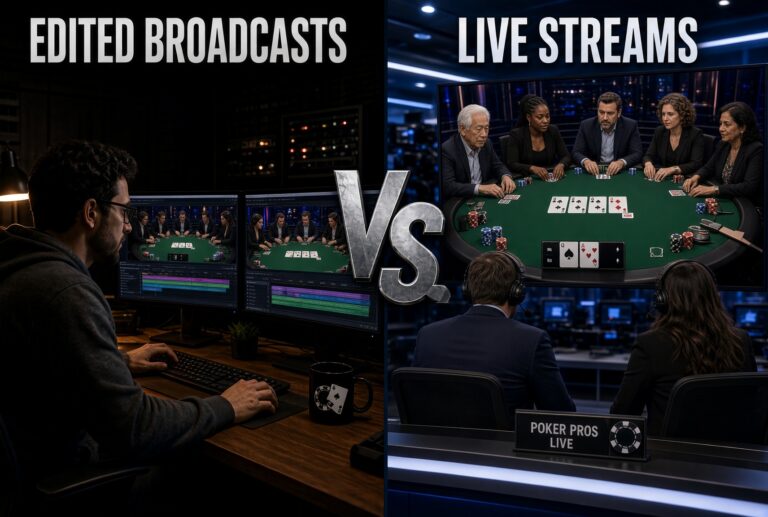
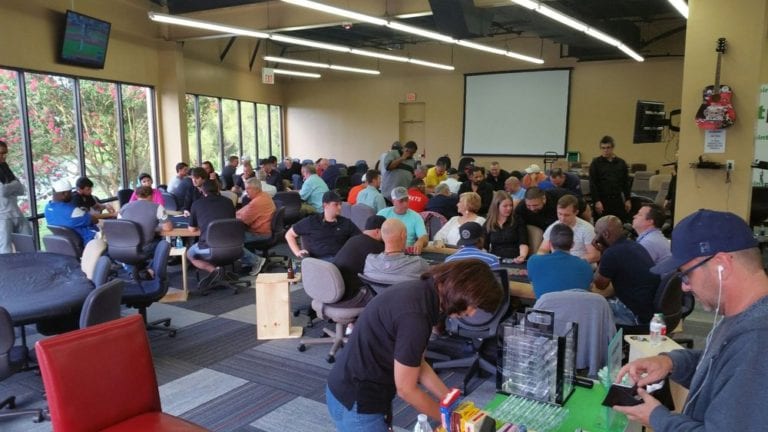
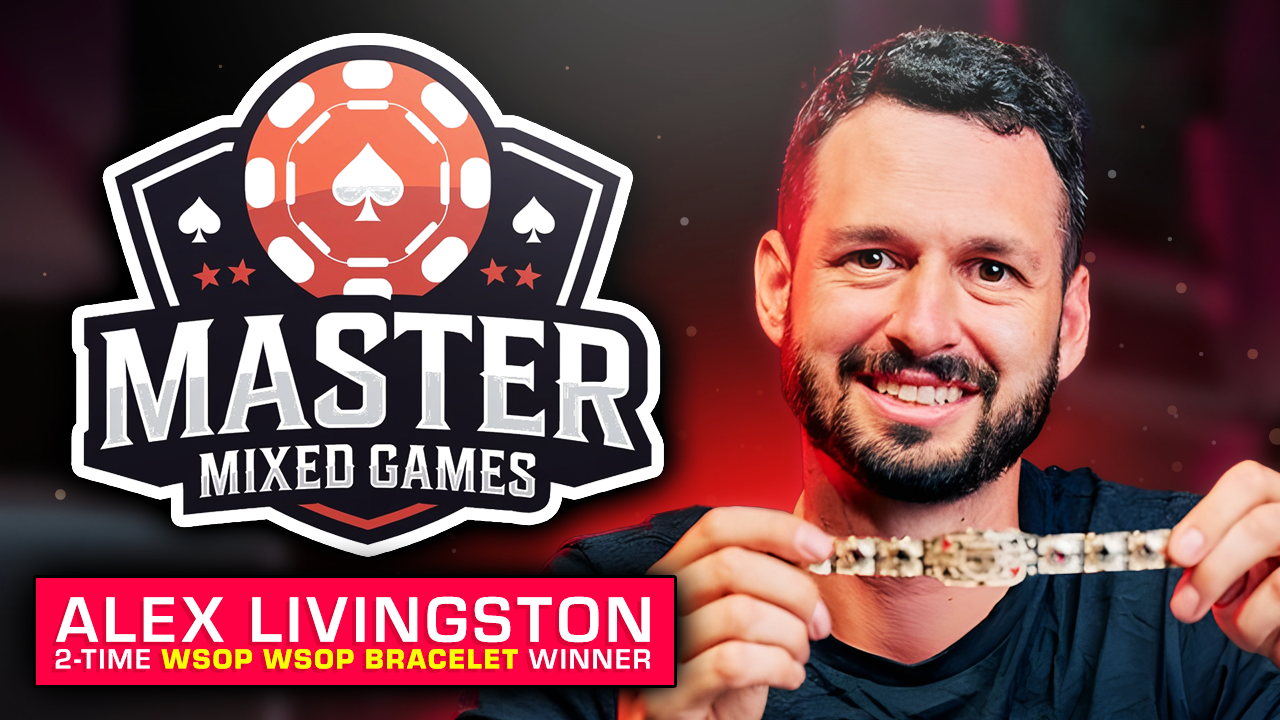
Poker broadcasts broadly fall into one of two categories: live streaming and edited content. Poker TV has long revolved around edited shows that condense 12-hour long sessions into palatable episodes that are suitable for even casual fans who have little understanding of the game.
For serious pros and GTO wizards, edited shows don’t tell the full picture and often cut out the little moments that really change the course of a game. Only live streams can offer a proper glimpse into poker’s true reality.
As the poker ecosystem has evolved, both edited shows and live streams have a role to play in capturing what is now a fairly equal split of casual and hardcore fans.
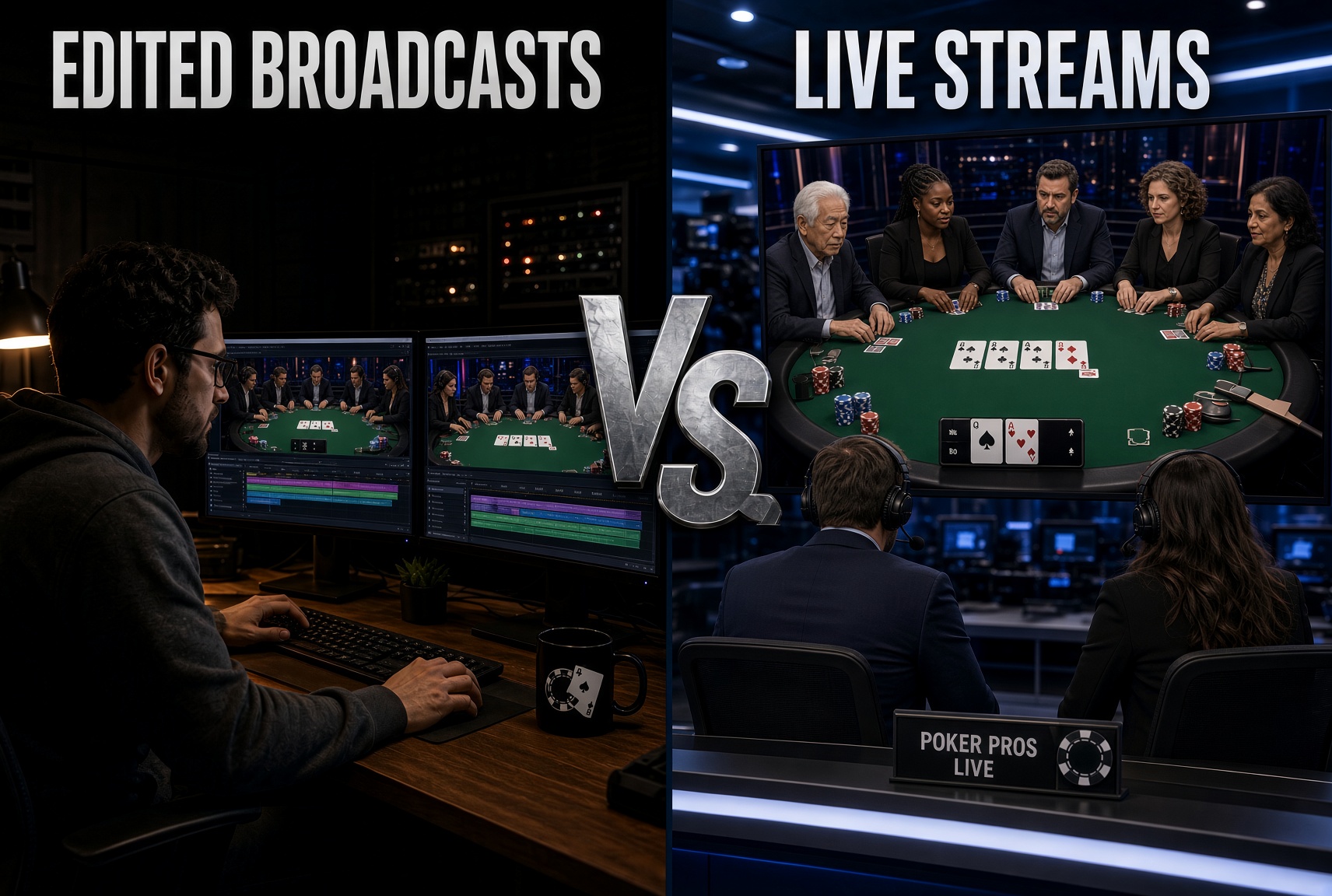
Crafting the Narrative
The edited shows approach is both practical and entertaining. The game of poker itself, which in real life will nearly always feature prolonged moments of downtime, can be condensed into digestible episodes that fans enjoy and that can potentially land a lucrative slot on a cable channel.
The production team behind edited poker shows have the advantage of knowing what happened, which hands mattered, and ultimately who came out on top. They can also pick out vibrant personalities, funny moments, and dramatic ego clashes, weaving it all into a narrative that has a clear beginning, middle, and end.
Dead time, meanwhile, can be removed entirely. You don’t have to watch the hands where everyone folds, or see a full orbit of check-folds on the flop, or wait five minutes while a player tanks.
With a greater emphasis on highlights and post-production, viewers can experience the drama of poker and get to know its characters without having to watch them painstakingly fold 80% of hands while they wait for a better spot. There’s none of that boring stuff.
Can Editing Take Away from the Action?
But wait… isn’t that boring stuff part of the game? Poker isn’t all about the huge aces versus kings clashes. It’s also about how players navigate being card dead, how they survive a blind increase by shoving a short stack, how they gradually accumulate chips by applying pressure to opponents, and so much more.
If you’re keen on understanding strategy and game flow, the rare but inevitable coolers are not as interesting as the subtle moves that stack up and eventually lead to a player’s victory. In that respect, edited shows can take away from the action, cutting out key moments and giving the (mistaken) impression that every other hand played is an all-in cooler.
Serious players can sometimes be turned off by this apparent bastardisation of their beloved game. Joe Cada, winner of the 2009 WSOP Main Event, the final table of which was shown on ESPN as an edited two-and-a-half-hour broadcast, said himself in an interview, “they didn’t show many hands” and “I wish they’d have shown some of the hands where I actually got the better of people.”
When Poker TV Pulled in the Numbers
Despite Cada’s slight criticism, his Main Event win was one of the most popular poker broadcasts ever shown, attracting over 2.1 million viewers. The edited format was hugely successful, especially at that time, when both poker and cable TV were booming.
By condensing what can be a slow and steady game into more action-packed, narrative driven episodes, ESPN brought in a wider audience and made poker more accessible to the masses, who didn’t need to understand the maths to enjoy the thrill of the game.
Likewise, the early seasons of WPT, which were fully edited and post-produced, regularly pulled in viewerships in the seven-figure range. Season 2 reportedly averaged 1.3 million viewers per episode, while founder Steve Lipscomb has stated that weekly figures across all episodes shown, including repeats, once stood at around 3-5 million.
Highly edited cash game shows like High Stakes Poker also had decent numbers back in the day, upwards of 200,000 viewers per episode, drawing on elite talent like Phil Ivey, Phil Hellmuth and Daniel Negreanu to bolster ratings.
Since then, there have been fewer major poker shows on TV, although the edited format still exists. High Stakes Poker, for example, has migrated to PokerGO, while various brands and ambassadors release edited content on their channels.
Showing the Whole Truth
Although there’s no doubt that it’s an entertaining, TV-ready format, highly produced poker shows leave something to be desired for the hardcore poker fans.
Live streams fill that gap, offering a very different viewing experience. Nobody knows the upcoming results and nothing is edited out. It’s the whole truth, and nothing but the truth, for better or worse.
From the moment the stream starts, every second of every hand is shown right up until the game finishes, potentially 10-12 hours later. As a viewer, you could witness history, or you could be subject to three hours of raise-folding. Maybe both…
It’s obvious that the live stream format comes with its own pros and cons. For serious fans, being able to follow a tournament from start to finish, or witness every moment of a legendary high stakes cash game, is a massive privilege. It’s a chance to get closer to the event, the players, and to learn something about poker.
“In poker, all of the little moments are what make the big moments happen. Whether it’s a big bluff, or big hero call, or two people going at each other and it becoming more about ego, without the colour from the rest of the broadcast, I don’t think the highlights are quite as impactful,” says legendary poker commentator David Tuchman.
“But if you’re watching the entire game and then that moment happens, it takes you off your feet. I think that’s what poker live streams can offer than an edited show cannot.”
For casual viewers, though, who would rather not endure the slower orbits and who don’t want to watch the game for hours on end, the live stream format is potentially boring to watch. Even hardcore fans tend to dip in and out of streams, with viewerships typically rising during deep runs or when action heats up.
Live Streams are Still Highly Produced
It’s important to note that although live stream footage is raw and unedited, it’s not just a case of sticking a camera over a table and letting it roll. The show itself is still highly produced.
A professional stream has hole card graphics and percentages overlaid, so the audience can follow along with each hand. Multiple cameras track the action, moving between the board cards and players who are involved in the pot to give a sense of the event taking place in a room.
Commentators have the mammoth task of keeping viewers engaged; talking through hands, responding to comments in the chat, and striking up light conversation or deep debate to fill the gaps. During big moments, they will also draw on player info, results databases, and previous hands to add depth to the coverage.
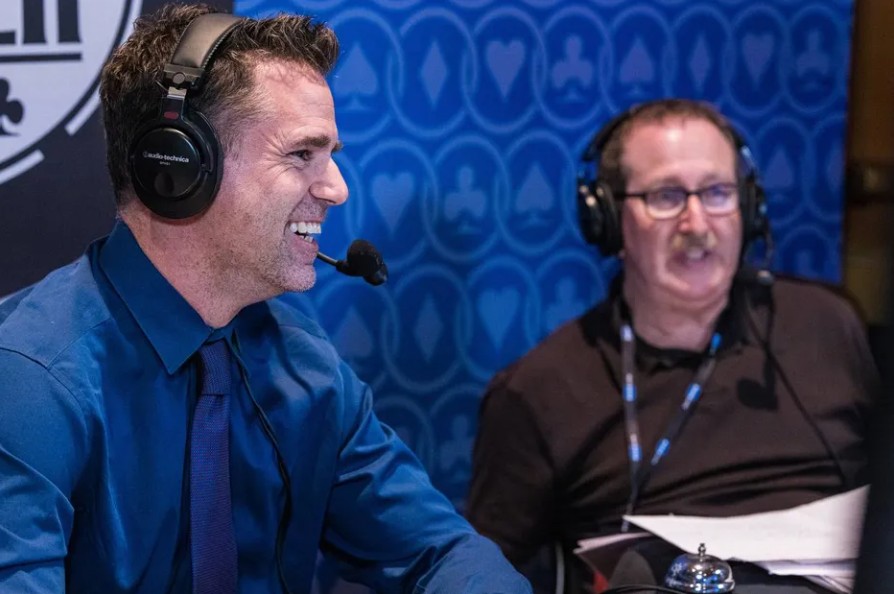
David Tuchman (left) and Norman Chad (right) | Image credit: Poker.org
The audio, which has to be carefully balanced so you can hear players talking to each other, chips clinking, and commentators discussing hands, without any clash in sound. On top of that, the whole stream is on a slight delay for game integrity.
The integration of chat features means that viewers can talk to each other and to the commentators during the stream, adding an interactive element that makes live streams more of a participatory experience.
Tuchman says, “In many ways, I’ve always equated poker live streaming to baseball because there’s a lot of ‘nothing’ happening. There’s a lot of filling time, a lot of telling stories.
Something [baseball commentator] Vin Scully was brilliant at, is he treated the broadcast as a kind of one-on-one friendship. He rejected the industry norm of talking to a massive faceless crowd.
I’ve always thought of poker in the same way. I want to make it personal. I act like I’m talking to one individual.”
Poker live streams are as authentic as it gets when it comes to the action, but the production and commentary is just as important for attracting an audience and keeping engagement levels high.
Different Platforms, Different Metrics
Aside from huge events like the World Series of Poker, it’s unlikely any cable channel is going to show 10 hours of unedited poker. Live streams instead lends themselves well to platforms like YouTube and Twitch, where event organisers, media companies, brand ambassadors, and online streamers can attract a smaller but highly engaged audience.
It’s difficult (and unreasonable) to compare the viewership numbers of poker live streams with the mainstream TV shows that were running back in the 2000s. Given the format and length, live streams are usually measured in concurrent viewers and sometimes in time spent watching.
One of the most popular live streams, Hustler Casino Live, reportedly reached 100,000 concurrent viewers in 2022. The lineup included Tom Dwan, Phil Hellmuth, Alexandra Botez, and Mr. Beast.
Former PokerStars streamer Lex Veldhuis, meanwhile, holds the record for Twitch poker streaming with 58,799 concurrent viewers during the 2020 SCOOP.
Outside of exceptional cash game streams or poker ambassadors running deep in a major series, live streams typically attract a few hundred or thousand concurrent viewers. Arguably, those viewers are more engaged and, from a brand and marketing perspective, further down the funnel, but that’s a point for a different day.
Live streams also have another big advantage in terms of an overall approach to poker content. Streams can be shown live, then later released as edited videos or social media shorts. These highlight reels can generate thousand of millions of viewers, ticking all boxes by appealing to a wider audience of casual fans. For example, the aforementioned 50-minute episode from the HCL stream that focused on Mr. Beast gained 3.3 million views.
Is Poker Viewership Falling?
Interestingly, ESPN took a hybrid approach to their broadcast of the 2026 WSOP, showing both edited episodes and full length live streams of the event. Unfortunately, the broadcast made headlines for failing to pull in anywhere near the same numbers as Cada’s run during the post-Moneymaker boom. A reported 593,000 viewers tuned in to watch Lucas Jumalon claim the bracelet and $10,000,000 top prize.
First, let’s clear up the biggest worry. The decline in viewership has little to do with poker’s popularity as a game. The Main Event attracted 9,200 entries, making it the fourth largest ever held.
One of the main factors impacting numbers may have nothing to do with the lineup or format. Cable TV subscriptions are down from a peak of 105 million in 2010 to around 69 million in 2025, which is only around 36% of US adults. The way people are viewing media is changing and so viewership will naturally decline.
Still, with few poker shows currently on TV and the ESPN ratings declining, it’s tough not to think that the problem could be deeper than just how we consume media. A recent op-ed here on Cardplayer Lifestyle explored the possibility that televised poker in all its forms is broken because it has become unrelatable.
The article outlines the relatively small numbers that tuned in even after the facts to see the record-breaking cash game pot between Ossi “Monarch” Ketola and Dan “Jungleman” Cates, whereas Doug Polk’s breakdown of the hand now has close to a million views.
It’s clear that whether it’s a live stream or edited episode, stoically throwing money at a pot isn’t enough on its own to attract a wider audience. The story of an event needs to involve passion and emotion as well as ICM and GTO.
The Case for Both Streaming and Edited Shows in Poker
The last word belongs to PokerGO President, Poker Hall of Famer Mori Eskandani, producer of some of the most popular poker shows ever made, including Poker After Dark and High Stakes Poker, who points out that poker audiences have changed and evolved over time, and makes the case for why live streaming and edited shows are both crucial to appeal to both sides of the modern audience.
“TV poker, at its inception, had very few viewers who had a deep understanding of game strategy. The main appeal centred around understanding the basic structure of NLH and the characters who played it in tournaments, and later in real cash games.
A high percentage of contemporary viewers now have a much stronger understanding of game strategy and are more eager to learn from the top pros. I would guess our current audience is split 50-50 between the “Casuals,” who just want to grab a beer and be entertained, and the “Eagers,” who want to dig deeper into the pros’ mindsets with every hand.
Edited shows allow us to cater to the Casuals much better by stringing together only the most interesting hands and entertaining table chat among the players.
Live streams, on the other hand, allow us to provide a true railbird experience by showing every hand and therefore giving viewers a chance to get into the minds of the pros without any kind of edit.
If you want to be entertained, watch the edited TV episodes. If you want to learn and become a more skilled player, watch the live streams.”