This covers an in depth look at the UK online poker industry, from the early years of growth and the rise of mobile and online tournaments, through to international competition and how technology is already playing such a role around regulated poker.
What is clear is that the poker market across the UK has followed a different path than we have seen across the wider overall online casino industry.
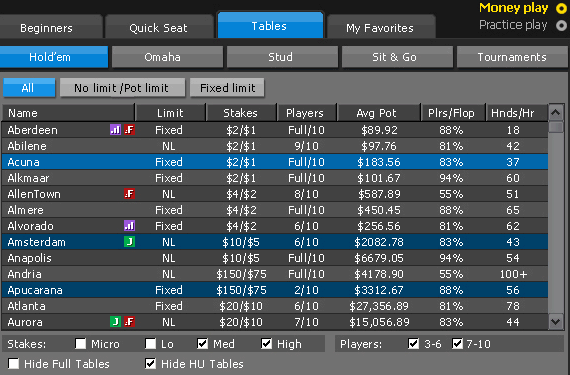
Online slots have quickly become a dominant force across overall casino revenue and poker is now more well known as a specialised market as such, which is mostly seen through the incredible innovation of the large tournaments taking place around the world. Much of this comes down to the fact that slots can be operated by one person and from anywhere, whereas poker needs to be played amongst a number of players, with liquidity and player retention key as recreational and experienced players intertwine.
The key question now and especially within the UK is whether online poker can continue to recreate the excitement of the early years and develop into somewhat of a more sustainable model in order to remain successful for years to come.
How Big is the UK Online Poker Market?
Having extensively researched the UK online poker industry and looked at all available statistics including from the UK Gambling Commission reports around online poker and the gross gambling yield (GGY) provides a very clear picture of where the regulated market is currently. It does also show a difference of where poker is currently, in comparison to other areas of the online casino industry. Casinos Like for example has covered this extensively, as a new resource around UK online casino news.
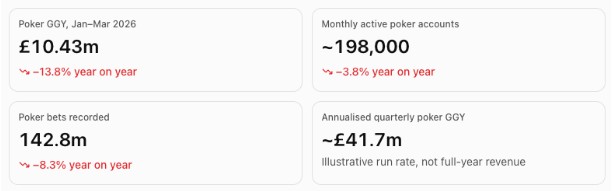
Source: Calculated from the Gambling Commission’s January–March 2025 and 2026 operator datasets. Coverage is approximately 70% of the online market, not every licensed operator. Monthly active accounts are not unique individuals.
The data is showing a clear trend that poker is on the decline year on year, which is a stark comparison to other areas of the industry like online slots, that continue to see major growth.
Why is poker so different to the rest of the online casino market?
The clear answer to this, is that poker is a player vs player game. This is a stark contrast to online slots for example, where the outcome to determined by the mathematical design that is put in place. In Poker it is all about competing against one another, with the operator earning money through ‘rake’ or simply tournament fees. This therefore creates a completely different commercial model.
| Market characteristic | Online poker | Online slots |
| Main competition | Players compete against other players | Outcomes determined by game mathematics |
| Operator revenue | Rake and tournament fees | Gross gambling yield from game outcomes |
| Need for other players | Essential for normal multiplayer games | Not required |
| Importance of skill | Significant over repeated play | No comparable player skill advantage |
| Role of luck | Important, particularly in the short term | Central to outcomes |
| Product availability | Depends on player liquidity | Games can operate individually |
| Main business challenge | Maintaining active, balanced player pools | Attracting and retaining customers within regulatory rules |
Due to poker having such reliance on other players, is why the entire market is behaving so differently to the likes of online slots.
The evolution of poker to where it is today
During the early 2000s and modern online poker was growing rapidly, with much of this coming through the growth of tournaments and of course the online poker scene. Chris Moneymaker was victorious at the 2003 World Series of Poker Main Event, which also helped lead to a surge of popularity of players looking to get involved in Poker.

Chris Moneymaker / Photo: Omar Sader
The market of poker continued to mature but also strengthen with many more online platforms opening up over the years.
- Early 2000s — The online poker boom
Internet poker rooms expand; televised tournaments attract attention and large numbers of recreational players discover the game.
- 2010s — Market maturity
Mobile apps, advanced strategy tools and more experienced player pools change the competitive environment.
- 2020–2021 — A digital activity surge
Restrictions on physical venues and changes in leisure behaviour create unusual conditions for online poker participation.
- 2022–2026 — A more competitive landscape
Operators increasingly compete through tournament schedules, software, liquidity, security and player experience.
- 2027 onwards — The next challenge
The industry’s prospects may depend on attracting new players while maintaining fair games and sustainable player pools.
Regulation and Tax – The implications this is having on UK Poker
It is very clear the entire UK online casino industry is being impacted greatly by regulation and tax in recent years, with shop front bookmakers and operators closing doors and cutting many jobs. The same can be said for online poker but it does come under some different measures in some small cases. However, the continued regulatory changes are putting a negative outlook for online poker in the UK in general, so it is going to be an interesting period ahead and how poker combats the lack of growth in general.
What can be expected of the UK Poker market moving forward through 2027 and 2028?
It is certainly going to be period of rebuilding for poker and look to engage with the wider market.
There really are three possible scenarios that we see for the UK poker market over the coming years. The first will be recovery with improved technology playing an important role in higher activity and more players. The other is simply remaining stable with a big focus amongst operators on retention and improving the current models on offer. Then finally it could continue to see a decline with less people looking to play poker. It is very clear that for the UK poker scene and this is a hugely important period of time and hopefully we can see popularity grow again for poker in the coming years.