For more than a decade, my job has been finding out how a process actually goes. Not how everyone believes it goes — how it goes. It is unglamorous work. You take something the whole building has an opinion about, you count it properly, and roughly once a quarter the count says something nobody wanted to hear.
I have played $1/$3 No Limit Hold’em for a long time. At some point it occurred to me that I had never once pointed the method at myself, so I started collecting data.
What I expected to find was a hand. Some specific catastrophe — the aces cracked by a player who called a raise with seven-four, the set-over-set I could not put down, the night I rebought three times and drove home doing arithmetic I did not enjoy. Those were the hands I remembered, and remembering them felt like evidence.
It is not evidence. Those hands are memorable, which is a completely different property from expensive, and quietly confusing the two is the most costly habit a recreational player has.
Why you cannot feel these leaks
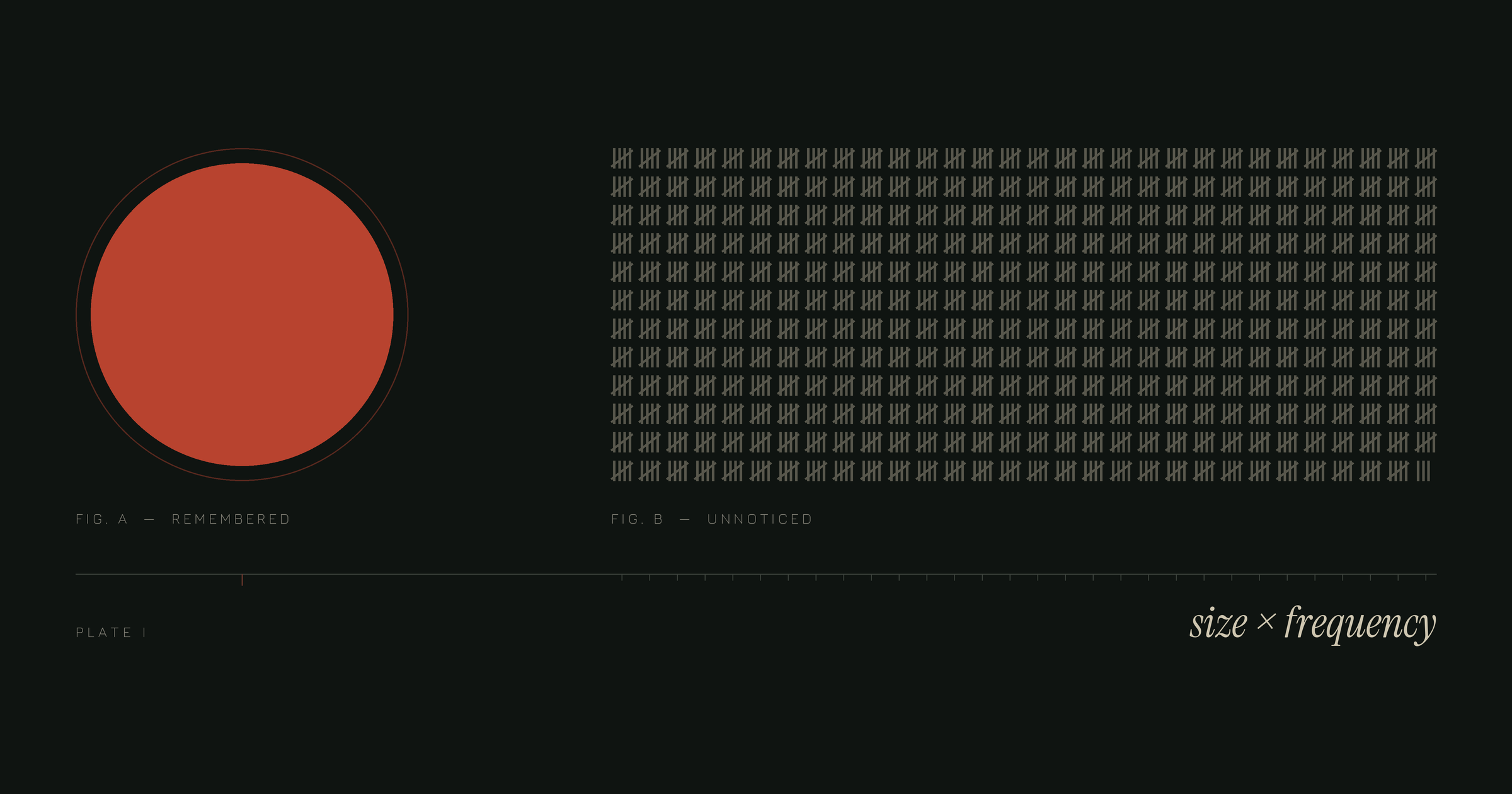
Here is the thing that took me an embarrassingly long time to see. You judge a mistake by what it cost you in the moment. This is not irrational — it is how people are built, and in most of life it works fine. A $400 pot you butchered registers as a $400 event. It has a size. You can feel it.
But the cost of a habit is not its size. It is: size × frequency
And frequency is the term you never compute. You cannot. It does not arrive as an experience. It arrives as an absence of one — thousands of small moments that never crossed the threshold where memory bothers to keep a copy.
So your sense of your own game is measuring one of the two terms and silently setting the other to 1. That is the whole argument. Everything below is arithmetic.
The multiplication nobody does
Let me make it concrete, and let me be careful about which numbers are facts and which are inputs, because that distinction is the actual thing my day job taught me. Say you play six hours a week. Live, at roughly 30 hands an hour, that is about 180 hands a week — a little over 9,000 hands a year. Those are not my numbers to give you. Replace them with yours.
Now take a decision that comes up in 15% of your hands. Not a rare, dramatic spot. An ordinary one. That is about 1,350 times a year.
Now suppose — and this is an assumption, not a measurement, and I will not pretend otherwise — that you get that decision wrong by an average of a third of a big blind. A third of a big blind. At $1/$3 that is one dollar. By any standard you would apply in the moment, that is nothing. If I stopped you mid-session to tell you that call cost a dollar in expectation, you would correctly conclude that I needed a hobby.
1,350 × $1 = $1,350 a year. That is your year. Gone, through an error so small that noticing it would feel neurotic.
And here is the genuinely cruel part. A $1,350 downswing you would feel. You would analyse it, you would talk about it, you might post about it. This one is invisible for one reason only: it was never delivered in a lump.
Four leaks that work exactly like this
I will examine four such leaks. Not because they are the four largest, but rather because they are four where the gap between how it feels and what it costs is widest.
1. Limping in to see a flop
It feels like the careful option. You are not committing, you are not bloating anything, you are paying a small price for information. What you are actually buying is a pot you cannot win without making a hand, against more opponents than you would otherwise have faced, from a position where you act first for the rest of it — having given away the one route to winning that requires no cards at all, which is everybody folding.
Frequency is what makes this expensive. Limping into even a modest share of hands and you are running a decision several hundred times a year that opens by surrendering your two best assets. Because each individual instance costs so little, nothing in the session ever flags it. There is no moment. There is never a moment.
2. The curiosity call
River. You missed, they bet, and you already know. There is a specific sensation here that I would bet most recreational players recognise instantly: not I think I am good, but I want to see it.
That sensation is worth learning to name because it is the cleanest tell you will ever get about yourself. When the reason for a call is that you want to know, you have stopped playing poker and started buying information you will never use. You will not remember the hand by Thursday. Even if you did, one observation of one player’s holding in one spot is not data — it is an anecdote that will cost you again later, when you act on it.
Cost per instance: one bet. Frequency: however many times a week you are curious. Multiply.
3. Playing the session length instead of the session
You sat down planning four hours. You are three hours in and playing worse than you were at hour one — slower to notice things, quicker to call, running on something nearer habit than attention.
You stay because four hours was the plan. Or worse, you stay because you are down, and leaving would make it real.
This one is different from the others: its per-instance cost is not small at all. But it hides in a different way. It does not feel like a decision, because the decision was taken at hour zero and everything after is just follow-through. The leak is not in any hand. It is in the hour — and the hour never gets reviewed, because reviews are organised by hand. The fix is almost free and almost nobody does it: decide before you sit down what would make you leave, stated in terms of how you are playing rather than what you are holding or what you are down.
4. Sizing by habit
You bet about the same fraction of the pot in most spots. Maybe two-thirds. Maybe half on the flop and larger on the turn. Whatever it is, it is stable, and its stability has nothing whatever to do with the board, the opponent, or what you are supposed to be representing.
Habitual sizing is the most forgivable item on this list, because it never once produces a moment you would flag. There is no hand where you think the sizing was the error. It simply loses a small amount in a very large number of spots — value you did not collect, folds you did not buy, information you handed over for free.
It also has the highest frequency of anything here. It runs on every street of every hand you play.
“Isn’t this just telling me to play tighter?”
No, and the difference matters. Play tighter is advice about which hands to enter with. It is one lever, it is the lever every book pulls, and if you have been at this a while you have already pulled it as far as you are willing to.
This is not advice about hands at all. It is a claim about where to look. Three of the four above have nothing to do with starting hands: two are about what you do on later streets, one is about what time you go home. What they share is a shape — small, repeated, and below the threshold at which you notice anything. You could tighten up considerably and leave every one of them completely intact.
How to count your own
Here is how to work out for yourself whether your limping costs you 4.2 big blinds per hundred hands, or 5.6. It takes three columns. Take a notebook to your next five sessions. For each leak you suspect:
How often. Tally marks, made at the time. Not reconstructed afterwards — afterwards is exactly where the error lives. This is the term you are wrong about, and you will be wrong in a predictable direction: everyone underestimates their own frequency, because the instances are not memorable, which is precisely why they are expensive.
How much. Your honest estimate of the average cost in big blinds when you get it wrong. Is it a tenth of a blind or a whole one?
Multiply. Times it happened × average cost, divided by the hands you played, times 100. That is your cost per hundred hands.
Your estimate of the cost is the weak input, which is why the tally matters most: it is the one column you can make exact, and it is the one your impression leaves out altogether. And when you do it, the ranking will surprise you. Mine did. The leaks I would have named in advance, the ones with stories attached, the ones I had replayed in the car, came out modest. The ones that actually mattered were boring, small and constant, and no amount of thinking hard about my play would have found them — because thinking hard about your play means thinking about the hands you remember, and that is the one place these never appear. I ended up writing the whole countdown — 15 of them — in my book, Live to Fold Another Hand.
The cheap fixes are unglamorous
There is a reason this is an unpopular project. Fixing a memorable leak feels like progress. You study the spot, you understand it, you get it right next time, and there is a small moment of visible competence attached to it. That moment is the reward, and it is why studying spots is pleasant.
Fixing a frequency leak has no moment. You simply limp less. Nothing happens. No hand goes differently in a way you can see. The improvement is delivered by exactly the mechanism that delivered the loss — a fraction at a time, under the threshold of experience — and you will never once feel it arrive.
Which means you have to take it on arithmetic, and keep taking it on arithmetic for months, with nothing rewarding you along the way. That is genuinely hard. It is much harder than learning a new spot, and it is worth saying so out loud rather than pretending the discipline is easy.
But it is where the money is. Not in playing better hands. In playing the ordinary ones a fraction less badly, several thousand times a year.
The showdown is where poker is dramatic. It is hardly ever where it is the most expensive.