Taking effective notes on poker hands is one of the most underrated skills in improving as a player. Whether you’re grinding online MTTs, playing live cash games, or studying away from the table, the way you capture and organize hands directly impacts how much you actually learn from them. Most players either jot down vague thoughts or rely on memory. That can be unreliable, and usually your bias will creep in. Strong poker players treat objective note-taking as part of their edge.
This guide walks through how to take clear, useful, and actionable notes on poker hands so you can consistently improve your decision-making.
Why Note-Taking Matters in Poker
Poker is a game of incomplete information. You rarely know if a decision was correct in real time. Without recording hands, you lose the opportunity to review spots objectively. Note-taking in poker helps you:
- Identify leaks in your game
- Recognize patterns in opponents
- Build a database of tricky situations
- Improve your strategic thinking over time
More importantly, it forces you to slow down and think. Writing something down means you cared enough about the spot to revisit it. This is where real growth happens.

What Hands Should You Record?
You don’t need to document every hand. That’s inefficient and overwhelming. To start, you should focus your poker note-taking on these five types of hands:
- Big Pots: Any hand where a significant portion of your stack (or your opponent’s) is involved.
- Uncertain Decisions: If you weren’t sure whether to call, fold, or raise, that’s a prime candidate.
- Close Spots: Thin value bets, marginal calls, or tricky bluffs.
- Interesting Lines: Unusual plays by opponents or yourself. Think check-raises on the turn, overbets on the river, etc.
- Emotional Hands: Hands where tilt might have influenced your decision-making.
If a hand sticks in your mind for more than a few seconds, it’s worth recording. Notes can be taken by hand if you prefer, but keep in mind that a notebook at the table is going to draw attention from your opponents. Try taking notes in your phone’s Notes app or Google Docs for concealed notetaking.
READ MORE: Jared Tendler on Poker Note Taking
The Structure of a Good Poker Note
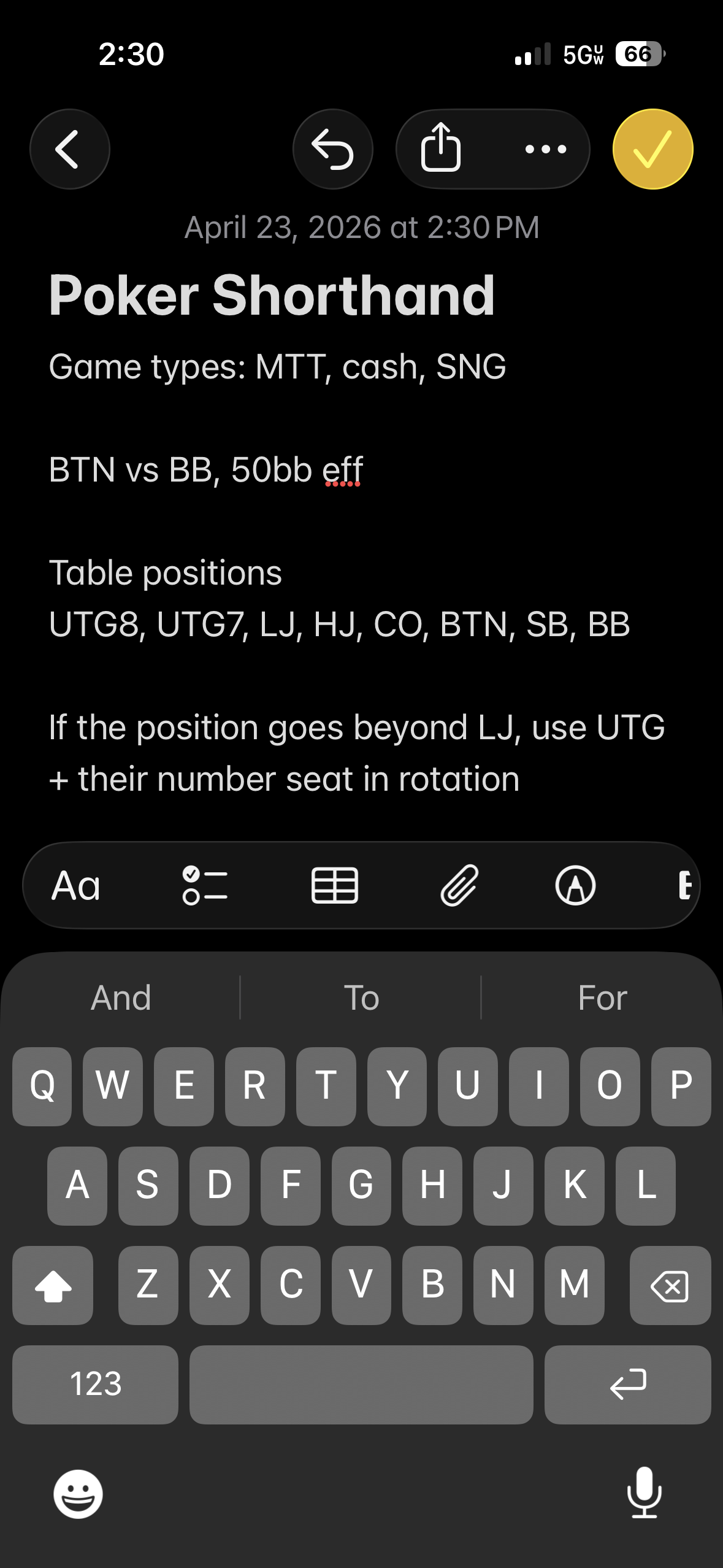
The biggest mistake poker players make is taking notes that are too vague. “Weird spot” or “bad beat” won’t offer you much to learn from. Instead, every note should follow a structured format. Keep in mind common poker shorthand so that your notes can be taken quickly and understood by other players.
1. Basic Context
Start with the essentials:
- Game type (MTT, cash, sit & go)
- Stakes or buy-in
- Stack sizes (recording the effective stack is key)
- Positions (e.g., BTN vs BB, UTG vs CO)
- Stage (early, bubble, final table, etc.)
Example: $55 MTT, 40bb effective, BTN vs BB, mid-stage
2. Preflop Action
Clearly describe what happened before the flop:
- Who opened
- Bet sizes
- Who called or raised
Example: BTN opens 2.2bb, I call BB
3. Postflop Action (Street by Street)
Break it down by street:
- Flop: board texture, bets, sizing
- Turn: what changed, actions
- River: final decisions
Example:
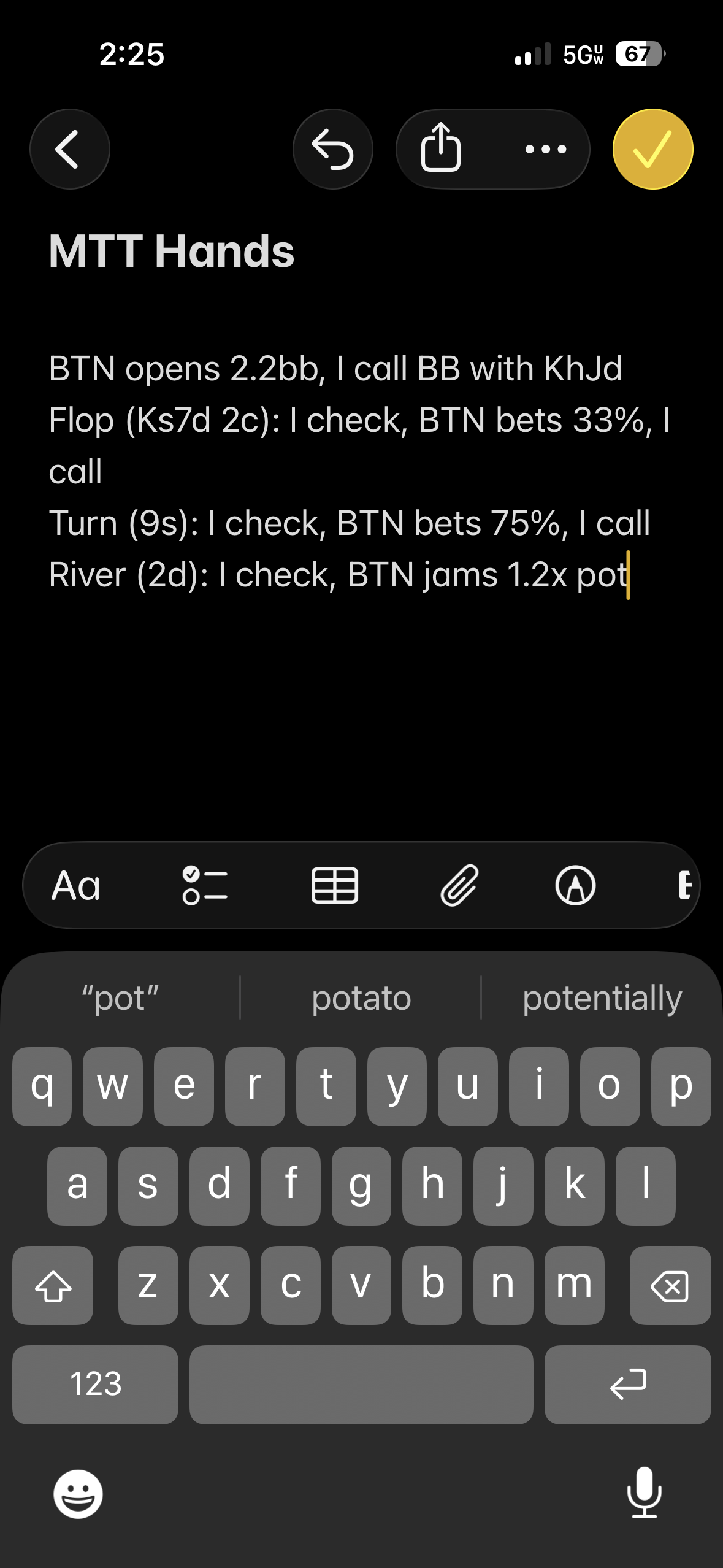
BTN opens 2.2bb, I call BB with KJo
Flop (K♠ 7♦ 2♣): I check, BTN bets 33%, I call
Turn (9♠): I check, BTN bets 75%, I call
River (2♦): I check, BTN jams 1.2x pot
If it helps you get started, you can record that bets are small, half-sized, or large in relation to the pot. But as you improve, you will want to be as specific as possible.
If you’re taking notes quickly on a phone, consider noting the card suits like so.
4. Your Thought Process
This is the most important part that most poker players tend to skip.
Write what you were thinking at the moment. For example:
- What player type was your opponent?
- What range did you assign your opponent?
- Why did you take your line?
- What were you trying to accomplish?
Example: Thought BTN had wide c-bet range on flop. Turn sizing felt strong but still contains draws. River jam polarized—struggled to find bluffs.
5. The Question
End your poker note with a clear question. This turns your note into a study prompt.
Examples:
- “Is this a call vs population?”
- “Should I be raising turn?”
- “Do I overfold here?”
Without a question, your poker note lacks direction when you review it later. Use your notes to talk through hands with other players and get their perspective on hands.
Example of a Complete Poker Note
Here’s what a strong note looks like when everything is put together:
$55 MTT, 40bb effective, BTN vs BB
BTN opens 2.2bb, I call BB with KJo
Flop (K♠ 7♦ 2♣): I check, BTN bets 33%, I call
Turn (9♠): I check, BTN bets 75%, I call
River (2♦): I check, BTN jams 1.2x pot
Thought process: BTN has range advantage on flop, so I defend. Turn sizing felt strong. Maybe value-heavy, but still includes draws. River jam seems polarized. I block Kx but don’t block missed draws.
Question: Is this a standard call vs population, or should I overfold the river?
The above note gives you everything you need to analyze the hand later or discuss it with others.
Final Thoughts
Taking notes on poker hands is a habit that separates casual players from serious ones. It doesn’t require GTO (Game Theory Optimal) strategy, just enough detail to understand the situation. If you consistently record meaningful hands, capture your thought process, and review them with intention, your improvement will compound over time.