Poker has a long history. Created in the United States in the 1820s, it evolved from a regional pastime into a globally recognized competitive game. The World Series of Poker, launched in 1970, gave it a professional stage and a symbol of high-stakes strategy, and the world paid attention. Texas Hold’em became the dominant format. Then the internet arrived, and everything accelerated.
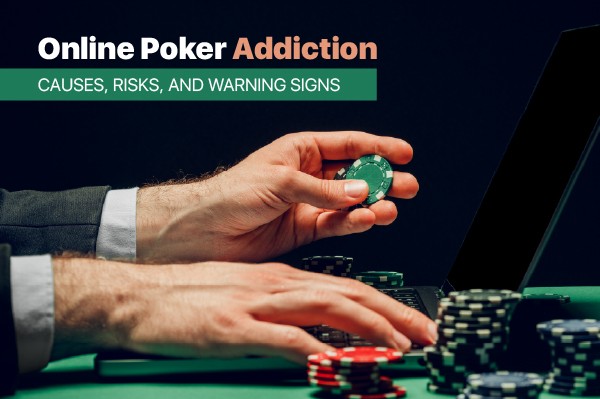
Today, millions of people play online poker daily, from casual hands-on poker online free platforms to high-stakes real money tables. Online poker real money sites have transformed:
- Who plays
- When they play
- How often they play
With that shift came a harder question. A French survey found that one in five patients at the Excessive Gambling Reference Centre in Nantes was a poker addiction player, 75% of them online. The French Game Observatory reported that 22% of the poker addiction player population shows problematic use, including 14% with excessive use. These are not small numbers.
This article dive deep into why online poker addiction develops, what various research studies say, and how to remain aware and cautious about all the warning sings before regular games become a serious problem.
Why Poker Can Be So Addictive
There is something uniquely powerful about a game that rewards skill. Psychiatry researchers have long pointed to a concept called intermittent reinforcement as one of the primary engines behind gambling addiction. Unlike fixed rewards, intermittent reinforcement delivers wins unpredictably, and that unpredictability is exactly what makes behavior so hard to extinguish.
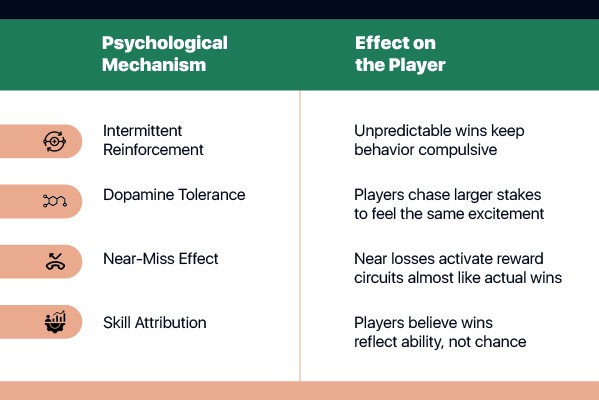
Dr. Rani Hoff, Emeritus Professor of Psychiatry at the Yale School of Medicine, explained it plainly: “In poker, for example, you win more if you know what you’re doing. Intermittent reinforcement is the most powerful reinforcer for any living organism, for humans particularly.” The brain’s mesolimbic pathway releases dopamine not just during wins, but in anticipation of them. Over time, chronic players require more stimulation to feel the same effect, a phenomenon known as tolerance. The cycle builds quietly and fast.
How Poker Addiction Creates an Illusion of Control
Poker has significant differences compared to regular slots or roulette. The competition among players, not the house, drives for higher stakes. That gives the game a real skill component, and that is precisely what makes the online poker addiction gambling trap so effective. When players win, they attribute it to their ability. When they lose, they blame bad luck. This asymmetry feeds the illusion of control.
In reality, no player consistently out-earns the house. Every online poker addiction game and live table takes a rake, ensuring the host wins over the long run regardless of individual player skill. However, the feeling of control remains prevalent. For example, Michael “Roxy” Roxborough, a legendary Las Vegas bookmaker, described poker as a mood changer and a time black hole that captures a sense of time and emotional state.
This dynamic is especially relevant for players who use a casino bonus to begin their poker journey. A bonus reduces the early financial risk and extends playing time, which may reinforce the mistaken belief that winning is a product of skill alone. Studies show that the illusion of control carries a regression coefficient of β = 0.23, p < 0.001, making it one of the strongest cognitive predictors of pathological gambling behavior. Key warning signs of developing poker addiction:
- Playing online poker for longer than planned despite wanting to stop
- Returning to playing online poker after losses to get even
- Feeling irritable or anxious when not playing poker online free or for money
- Increasing bet sizes to recapture the original excitement
- Neglecting work, relationships, or sleep because of playing online poker
What Research Says About Poker Addiction
A landmark peer-reviewed literature review on the topic was conducted in 2016 and published in the Journal of Behavioral Addictions. The literature review analyzed 17 studies on the psychopathology of online poker addiction players. The researchers at the University of Toulouse and the University of Nantes found that the proportion of problematic gamblers was particularly high in online poker addiction. Several factors predicted excessive play:
- Stress
- Internal attribution
- Dissociation
- Boredom
- Negative emotions
- Irrational beliefs
- Anxiety
- Impulsivity
Two models in the review explained 42% and 67% of the Problem Gambling Severity Index (PGSI) score variance among online poker addiction samples. The strongest predictors were time played (β = 0.62, p < 0.001), dissociation (β = 0.33, p < 0.001), and impulsivity (β = 0.21, p < 0.01).
In a study of 179 online poker players, it was determined that approximately 9% of the players scored at a problem gambling classification on the Canadian Problem Gambling Index, and the average player spent 20 hours per week playing online poker. The research is detailed: Is poker addictive? For a statistically significant share of players, the answer is yes.
Cognitive Distortions Make Poker More Dangerous
Cognitive distortions are a central mechanism in the psychology of gambling addiction, and poker addiction players show them in specific, measurable ways. Barrault and Varescon found that irrational beliefs, particularly the perceived inability to stop gambling and the illusion of control were strong predictors of pathological gambling scores. Depression and anxiety compounded the risk. In practice, cognitive distortions cause players to misread losses as near-wins, to overestimate skill after a lucky run, and to believe that a different strategy will reverse a losing streak.
Tilt Can Trigger Loss of Control
Tilt is one of the most poker-specific psychological phenomena, and it carries real clinical weight. One study examined tilt in detail and found it typically begins after a significant loss, then moves through stages:
- Dissociation
- Feelings of injustice
- Anger
- Chasing behavior
The consequences extend well beyond the table. The studies found that tilt is associated with guilt, anxiety, depressed mood, rumination, and disrupted sleep. It does not resolve when the session ends. It follows the player. Sensitivity to losses was identified as a strong predictor of tilt severity, meaning emotionally reactive players face a compounding risk.
Online Play and Higher Gambling Risk
Online poker playing was positively correlated with higher scores on the Problem Gambling Severity Index. A study has shown that poker players scored higher on the AUDIT scale for alcohol consumption, which indicates that risky poker addiction behavior does not exist independently. It often goes hand in hand with other risky behaviors.
Online poker sites offer features that accelerate risk exposure:
- Multi-tabling
- 24/7 access
- Fast hand rates
- No physical cash changing hands
These structural features remove natural friction points that might otherwise slow a player down. The compulsive gambler’s relationship with online poker real money games is, in this sense, fundamentally different from a monthly home game.
Is there a difference between playing online vs. a live poker table?
Research on whether online poker addiction is more severe than live poker addiction has produced conflicting results. Among a Hungarian sample of 131 players, traditional poker players appeared more problematic, with 94.3% of table players classified as symptomatic compared to 67.7% of online players.
Another study reported the opposite pattern among Montreal university students. However, problem gambling was significantly more prevalent in online poker players (17.6%) than in their offline counterparts (1.1%). Illicit drug use was also more prevalent in online poker players than in their offline counterparts.
Limitations in both studies were considerable. The authors of the literature review in 2016 indicated that there is insufficient evidence to conclude which type of poker game is more detrimental: online or offline.
How to Know If You’re Addicted to Poker
According to clinical criteria and verified gambling disorder research, the following indicators suggest a genuine poker addiction problem:
- Preoccupation
- Loss of control
- Chasing losses
- Continued play despite consequences
- Borrowing money
- Mood dependence
- Tolerance
If several of the above signs are present, speaking with a licensed mental health professional who specializes in gambling psychology is a practical and important next step.