For an Ontario poker player, the difference between a poker room and an online casino is more than a menu change. Both may appear under the same gaming brand and operate in the province’s regulated market. Yet money flows differently, the games reward different decisions, and opponent availability matters in only one.
Since Ontario opened its regulated commercial gaming market in April 2022, familiar branding has increasingly obscured how different products actually work.
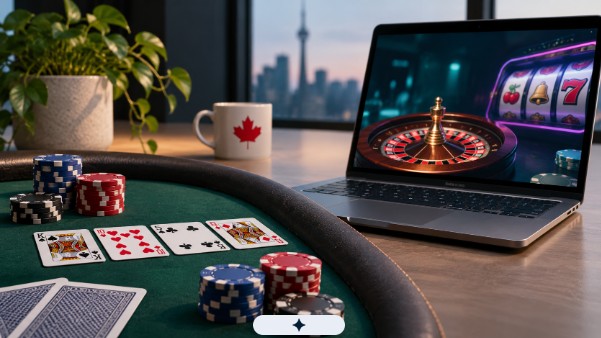
At a poker table, the opponent is another player
Texas Hold’em and Omaha are peer-to-peer games. The operator supplies the software, manages the game and generally collects rake or tournament fees. The players compete for money contributed to the pot or prize pool.
A player’s decisions can matter over time. Position, bet sizing, hand selection and the ability to adapt to opponents all influence results. Even experienced players endure long losing stretches, while fees can erase a marginal advantage. Cardplayer Lifestyle explores that uncertainty in its reflection on variance and emotional resilience in poker, examining why sound decisions do not always produce winning outcomes.
Online casino games usually work differently. In slots and roulette, the player is facing a game built around predetermined mathematical rules and a house advantage. Blackjack allows meaningful decisions, but correct basic strategy generally reduces rather than eliminates that disadvantage. Playing against a live dealer does not transform the underlying game into peer-to-peer poker.
The Ontario-only player pool changes poker more than slots
A poker room needs opponents. The size of the available player pool affects when cash tables run, which stakes are active and how many entries a tournament can attract. A slot machine does not need six other people to start a session.
Ontario’s regulated poker market currently operates with provincial player pools. iGaming Ontario’s operator guidance says games involving liquidity pools outside Ontario remain prohibited. An international poker brand therefore does not automatically provide access to its global tables.
That may change. In November 2025, Ontario’s Court of Appeal supported a proposed model that would allow international participation in certain online games. According to the Supreme Court of Canada’s official case record, the court heard an appeal on October 7, 2026, and reserved judgment. That hearing did not make international tables available.
For now, players comparing poker rooms should inspect actual table traffic and tournament schedules at the hours they expect to play, rather than assuming a familiar worldwide brand means worldwide liquidity.
One regulator, different products and conditions
Ontario requires players to be at least 19 and physically inside the province when wagering through its regulated internet gaming market. Accounts can be managed while travelling, but wagers cannot be placed outside Ontario.
Regulated private operators must register with the Alcohol and Gaming Commission of Ontario and have an operating agreement with iGaming Ontario. The latter maintains an official directory of regulated gaming websites, identifying whether individual sites offer poker, casino games, sports betting or a combination. As of November 6, 2026, the directory listed 83 websites from 48 operators. OLG.ca operates through a separate provincial arrangement.
Branding does not determine terms. Poker and casino products can have different promotions, available payment methods, tournament fees and wagering requirements. A bonus described prominently on a casino page may be irrelevant to a poker account. Before moving funds between products, players should check whether balances are transferable and whether restrictions follow the money.
Choosing a site calls for two different checklists
For poker, practical questions start with the games: Are the preferred stakes running? Is there enough tournament variety? How much is charged in rake or entry fees? What are the rules on disconnected hands, seating and prohibited software? These affect the experience even when two rooms have similar-looking interfaces.
Casino comparisons call for a different reading. Check the game rules, published return-to-player information where available, betting limits, payment restrictions and bonus conditions. Similar-looking casino titles can have different payout structures.
Casino.org lists online casinos in Ontario, which may help readers identify the kinds of products being marketed. Any listing should be treated as a starting point, not proof that a particular site is currently authorized. Confirm the exact web address against the regulator’s records before creating an account.
A final consideration applies to both formats: the pace of play. Fast casino rounds can generate many bets in a short period, while poker sessions can extend well beyond the time originally planned. Ontario-regulated sites must provide responsible-gambling tools, including limits and self-exclusion options. The province also operates BetGuard, a centralized self-exclusion system covering the regulated market.
What matters is understanding the opponent, fees, rules and affordable limits. Poker knowledge helps answer some of those questions, but it cannot replace reading the terms of a different product.