“The History of Online Poker” is the title of a recently published book by Wladimir Taschner. It fills a gap in the poker publishing industry, as there were previously no books that recounted the history of online poker in detail. The author begins in 1998 with the launch of the first poker site (Planet Poker) and brings the narrative up to the present day, where solvers have become a major focal point.
We spoke with Taschner, who played online for many years on Full Tilt Poker during the poker boom. We asked him about the process of writing the book, the key figures involved, the importance of online poker and what he misses about the “good old days”, among other topics. After the interview, we include a brief review and opinion section of the book.
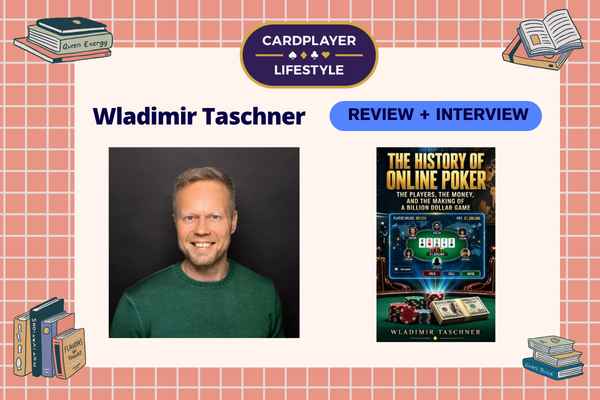
Interview with Wladimir Taschner
How did the idea to write the book come about?
The idea came to me while I was jogging. I regularly listen to audiobooks during my runs and particularly enjoy biographies of people like Roger Federer, Tiger Woods, Rafael Nadal and Elon Musk. While listening to Federer’s biography I started wondering why online poker had never received the same treatment. Although online poker isn’t a person, it has a fascinating story of its own. It has a beginning, a period of extraordinary growth, major crises and eventually a more mature phase. I was surprised that I couldn’t find a book telling that story from beginning to end. Having spent many years as a professional player myself, I thought it would be interesting to combine that history with my own experiences.
Do you think this was a necessary book for the industry? There have been books about live poker’s history, but none about online poker.
Online poker has influenced an entire generation and I believe its cultural significance is often underestimated. Millions of people participated in this world, from professionals and ambitious amateurs to recreational players who simply enjoyed playing after work. In some ways its impact reminds me of online gaming or social media.
There have been documentaries such as “Bet Raise Fold” and films about individual players. What I felt was missing was the bigger picture. Something I found particularly interesting was how people outside the poker world reacted to
my background. During job interviews they were often fascinated by the idea of making a living by playing poker online. They wanted to understand how it worked and what life as a professional player was actually like. For those of us who experienced it, online poker was simply part of everyday life.
What was the writing process like? Did you proceed chronologically or perhaps by topic?
One of the first challenges was deciding how much history to cover. Should I begin with Planet Poker and Paradise Poker or concentrate on the golden years of PokerStars, PartyPoker and Full Tilt Poker? I eventually decided to cover the entire history while placing greater emphasis on the boom years through Black Friday and its aftermath. That was the period I had experienced personally.
The book follows a broadly chronological structure, although I often researched individual people and events across several years. I also wanted to avoid simply listing dates, tournament results and poker sites. Most of that information is already available online. What interested me were the stories behind those developments and how players experienced them. I wanted readers to understand what it actually felt like to be part of that period.
Did you feel a sense of nostalgia while researching past decades? What do you miss about online poker?
Researching the book became surprisingly emotional at times. Reading old forum discussions and revisiting events from my playing days brought back memories I hadn’t thought about in years. It made me appreciate how extraordinary that period had been. I also realized how much poker had shaped the way I think. Evaluating decisions based on expected value rather than short term results, thinking long term and working backwards from a desired outcome are principles I still apply in my professional, private and academic life.
What I miss most is probably the golden era of Full Tilt Poker. Games were running around the clock and table selection was much less sophisticated. Nobody really knew how large the edges between players were, and poker strategies were constantly evolving. You could log in, find a game and start playing. There was always something new to learn and plenty of room to improve.
To what degree do you feel online poker helped cause the poker boom?
Online poker was essential to making the boom possible on such an enormous scale. Chris Moneymaker‘s victory created tremendous excitement, but online poker allowed millions of people to actually participate. Before that, access to poker depended heavily on where you lived. Many people had no casino nearby or enough friends interested in organizing a home game. Even if a casino was available, the stakes were often too high for beginners.
Physical poker rooms have significant operating costs and usually cannot offer games for just a few cents. Online poker removed those barriers. People could play from home at almost any time and start with very small amounts of money. They could spend half an hour playing during a lunch break or several hours in the evening. Television created the excitement, but online poker provided the infrastructure that allowed the game to reach millions of new players.
Among the great players mentioned in your book, which one do you think deserves their own biography?
Viktor Blom would probably be my first choice. His emergence as the mysterious “Isildur1” on Full Tilt Poker was one of the most fascinating episodes in online poker history. Despite his extraordinary achievements, relatively little is known about his personal experiences during that period. Tom Dwan, Patrik Antonius and Phil Galfond would also make interesting subjects. I’d particularly love to read a biography of Phil Ivey. Despite being one of the most successful players in poker history, he has always remained a relatively private person. What interests me most about these players is how they think, what motivates them and how they approach the game. Their results are well documented, but the people behind those achievements are often much less understood.

Isai Scheinberg was nominated for the Poker Hall of Fame several times, but he has not yet made it in. Do you think he deserves a spot? Will he be able to get in under the current system?
For me, Scheinberg belongs in the Poker Hall of Fame. I often wonder whether PokerStars would have become what it did without him. Someone else might eventually have built a similar company, but his understanding of what players wanted was exceptional.
Scheinberg’s approach reminds me somewhat of Jeff Bezos and Amazon’s focus on customer satisfaction. PokerStars offered excellent software, reliability and outstanding customer service. As a player you could really notice the difference. I hope Scheinberg will eventually be inducted. The Poker Hall of Fame should recognize the people who built the industry alongside those who achieved greatness at the tables.
What do you think about online rings and bracelets? Do they carry the same prestige as those won in live events?
Winning an online bracelet or ring is certainly an achievement, especially considering how competitive modern online tournaments have become. However, I don’t believe they generally carry the same prestige as major live titles.
Professional online players often measure their success through expected value, win rates or tournament ROI. An online bracelet can be a nice achievement, but it doesn’t necessarily attract much attention outside the online poker community. Winning the WSOP Main Event is something different. There is a history and emotional significance attached to that bracelet which goes far beyond its monetary value.
A few weeks ago, the largest online tournament in history took place, with 420K entries on GGPoker. Do you think that record will be broken again soon?
It’s an extraordinary achievement and demonstrates how much potential online poker still has. I can certainly imagine a tournament reaching one million entries at some point. Much will depend on regulation and whether online poker can expand into markets where access is currently restricted. If more people around the world can participate in attractive and properly regulated games, the potential audience could grow considerably.
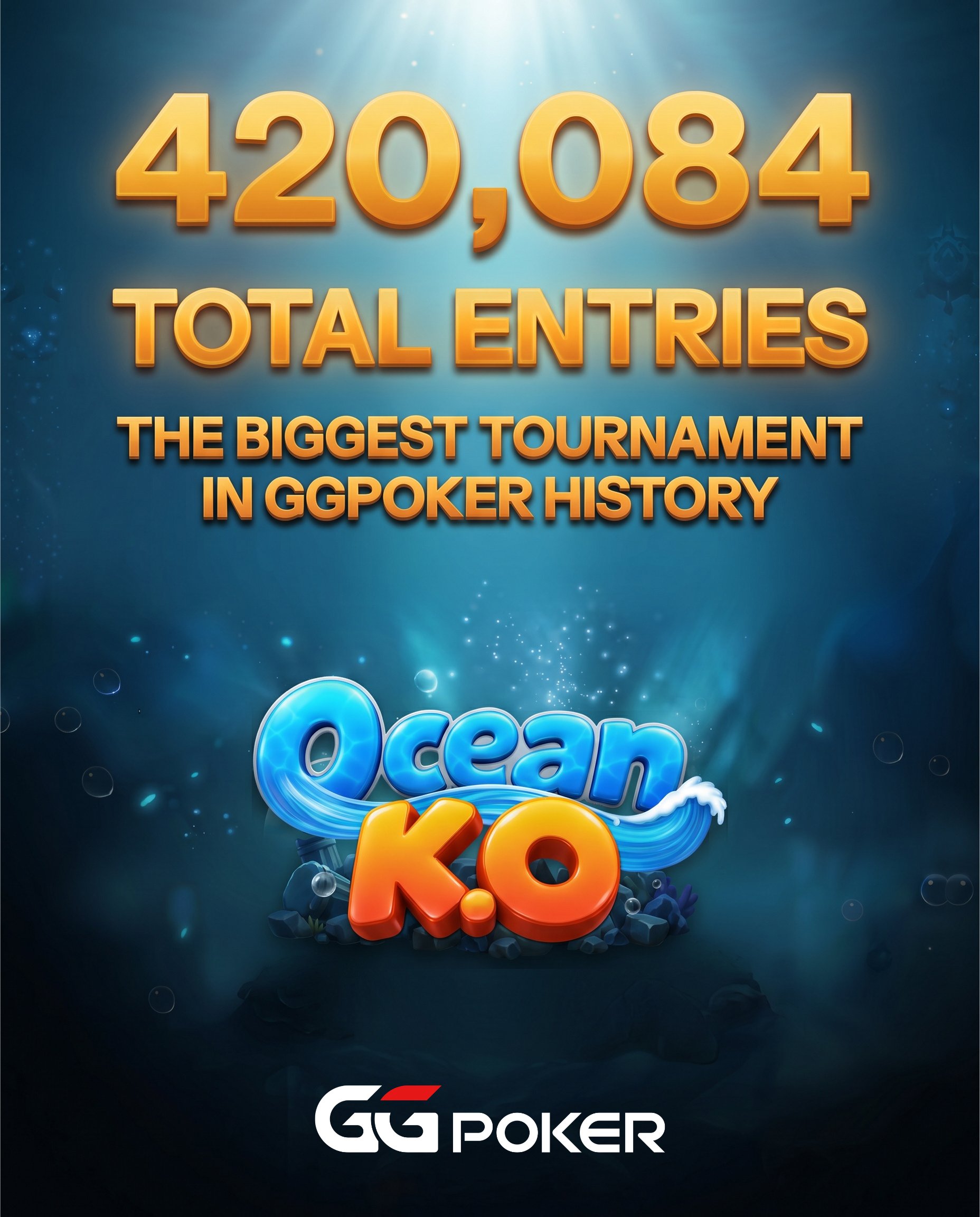
What do you think of the Space K.O. tournament format on Winamax and the Ocean K.O. format on GGPoker? Do they benefit inexperienced players while putting professionals at a disadvantage?
I can understand why recreational players enjoy these formats. They create additional excitement and offer the possibility of winning substantial prizes without necessarily reaching a final table. For professionals, the increased variance makes results less predictable, but it doesn’t automatically eliminate their long-term advantage. Skilled players can still make better decisions and adapt their strategies accordingly. I generally welcome innovation in poker as long as the balance between skill and luck is maintained. Both recreational players and professionals are important for a healthy poker ecosystem.
Do you foresee the United States ever legalizing poker on a federal level?
I believe further expansion is possible, although much will depend on cooperation between lawmakers, regulators and poker operators. Everyone involved has different interests and priorities. The challenge is finding solutions that
make economic sense while genuinely considering what players need. If the industry and regulators can establish a framework that provides safe games, fair conditions and sufficient player liquidity, I see considerable potential for further growth in the United States.
You’ve already published two books. Can you imagine writing another one about poker, or perhaps on another topic, further down the line?
Finishing this book has definitely made me interested in writing another one. The process requires considerable time and effort, especially when dealing with such a complex subject. But bringing everything together and finally seeing the finished book is an incredibly satisfying experience. Writing “The History of Online Poker” was particularly meaningful because the subject has been such an important part of my own life. I already have a few ideas about other topics that fascinate me. However, I would only want to write another book if I genuinely enjoyed the subject and had a clear vision of what I wanted to explore and how I wanted to tell the story. If the right idea comes along and I can find the time, I would certainly do it again.
Book Information: By The Numbers
- Title: “The History of Online Poker: The Players, the Money, and the Making of a Billion Dollar Game”
- Author: Wladimir Taschner
- Date of Publication: September 15th, 2026
- Pages: 386
- Prices: $13 Kindle / $25 Paperback / $35 Hard cover / Free with Kindle+
- Where can I buy it? Amazon
- You can read an excerpt here
Book Review: The History of Online Poker
Online poker is a fundamental part of the history of poker. It allowed millions of people to play from their own homes and played a crucial role in the 2003 poker boom, including Chris Moneymaker, who qualified for the World Series of Poker Main Event online. Players such as Blom, Galfond, Antonius, Dwan, and Chris Moorman — who are now legends — all began their careers online. For this reason, online poker deserved a book of its own, and Wladimir Taschner was the right person to write it, having played online during the glory years of Full Tilt Poker.
Reading this book is like taking a journey back in time to see what playing online poker was like when it has just started. We also get a look at how players studied and made deposits, as well as the early forums and virtual rails. It is fascinating to see how poker sites responded to player concerns and how they combated cheating and fraud attempts back when technology was not as advanced as it is today.
The book wouldn’t be complete without covering the high-stakes duels — featuring the likes of Viktor Blom, Tom Dwan, Patrik Antonius, and Phil Galfond — as well as the fateful “Black Friday” of 2011, a turning point for the industry that altered the lives of thousands of players. The author provides comprehensive information, allowing the reader to truly step into the shoes of those affected.
It is an excellent book, and I believe that anyone who played online between 1998 and 2011 will thoroughly enjoy it. It is also a book that younger players — those who have only been playing online for a few years — can benefit from, as it offers insight into what the industry was like in its early days. For those who enjoy reading about the history of poker, this is a must-read. Without a doubt, I believe it is one of the best poker books of 2026.
#NowReading 📖
“The History Of Online Poker” Wladimir Taschner
A book that had to be written, and Wladimir was the right person to write it. It provides a detailed analysis of the history of online poker, featuring all the key figures involved.
Soon review ✍️ + interview 🗣️ on @PokerLifeMedia
You can read it for free with Kindle+
— Santi G-M (@santijota8) October 22, 2026
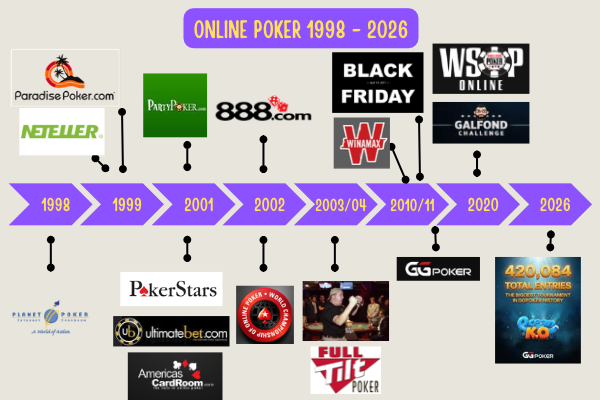
To conclude, we’ll list some of the major online milestones that occurred over the last 28+ years, almost all of which are mentioned in Wladimir’s book:
- 1998: Planet Poker
- 1999: Paradise Poker and Neteller
- 2001: Ultimate Bet, PartyPoker, PokerStars, Americas CardRoom and 2+2 Forums
- 2002: 888poker and first WCOOP
- 2003: Chris Moneymaker wins the WSOP Main Event after qualifying online
- 2004: Full Tilt Poker
- 2006: First Sunday Million and FTOPS
- 2007: PokerStars Supernova Elite
- 2009: First SCOOP, Team Online PokerStars, Gipsy Team and Durrrr Challenge
- 2010: Rush Poker PokerStars and Winamax
- 2011: Black Friday
- 2013: Expresso Winamax
- 2014: Spin & Go PokerStars
- 2015: Pio Solver and record of 253,692 entries in PokerStars tournament
- 2017: GGPoker
- 2018: CoinPoker
- 2019: PokerBROS
- 2020: GTO Wizard, WSOP Online and Galfond Challenge
- 2022: WPT Global
- 2024: Space K.O. Winamax
- 2026: Ocean K.O. GGPoker and record of 420,084 entries in GGPoker tournament