I build quantitative models for a living. I’ve done it for about a decade. The day job is data analytics, the degree says Master’s in Business Analytics, and the professional reflex is simple: don’t trust a claim you haven’t measured. Then I’d drive to the casino and spend 10 hours trusting claims I’d never tested about the one activity where I had real money on the line.
I’ve played poker on and off for more than 20 years — almost all of it online, low stakes, mostly for fun. Live poker is the new part. About three years ago I started playing seriously in card rooms, and because measuring things is what I do for a living, I tracked it from the first session — every buy-in, every hour, no exceptions. The ledger now holds more than 3,200 hours of live play. The numbers below come from my two home rooms, Woodbine Casino in Toronto and Casino Niagara: 439 cash sessions, 2,735 hours, mostly $2/5 with a growing share of $5/10.
The headline is the part I’m supposed to lead with: those sessions netted $225,859 CAD, about $83 an hour, profitable every year. That’s the number I would have quoted you at the table, and it’s true.
It’s also the least interesting thing in the spreadsheet. The interesting part is what the data said about HOW I made that money — because it contradicted the two beliefs I was most confident about.
BELIEF #1: LONG SESSIONS REPRESENTED DISCIPLINE
I wore long sessions like a badge. Ten hours on a Friday night wasn’t stubbornness, it was work ethic — the game gets soft after midnight, the tourists rebuy, and a pro sits there and collects. Leaving early felt like leaving money on the table.
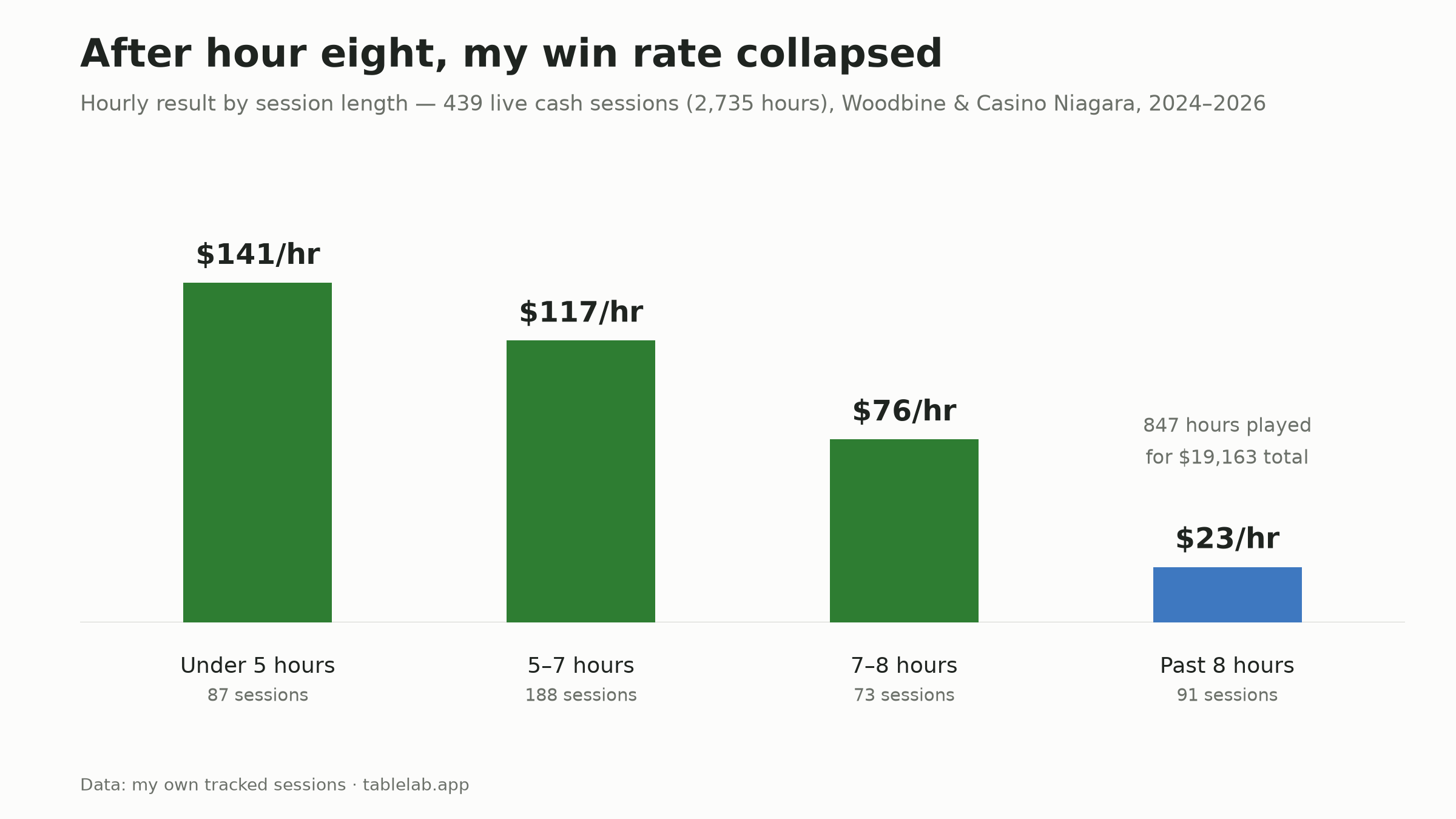
Here’s what the ledger actually says, sliced by session length:
Under 5 hours | 87 sessions | $141/hr
5-7 hours | 188 sessions | $117/hr
7-8 hours | 73 sessions | $76/hr
Beyond 8 hours | 91 sessions | $23/hr
Through seven hours I earn somewhere between $117 and $141 an hour. The rate starts eroding at hour seven, and past hour eight it craters to $23. I played 91 sessions that ran past eight hours. Together they lasted 847 hours and made $19,163. Had those hours paid what my sub-seven-hour sessions average (about $122 an hour), they’d have made roughly $103,000.
That gap — call it $84,000 over three seasons — was the price of my ‘work ethic’.
One honest caveat, because a data analyst who hides the caveat is just a storyteller with a spreadsheet: this is session-level data. I can’t cleanly separate the I played badly because I was tired, from, the session ran long because I was stuck and refused to leave. But notice that both explanations describe the same leak. Whether fatigue was eroding my edge or frustration was extending my losses, the decision driving it was identical: session length was being set by emotion, not by edge.
BELIEF #2: I QUIT AT THE RIGHT TIMES
Which brings me to the second belief. You’d have heard me say I ended sessions rationally: game got bad, I left; game stayed good, I stayed.
The ledger says otherwise. I’ve won 69% of my sessions, which sounds like a stat to be proud of until you look one layer deeper. My median winning session is $1,200. My median LOSING session is $1,330. I lose bigger than I win. And the top 10% of my sessions account for 64% of my entire profit.
That’s not the shape of a player who quits rationally. That’s the shape of a player who books the small win — racks up, feels good, goes home early — and sits with the loss, waiting to get even. The 69% wasn’t measuring my skill. It was measuring my exits. Combine it with the hour-eight cliff and you get one behavioral portrait, drawn twice: my short sessions were disproportionately the winning ones I’d cut short, and my marathons were disproportionately the stuck ones I wouldn’t leave.
Twenty years around this game, a career spent measuring things, and I was making the oldest documented mistake in poker: quitting winners and riding losers. I could not see it until the numbers were staring back at me from a chart.
HOW HAVE I CHANGED?
Eager to fix my leaks and profit more, I set a hard rule: I play my best seven hours and go home, winning or losing. Leaving stuck no longer requires a judgment call at 2 a.m. from the person worst qualified to make it – tired me, annoyed me, the me that wants “just one more orbit.” The rule makes the decision for me in advance.
Early returns are good: this year I’m averaging $124 profit per hour across roughly 600 hours, against $72 and $71 the two full years before. I’d love to tell you that’s the leak plugged and the edge realized. The honest version: some of it is probably variance. Even 2,735 hours only pins my true win rate inside a ±$25 band. Live poker’s sample sizes are brutal like that — which is how this leak survived three years inside a ledger I was dutifully filling in. Recording, it turns out, is not the same as looking.
The other thing that changed: I got tired of discovering these things years late, so I built the tool I wanted at the table. It’s a tracker called TableLab (https://tablelab.app/about) that does this kind of analysis on your own sessions instead of leaving it buried in a spreadsheet you’ll audit someday. Building it is its own story; the short version is that the leak I found first was mine.
TRACKING SESSIONS WILL UNCOVER YOUR LEAKS
If you play live and do not track your results, I’d gently suggest the following: there is very likely a pattern in your results that contradicts something you believe about your game. Mine was session length. Yours might be a stake, a game type, a time of night, a specific room. You will not discover it by feel, because feel is the thing generating it.
You don’t need my app for this — a notebook and honesty will do. Just track every session for six months: date, hours, buy-in, result, no exceptions and no forgetting the bad nights. Then slice it one way — by length, by day, by stake — and analyze what you see.
The numbers won’t care what you believe. In my experience, that’s the most valuable thing about them.