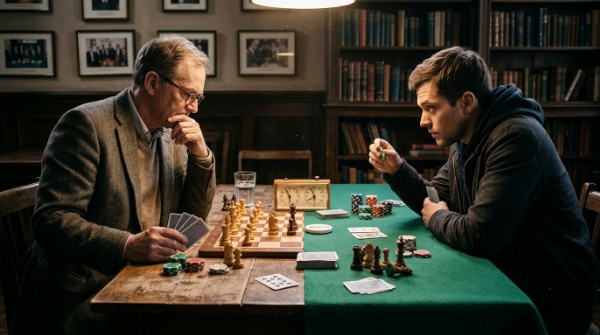
At first glance, chess and poker look like opposites. One is played in silence with every piece visible on the board, the other with hidden cards, bluffs and chips. Yet a surprising number of players move between the two, and many coaches argue that each game sharpens skills the other one needs. Looking at where they overlap and where they split helps explain why.
What Poker and Chess Have in Common
Poker and chess both reward patience, pattern recognition and calm decision-making under pressure. In both games, a single emotional mistake can undo hours of careful play. Players today study both through solvers, training apps and online platforms such as https://parimatch.com/en/crypto-casino, analysing hands and positions far more deeply than earlier generations could. That shared culture of study is one reason crossovers have become more common.
Some well-known players have bridged the gap. Grandmaster Alexander Grischuk has played poker seriously for years, and chess master Ylon Schwartz finished fourth in the 2008 World Series of Poker Main Event.
The Key Difference: Information
The biggest gap between the games is information. Chess is a game of perfect information: both players see the whole board, and luck plays no direct role. Poker is a game of imperfect information: opponents’ cards are hidden, and the deal adds variance that can punish good decisions in the short run.
Artificial intelligence showed how different these challenges are. IBM’s Deep Blue beat world champion Garry Kasparov in 1997, but computers needed another two decades to beat top professionals at no-limit hold’em. Libratus did it in heads-up play in 2017, and Pluribus beat elite players in six-player games in 2019.
Chess vs Poker at a Glance
| Aspect | Chess | Poker |
| Information | Fully visible | Hidden cards |
| Role of luck | None in the rules | Significant in the short term |
| Main skill | Calculation and strategy | Probability and reading opponents |
| Typical mistake | Missing a tactic | Playing emotionally after a bad beat |
What Chess Players Can Teach Poker Players
Chess players bring structure to poker. They tend to study systematically, review their games honestly and plan several moves ahead. Their habit of calculating lines translates well into thinking through how a hand might develop on later streets.
- Calculation over impulse: decisions are based on analysis, not mood.
- Deep preparation: openings in chess are like pre-flop strategy in poker.
- Post-game review: every loss becomes study material.
What Poker Players Can Teach Chess Players
Poker players are experts at handling uncertainty. They think in probabilities, accept that good decisions can still lose, and keep their emotions under control during bad runs. In chess, that mindset helps players stay calm in unclear positions and make practical decisions under time pressure instead of searching for a perfect move that may not exist.
Expert tip: Many coaches suggest that chess players judge a decision by its quality, not the result. It’s a lesson poker players learn early, because a correct call can still lose to a lucky card.
Conclusion
Chess and poker train different sides of the same skill: making strong decisions with the information available. Chess sharpens calculation and discipline, while poker teaches comfort with risk and uncertainty. Players who learn from both often end up stronger in each.