Poker has been played in Canada for generations, but the market around it has changed dramatically. Private card games became casino poker rooms, Canadian players started winning the world’s biggest tournaments, and online poker eventually developed into provincially regulated markets.
Research from the poker and casino experts at pokcas.com/ca/ also shows how fragmented the modern Canadian market has become. Regulation, available poker rooms and even the players you can compete against can depend on which province you are playing from.
This page covers:
- How poker developed from private games into Canadian casinos
- The poker boom of the 2000s
- Canada’s most important players and tournament results
- When regulated online poker arrived
- Ontario’s regulated market and what changed in 2022
- Where live and online poker stand today
How Poker Found Its Place in Canada
Poker arrived in Canada as a social card game long before dedicated casino poker rooms existed. By the late 20th century, however, provincial gambling expansion was giving poker a much more formal home.
The Criminal Code remained central to how gambling could operate, while provinces increasingly took responsibility for conducting and managing legal gambling. That provincial model is still one of the defining features of Canadian gambling today.
Poker benefited as permanent casinos expanded during the 1990s. Instead of relying on private games or temporary events, players increasingly had access to regulated card rooms with cash games running under established casino rules.
From Private Games to Casino Poker Rooms
The 1990s were a major turning point for Canadian casino gambling.
Ontario’s first commercial casino, Casino Windsor, opened in 1994, while Casino Niagara followed in 1996. Quebec had already opened Casino de Montréal in 1993. These large casino developments helped move table games into a much more visible and regulated environment.
Poker rooms subsequently became established at casinos across several provinces. The game was no longer limited to somebody’s kitchen table or a private club. Players could sit down in a regulated venue, play cash games and increasingly compete in organized tournaments.
That physical poker infrastructure was already developing when something much bigger arrived: online poker.
The Poker Boom Changed the Game
Poker exploded internationally during the early 2000s. Online poker rooms made games available around the clock, televised tournaments made professional players recognizable, and the 2003 World Series of Poker Main Event became a defining moment after Chris Moneymaker turned a $39 online satellite into a $2.5 million Main Event victory.
Canada was well positioned for the boom.
Canadian players could access major online poker platforms while live casino poker was already established. The result was a generation that could play far more hands online than would ever have been practical exclusively at a casino table.
Tournament fields illustrate just how quickly poker grew. The WSOP Main Event went from 839 entries in 2003 to 8,773 in 2006. Poker had moved from a relatively niche casino game into mainstream entertainment.
Canadian Players on the World Stage
Canada wasn’t just participating in the boom. Some of its players became central to it.
Toronto-born Daniel Negreanu emerged as one of poker’s most recognizable professionals, collecting multiple WSOP bracelets and becoming a fixture of televised high-stakes poker.
WATCH/READ MORE: Interview with Daniel Negreanu
Then came Canada’s biggest Main Event result.
In 2010, Jonathan Duhamel became the first Canadian to win the WSOP Main Event. He defeated a field of 7,319 players and collected $8,944,310 for first place. Six Canadian players won WSOP bracelets that year alone.
Those results mattered beyond the prize money. They showed that Canada had developed a serious poker culture at exactly the same time that online poker was making it possible for players to study, practice and compete at a scale previous generations never had.
By then, another important part of Canada’s poker history was already taking shape: governments had started bringing gambling online.
When Online Poker Became Legal in Canada
There was no single day when Canada simply “legalized online poker.” Gambling is largely conducted and managed at the provincial level, so regulated online poker developed province by province.
British Columbia was one of the early movers. BCLC launched PlayNow.com in 2004, initially without poker. Online casino games followed in 2010, and the bigger poker milestone came one year later.
2004–2011: The First Regulated Online Games
In 2011, British Columbia and Quebec launched peer-to-peer online poker on a shared network. Players in the two provinces could compete against each other rather than being restricted to a tiny provincial player pool.
That distinction matters in poker. A slot doesn’t care whether 20 or 20,000 people are online. Poker does. More players mean more active tables, larger tournament fields and a better chance of finding a game at a particular stake.
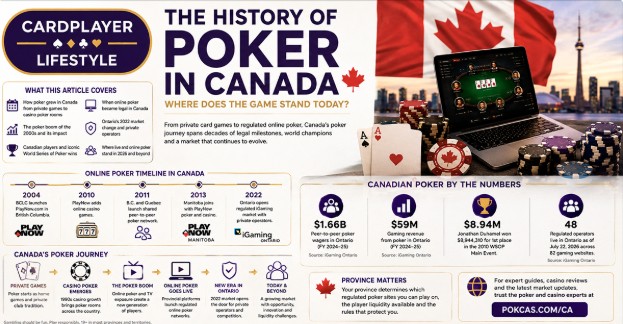
The early regulated timeline looked like this:
Year | Development |
| 2004 | BCLC launches PlayNow.com in British Columbia |
| 2010 | PlayNow adds online casino games |
| 2011 | B.C. and Quebec begin sharing a regulated peer-to-peer poker network |
| 2013 | Manitoba launches PlayNow with online poker |
| 2022 | Ontario opens its regulated competitive iGaming market |
BCLC confirms that regulated online gambling had been available in British Columbia since 2004 and that shared poker with Loto-Québec began in 2011.
2013: Manitoba Joins the Online Poker Network
Manitoba became the next important piece on January 23, 2013, when Manitoba Liquor & Lotteries launched a BCLC-powered version of PlayNow.
The platform offered sports betting, casino games and poker. More importantly for poker players, Manitoba joined the existing shared poker network rather than operating an isolated set of tables.
Canada therefore had regulated, multi-province online poker almost a decade before Ontario opened its private iGaming market.
The Offshore Poker Years
Provincial poker sites were only part of the story.
International poker rooms continued serving Canadian players, creating what was commonly called a grey market. The situation was quite different from having an operator licensed and regulated directly by a Canadian province.
That distinction still matters. BCLC, for example, states that PlayNow is the only online gambling website permitted to operate in British Columbia.
For players, the appeal of international poker rooms was obvious: larger player pools, more tournaments and more games running throughout the day. For regulators, those same sites raised questions around oversight, consumer protection and where gambling revenue was going.
Ontario Changes the Market in 2022
April 4, 2022 created a new model for Canadian online gambling.
Ontario opened a regulated competitive iGaming market where approved private operators could legally participate under agreements with iGaming Ontario. The market launched with 12 operators and expanded to 46 by the end of its first fiscal year.
Poker was part of that market from the beginning.
Private Operators Enter Regulated Online Poker
Ontario players suddenly had something Canadians in most other provinces didn’t: a choice between multiple provincially regulated private operators.
The poker numbers show that there was real demand. In its first fiscal year, Ontario’s regulated peer-to-peer poker market generated $37 million in gaming revenue.
By fiscal 2024–25, poker players wagered roughly $1.66 billion, producing about $59 million in gaming revenue according to iGaming Ontario’s audited annual report.
That still makes poker small beside online casino gaming, but it is hardly a niche experiment. iGaming Ontario has described its market as having the largest per-capita peer-to-peer poker market in North America.
Live Poker Is Still a Big Part of the Game
Online poker never replaced sitting across from another player.
Canada still has established casino poker scenes, particularly around major population centres in Ontario, Quebec as well as in Alberta and British Columbia. Live poker offers something software can’t completely reproduce: physical tells, table conversation, dealer interaction and the pressure of making a decision with everyone watching.
The two formats now serve different purposes. Online players can fit far more hands into an hour and play from home. Live players get a slower, more social version of the game.
For many Canadian players, there is no reason to choose one permanently. They move between both.
What Online Poker in Canada Looks Like Today
Canada in 2026 still doesn’t have one national regulated online poker market.
Ontario has its competitive regulated iGaming system. British Columbia maintains its provincially operated PlayNow model. Other provincial markets follow their own approaches, while international operators remain part of the wider Canadian poker conversation.
Ontario’s numbers show just how established regulated online poker has become. Peer-to-peer poker generated around $1.7 billion in wagers during fiscal 2024–25, up approximately 2% from the previous year.
When looking at where to play today, Canadian players therefore need to check more than the poker room itself:
- Start with the province. The regulated options available in Ontario are not necessarily the same as those available in British Columbia.
- Check who regulates the platform. A Canadian-facing website and a provincially regulated operator are not automatically the same thing.
- Look at player liquidity. More active players generally mean more tables, tournament choices and available stakes.
- Compare the actual games. Cash-game traffic, tournament schedules and rake can matter more than a large signup offer.
Why Your Province Still Matters
Geography can directly determine what regulated poker products you can access.
In British Columbia, for example, PlayNow’s player agreement requires users to be B.C. residents and physically located in the province when wagering.
Ontario operates under a different regulatory structure built around competing private operators.
That provincial divide is arguably the defining feature of Canadian online poker today. Two Canadian players living a few hundred kilometres apart can face very different regulated markets.
Where Canadian Poker Goes From Here
The next big question is liquidity.
Ontario has proven that a ring-fenced market can sustain substantial poker activity. In fiscal 2023–24, five operators generated more than $1.5 billion in peer-to-peer poker wagers, making Ontario the largest ring-fenced online poker market in North America by gaming revenue at the time.
But poker becomes more attractive when there are more people to play against. That creates a natural tension between keeping players inside provincial regulatory boundaries and giving poker rooms access to deeper player pools.
Canada has already moved through private games, casino poker rooms, the online boom, provincially operated poker and Ontario’s competitive model. The next chapter may be less about whether Canadians can play online and more about who they are eventually allowed to sit down and play against.