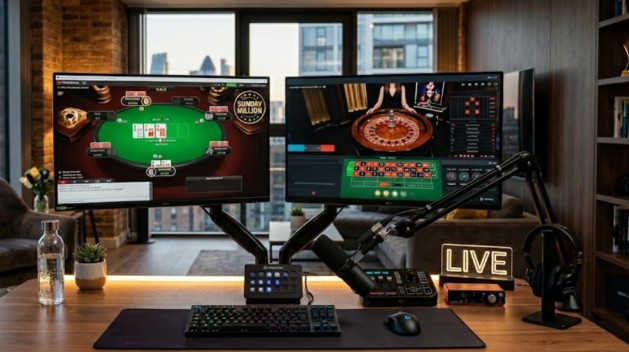
Poker used to reward gut feel and table chatter. Now it rewards prep. The edge often shows up before the first hand is dealt, in your database, your solver work and the site you choose to play on. Sit down unprepared and you are already behind.
Online poker did not start with solvers. It started with chat boxes, forums and people arguing about whether Ace-King is a drawing hand. Back then, edge came from feel. Today, you open a laptop and you are staring at hand histories, HUD stats and solver outputs before you even click “join table.” The game looks the same on the surface. Underneath, it runs on data.

From Forum Tables to Early Online Communities
Before tracking software became normal, poker players learned from each other. Online forums replaced cardroom railbirds. Annual gatherings such as BARGE, which began in the early 1990s through the rec.gambling newsgroups, show what that era looked like. Players met in person, shared stories and tested ideas at the table.
Strategy lived in discussion threads and handwritten notes. You adjusted because someone seemed aggressive, not because a HUD showed a 32% VPIP. There were no solver charts to download. You watched showdowns and made mental notes. That culture built strong instincts, but it was still guesswork compared to what you have now.
Participation Numbers Show a More Competitive Pool
The player pool today is larger and sharper. In the UK, online poker participation moved from 5% in 2021 to 10% in 2024. That is a doubling in three years. You are not battling the same casual mix that logged on during the early boom.
The age split is tight. 44% of online poker players are aged 35 to 54. 43% fall between 18 and 34. But gender based, this is a male-dominated game. More than 75% of players are male.
Staking patterns tell another story. 57% of players wager between £1 and £100 per month. 28% stake between £101 and £500. 15% are above £500 monthly. A meaningful slice of the field is putting serious money into the game.
Solvers, AI and the Benchmarking of Decision Quality
Modern study is built around measurable decision quality. The PokerBench project created a dataset of roughly 11,000 critical poker scenarios covering pre-flop and post-flop spots. Large language models were tested on these spots. Base versions underperformed against optimal solutions. After fine-tuning, performance improved and correlated with stronger simulated win rates.
That matters for you at the table. Strategy is no longer judged by opinion. It is judged by alignment with equilibrium outputs. You run a hand through a solver and compare your line with an optimal baseline. Deviations are not philosophical debates. They are percentages.
AI research has moved from novelty to benchmarking tool. Even when models fall short, the exercise sets a standard. The gap between instinct and theory becomes visible. That visibility changes the way players prepare.
Where Casino Ecosystems Intersect With Modern Poker Study
Edge today includes platform selection. Rake structures, traffic levels and bonus mechanics all influence long-term results. Canadian players researching options often consult Online Casino Canada to compare regulated platforms, promotional structures and payment frameworks before committing to a site. Serious players also pay attention to licensing details, withdrawal timelines and regional availability. That extra layer of research reduces friction once you are playing real money games. You are not scrambling to check terms mid-session. The groundwork is done, and that stability supports sharper focus when decisions start to stack up.
That behaviour ties into strategy. A softer player pool at one site can outweigh a marginal rake difference elsewhere. A reload bonus can offset variance during a downswing. Game selection tools become part of your preparation, not an afterthought. Data-driven poker extends beyond hand charts. It includes informed choices about where you sit.
Strategic Study in the Modern Era
Study culture now looks organised. Players review hand histories, filter databases and drill specific positions. Dedicated strategy hubs collect analysis, coaching material and tactical breakdowns in one place. That reflects the way preparation has changed.
You do not rely on memory alone. You tag hands. You calculate frequencies. You compare river lines against solver outputs. The gap between amateur and serious regular often shows up in study discipline, not table talk. In terms of study and preparation, Poker these days have more in common with chess than with just “playing the luck of the draw”.
However, online poker still rewards feel. Reads still exist. Live tells still matter in mixed formats. Yet the backbone of modern strategy is numerical. Participation rates have doubled in key markets. 15% of players are staking more than £500 per month. Research datasets include 11,000 defined decision points. Those are hard numbers.
When you sit down now, you are stepping into a game shaped by tracking software, equilibrium models and benchmarking studies.
The cards have not changed.
The way people prepare for them has.