A deck of 52 cards can produce hundreds of different games. Some take years to master. Others can be learned in the time it takes a dealer to shuffle. Yet the most popular card games tend to share one quality: their rules are simple enough to attract newcomers, while the experience gives people a reason to return.
Poker rewards patience, observation, and calculated decisions. Blackjack asks players to make mathematical choices against a dealer. Baccarat removes most of those decisions, leaving the outcome to the cards. Each game attracts a different type of player.
Understanding those differences makes it easier to appreciate why certain card games have remained popular for generations.
Poker: The Card Game That Rewards Better Decisions
Poker occupies a special place among card games because players compete against one another rather than simply trying to beat the house. The casino typically collects a fee or rake, but the money at stake comes from other players.
That distinction changes everything.
A strong poker player needs more than good cards. Position, betting patterns, stack sizes, and opponents’ tendencies all influence the value of a hand. Sometimes the best decision is to fold a promising hand. Other times, an aggressive bet can win a pot without a showdown.
Texas Hold’em
Texas Hold’em remains the dominant format in major poker tournaments and many cash games.
Each player receives two private cards. Five community cards appear across the flop, turn, and river, with betting rounds separating the action. Players make their best five-card hand using any combination of their private cards and the board.
The rules are easy to explain, but the decisions become complicated quickly.
Consider a player holding A♠ K♠ on a board of K♦ 9♠ 6♠. They have top pair and a flush draw, but their next move depends on the opponent, the betting action, and the effective stack sizes.
There is no automatic answer that works against every opponent.
This depth helps explain why Hold’em attracts both recreational players and professionals.
Omaha
Omaha uses four private cards instead of two. Players must use exactly two cards from their hand and three from the community board.
The additional cards create more possible combinations, stronger draws, and frequent confrontations between powerful hands.
A hand that looks excellent in Hold’em may be vulnerable in Omaha. Top two pair, for example, can lose considerable value on a coordinated board.
Pot Limit Omaha is particularly popular among experienced players who enjoy complex post-flop situations and action-heavy games.
Dragon Tiger: The Fastest Route to a Card Showdown
Not every popular card game needs multiple betting rounds or complex hand rankings.
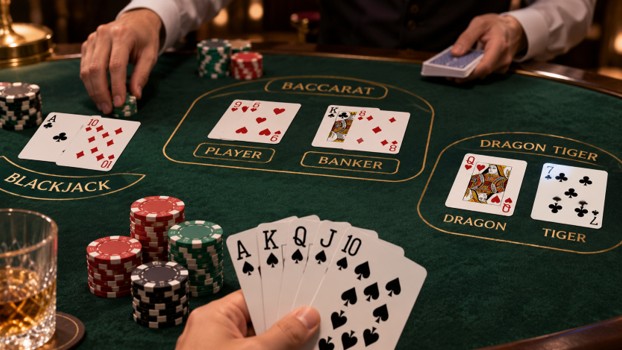
Dragon Tiger reduces the contest to two cards. One card is dealt to Dragon and another to Tiger. The higher card wins, while equal ranks produce a Tie.
The game is especially familiar in Asian casino markets and appears in various live dealer and online formats.
Someone exploring a dragon tiger real cash game will find a much simpler betting structure than poker or blackjack. There are no decisions to hit, fold, or raise after the cards are revealed. The entire round is determined by the initial wager and the two cards.
Understanding the Odds
Standard Dragon Tiger is commonly played with eight decks, although rules can differ between operators.
A common version pays even money on Dragon or Tiger, with half the original stake lost when the cards tie. Under those rules, the house edge on Dragon and Tiger is approximately 3.73%.
Other versions treat a Tie as a full loss or offer different Tie payouts. These changes affect the expected return.
The Tie bet may appear attractive because of its larger potential payout, but the payout must be compared with the probability of matching ranks.
The game offers speed and simplicity rather than meaningful strategic depth. Players who enjoy calculating ranges or studying opponents will find little of that experience here.
Blackjack: A Different Kind of Card Strategy
Blackjack replaces poker’s psychological battles with decisions based largely on probability.
The objective is to finish with a hand closer to 21 than the dealer’s without exceeding that total. Players decide whether to hit, stand, double down, or split pairs according to their cards and the dealer’s visible card.
Unlike poker, blackjack offers no opportunity to bluff. The dealer follows fixed rules, and opponents’ behavior has no direct influence on the outcome of an individual hand, although their decisions can change which cards are dealt next.
Why Basic Strategy Matters
Suppose a player has a hard 16 against a dealer’s 10. Standing feels safer because hitting could cause an immediate bust.
However, standard basic strategy generally recommends hitting in this situation when surrender is unavailable, assuming an ordinary multi-deck game with no relevant deviations.
The recommendation does not mean hitting will win the hand. It means that, over many comparable situations, the decision produces a better expected result than standing.
This distinction is central to blackjack.
Good decisions can still lose, and poor decisions can occasionally win. The quality of a decision should be judged by its expected outcome, not by the result of one hand.
Blackjack rules also matter. A table paying 6:5 for a natural blackjack is less favorable than an otherwise identical table paying 3:2. That difference alone adds roughly 1.4 percentage points to the house edge.
For poker players accustomed to calculating pot odds and expected value, blackjack offers a familiar mathematical challenge in a different setting.
Baccarat: Simple Rules, Serious Stakes
Baccarat has traditionally been associated with high-limit casino rooms, but its basic rules are among the simplest in casino gaming.
Players wager on the Player hand, the Banker hand, or a Tie. The dealer then distributes the cards and follows predetermined drawing rules.
Neither side represents the person placing the bet. Player and Banker are simply the names of the two hands.
The hand closest to nine wins. Cards from two through nine retain their face values, aces count as one, and tens and face cards count as zero. Only the final digit of the total matters.
For example, a seven and an eight produce a total of five rather than fifteen.
Why the Banker Bet Is Usually Preferred
In traditional commission baccarat, the Banker bet has a house edge of approximately 1.06%, compared with approximately 1.24% for Player.
The Tie bet is considerably less favorable, with a house edge of roughly 14.36% in a standard eight-deck game paying 8:1.
Those figures depend on the rules and payouts, but they explain why experienced baccarat players often avoid the Tie.
Baccarat also illustrates an important limitation of simple casino games: players have almost no control over the outcome once a wager is placed.
A record of previous Banker and Player results may be interesting to follow, but it cannot reliably predict the next hand.
Three-Card Poker: Familiar Hands, Different Mathematics
Three-Card Poker combines recognizable poker hand rankings with the structure of a casino table game.
Instead of competing against other players, participants try to beat the dealer with a three-card hand.
In the common Ante and Play format, a player places an Ante wager and receives three cards. After examining the hand, they either fold or make a Play wager equal to the Ante.
The dealer typically needs queen-high or better to qualify.
The ranking system also differs from traditional five-card poker. In Three-Card Poker, a straight beats a flush because there are fewer possible three-card straights than three-card flushes.
This small change can surprise experienced Hold’em players.
Is Three-Card Poker a Skill Game?
There is an optimal decision rule for the standard Ante and Play game: continue with Q-6-4 or better and fold weaker hands.
That strategy helps reduce unnecessary losses, but it does not remove the casino’s mathematical advantage.
Three-Card Poker therefore sits between blackjack and baccarat in terms of player involvement. Players make a meaningful decision, but the scope for long-term strategic improvement is limited.
Rummy: Card Strategy Without a Casino Dealer
Rummy represents another side of card gaming.
Rather than trying to beat a dealer or assemble poker hands, players collect combinations of matching ranks and consecutive cards of the same suit.
The objective depends on the variation, but most forms involve creating sets and runs while reducing the value of unmatched cards.
Rummy has many regional versions, including Gin Rummy and Indian Rummy.
Why Hand Management Matters
Rummy rewards careful decisions about which cards to keep and discard.
Holding several promising combinations may seem sensible, but every retained card creates an opportunity cost.
A player waiting for one particular card might ignore a stronger alternative that becomes available through the discard pile.
Observing opponents’ discards also provides information about their likely hands. Unlike baccarat or Dragon Tiger, the game allows players to adapt their decisions as the round develops.
These features make Rummy particularly appealing to people who enjoy hand management and memory-based strategy.
Bridge: The Partnership Game With Extraordinary Depth
Bridge rarely receives the same attention as poker in casino discussions, yet it remains one of the most demanding traditional card games.
Four players form two partnerships. Each receives thirteen cards, and the game revolves around bidding and trick-taking.
The bidding phase communicates information about hand strength and suit distribution. During play, partners must work together to fulfill their contract or prevent the opposing pair from succeeding.
Successful bridge players combine probability, memory, inference, and communication through an established bidding system.
A small error in bidding can create a difficult contract. A single poorly timed play can turn an otherwise successful hand into a loss.
Bridge also demonstrates that competitive card gaming does not require financial stakes to create pressure. Tournament scoring and partnership responsibility provide plenty of tension on their own.
Comparing 8 Popular Card Games
Although these games all use playing cards, they demand very different skills.
| Game | Main Challenge | Player Decisions | Main Opponent |
| Texas Hold’em | Reading ranges and managing bets | Extensive | Other players |
| Omaha | Evaluating draws and strong hands | Extensive | Other players |
| Blackjack | Applying mathematical strategy | Moderate | Casino dealer |
| Baccarat | Choosing a wager | Minimal | Casino |
| Dragon Tiger | Choosing a wager | Minimal | Casino |
| Three-Card Poker | Deciding whether to play or fold | Limited | Casino dealer |
| Rummy | Building combinations | Extensive | Other players |
| Bridge | Bidding and partnership play | Extensive | Opposing partnership |
The most important distinction is between games where decisions can create a lasting advantage over weaker opponents and games where fixed house rules determine the expected return.
Poker, Rummy, and Bridge reward experience in ways that Baccarat and Dragon Tiger generally cannot.
Blackjack occupies an interesting middle ground. Strategy has a measurable effect on results, but ordinary basic strategy does not eliminate the house edge under typical casino rules.
Why Some Card Games Stay Popular for Generations
A game’s popularity cannot be explained by its rules alone.
Poker benefits from its social dimension. Every opponent introduces a new problem, and the same starting hand can create completely different situations from one session to another.
Blackjack appeals to players who prefer structured decisions. There is satisfaction in learning a strategy and applying it consistently.
Baccarat and Dragon Tiger offer a different experience. They require little preparation, their outcomes are resolved quickly, and newcomers can understand what is happening without studying complicated rules.
Rummy and Bridge thrive through personal interaction. They can be played at home, in clubs, or in organized competitions, often creating long-standing communities.
Online platforms have made many of these games more accessible, but technology has not erased their differences. A live dealer stream may reproduce the atmosphere of a casino table, yet the mathematics and decision-making remain largely unchanged.
Which Card Game Is Worth Learning?
For someone interested in strategic improvement, poker offers an unusually deep learning curve. Hand reading, position, bet sizing, and tournament theory provide years of material to explore.
Blackjack is a more structured starting point for studying probability. Its decisions can be learned through basic strategy charts, and mistakes can often be identified objectively.
Rummy and Bridge are excellent choices for players who enjoy competition without relying on casino wagering. Both reward experience, concentration, and the ability to interpret incomplete information.
Baccarat and Dragon Tiger are easier to learn, but that simplicity comes with limited control over results.
The right choice depends on what someone wants from a deck of cards. Some people enjoy solving difficult problems. Others prefer a quick game with friends or the atmosphere of a casino table.
A 52-card deck can accommodate all of those preferences. The experience changes dramatically depending on how the cards are dealt, what decisions are available, and who sits on the other side of the table.