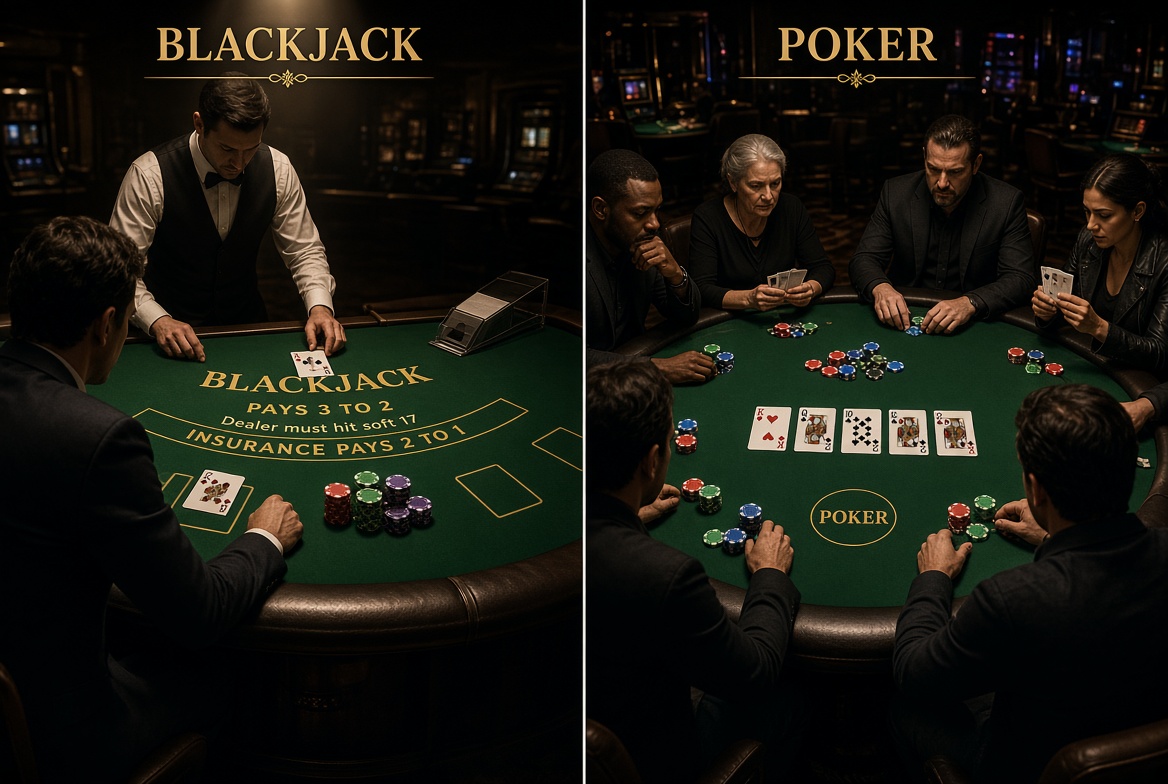
At first glance, blackjack looks similar to poker in a lot of ways. Players are each dealt two individual cards as a starting hand and bet chips as they attempt to win the hand. However, that’s about as far as the similarities go. Blackjack is a casino table game played against the house, and it has very different rules to poker.
But what skills actually carry over between one game and the other, and how easy is it for poker players to pick up blackjack?
Both are Found at Casinos and Online Sites
For poker players who are looking to branch out into blackjack, you won’t have to look far. Blackjack is a popular table game that is widely available at casinos.
You can also play online casino blackjack with Bitcoin at popular sites, allowing you to deposit using cryptocurrency or other transaction methods. Online platforms offer a much wider variety of games and rulesets, so you’ll be able to pick out the highest value tables or play your favorite type of blackjack.
Making the transition from one game to the other is easy and, you’ll be glad to know, some of the skills you already have as a poker player will apply to the blackjack tables.
Awareness of Probability
Both poker and blackjack involve an awareness of probability and odds. In poker, for example, you have to weigh up the price of making a call against the odds of winning a hand. Every decision involves probability, so players become accustomed to thinking this way.
This skill carries over well to blackjack, which also involves probability as part of the decision making process. In blackjack, you have to decide whether to Hit or Stand, or sometimes Double or Split if the situation allows it.
The strength of your own hand is weighed against the dealer’s visible upcard to work out the probability of winning by standing compared to the risk of taking another card.
In blackjack, however, the probabilities and solutions are simple enough that you can learn basic strategy by using blackjack charts, which outline what move to make. Memorizing these charts is all it takes to perfect the game.
Decision Making Under Pressure
In both poker and blackjack, you’ll sit down at a casino table, or online table, and be dealt into the game. As a player, it’s up to you to keep up with the flow and not cause any unnecessary delays. This creates extra time pressure, as all decisions have to be made in time on your turn to act.
In poker, players sometimes have time banks which determine exactly how much time is left to act. This is nearly always the case when you play online poker. In other cases, there’s no formal time bank, but other players can call the clock if they feel like you are taking too long.
In blackjack, the dealer will go around the table asking each player how they want to act. On your turn, you have to be ready to make your move so that you don’t hold up the game.
Bankroll Management
Bankroll management is an essential part of a serious player’s approach to any casino game. The premise is simple enough. First, you want to set aside funds that you will use exclusively for playing your chosen game. This should be money that you can comfortably afford to play with.
Then, with your bankroll set aside, you should play at stakes that are well within your limits. For example, if you have a bankroll of $100, it’s much better to play $1 stakes 100 times than it is to risk the lot in one or two games.
Taking a slow and steady approach helps to smooth out variance and gives you much more playtime. For winning poker players, bankroll management is a way of drastically reducing the chances of going broke, especially by moving up and down in stakes as your bankroll allows.
Although the house has a small edge in blackjack, the same philosophy of bankroll management still applies. Set aside your funds and play at very low stakes compared to your overall bankroll so that you can play hundreds of hands. This allows you to practice and perfect basic blackjack strategy, extends playtime, and keeps the game enjoyable.
Emotional Control
Poker requires an immense amount of emotional control so that you can play for hours without losing your cool and making subpar decisions. It’s all good knowing the best moves to make, but it’s another task altogether applying what you know at the tables in the moment, especially when bad beats happen or you start running bad.
Every poker player knows the feeling of going on ‘tilt’ and losing control of their emotions, and how quickly this can lead to losing massive amounts of chips.
Blackjack also requires emotional control so that you can stick to the basic strategy and make the correct move according to your hand and the dealer’s upcard. You don’t want to be acting on ‘intuition’ or making bad moves because you’re angry or tired. Keep it chill.
Emotional control is also very important for bankroll management. The worst thing you can do when you’re on tilt is start firing up more games or, worse still, move up in stakes.
What Skills Aren’t Needed in Blackjack
There are many skills that poker players have to learn if they want to establish themselves as top tier players, such as hand reading, bet sizing, and bluffing opponents off their cards. These skills are not needed in blackjack, because you’re not competing against the other players at the table.
In blackjack, you only have to be concerned with the dealer’s upcard, so there’s no need for any hand reading or psychoanalysis of opponents. The dealer also has certain rules that they must follow, such as standing on 17, so their play is already pretty much defined.
In blackjack, the optimal play is purely odds based and static. All you have to do is learn basic strategy and apply it correctly.
For poker players, this is part of the appeal of other card games like blackjack. It’s more of a relaxed game with less mental load. At the same time, skills like probability and bankroll management carry over, making it easy for poker players to make the transition.