Every time a poker player slides chips into the pot, they leak valuable information. In both online software and live card rooms, the wager size acts as an unencrypted map of actual hand strength. If you learn to decode these patterns, you can read cards before the showdown. This technical guide breaks down the mathematical imbalances and timing tells that expose what your opponents hold.
To exploit these leaks, you must first understand range elasticity. An elastic range means a player changes their calling frequency based on the wager size. For example, they might call a $20 raise but fold to an $80 raise. This dynamic is completely different from practicing strategy on a free play platform or a casual Social Casino where real money pressure is absent. In real games, knowing when your opponent has an inelastic range allows you to maximize profits. If they call with any draw, wager larger to charge them a premium.

Online Imbalances and Timing Tells
In the digital arena, you cannot see your opponent’s face. However, HUDs and other poker software provide precise statistics like Fold to Flop C-bet and Went to Showdown (WTSD%) alongside clear timing patterns. Many players rely on automatic habits that betray their actual holdings. By watching how fast they act and how much they choose to wager, you can pinpoint specific logical errors.
These online cues are highly reliable because players often play on autopilot. When you notice these three common sizing mistakes, you can immediately exploit them.
- Pre-flop open-raise spikes: When a weak player who usually opens to 3BB suddenly raises to 5 or 6BB, they are trying to protect a vulnerable pocket pair like tens or jacks.
- The automatic snap-conbet: A lightning-fast continuation bet on the flop often indicates an automated action. This represents a wide range of bluffs rather than a carefully planned value wager.
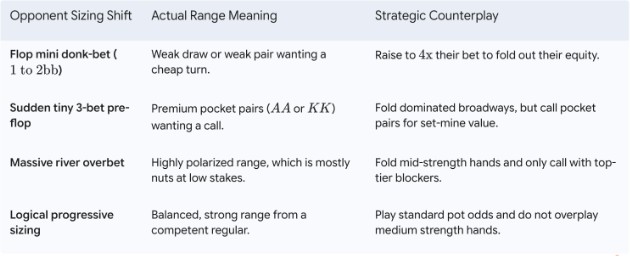
- Small flop donk-bets: When a rival leads out for just 1-2BB into a large pot, they want to buy a cheap turn card. You should treat this as a sign of weakness and raise them.
Reading the Physical Game in Live Poker
Live games introduce physical mechanics that do not exist online. Players must physically count their chips, which introduces psychological friction and stress. This physical aspect often leads to subconscious sizing decisions. Observing chip handling reveals underlying structural intentions.
Physical tell indicators require close attention because players cannot hide their manual actions. Watch for these three behavioral patterns during live cash games. Whether you’re an experienced player or completing your Win Bonanza signup, understanding these live poker dynamics can provide a valuable edge at the table.
- The comfortable chip syndrome: Average players often bet round amounts that are easy to grab. They might throw a single green $25 chip instead of counting a precise $18 wager. If someone spends a long time counting exact change, they are usually trying to price their wager perfectly for thin value.
- The tiny river value block: Older, conservative players often make exceptionally small wagers on the river when a draw completes. They are terrified of being raised but still want a small payout.
- Post-tilt overbets: A player who recently suffered a bad beat will often make massive raises to force folds. They are trying to win back their losses.
Strategic Cheat Sheet for Exploiting Sizing Shifts
Adjusting your strategy requires watching how your opponents size their raises across multiple streets. A standard competitor scales bets logically from $33 on the flop to $75 on the river. Any sudden deviation from this progressive path represents an exploit opportunity.
To help you make quick decisions at the tables, use this practical guide to common sizing anomalies. It outlines the logical meaning behind each play and the correct counter-strategy.