ICM is one of those concepts every serious tournament poker player knows they need to understand, but far fewer actually feel comfortable applying at the tables.
It’s easy to grasp the basic idea: tournament chips don’t have a fixed monetary value, and the closer you get to meaningful pay jumps, the more the value of your stack changes. The difficult part is translating that knowledge into actual decisions.
How wide should you be calling? When does a big stack get to apply pressure? How much should a short stack tighten up? And, perhaps most importantly, how do you recognize these spots without having to run a simulation every time?
That’s where Alex Theologis’ new Run It Once course Practical ICM Mastery comes in.
Rather than treating ICM as an abstract mathematical concept, Theologis takes a highly practical approach, using Holdem Resources Calculator (HRC), real tournament hands, different stack configurations, and a progression through the various stages of a tournament to show how ICM should influence your decisions.
Practical ICM Mastery at a Glance: What’s Inside?
The course begins with the fundamentals before gradually moving into increasingly complicated tournament situations. Theologis first introduces his approach to ICM and explains why he believes a practical understanding is so important.
From there, he introduces HRC, one of the key tools used throughout the course, before diving into risk premiums and how they shape tournament strategy.
The course then progresses chronologically through a tournament, covering:
- Early-stage ICM
- Mid-stage ICM
- Late registration decisions
- Near-bubble play
- Stone-bubble situations
- Post-bubble ICM
- Pre-final-table play
- Final-table ICM
- Blind-vs-blind situations
A strength of the structure is that Theologis doesn’t simply tell you that ICM becomes more important near the bubble or final table. He demonstrates why it changes, what drives those changes, and how the strategy should adapt.
That makes the material much easier to translate into your own tournament play.
New ICM course Practical ICM Mastery out now on @RunItOnce
The course features :
● 25+ hours of content
● Preflop and postflop ICM
● Real hand examples from every stage of the tournament
● Practical work with tools like HRC
● Private discord, ICM quiz and more! pic.twitter.com/KQ9qCq6b0i— Alex Theologis / Pwndidi (@AlexPwndidi) August 31, 2026
Understanding Risk Premium Is the Key
If there’s one concept that repeatedly comes up throughout Practical ICM Mastery, it’s risk premium.
For tournament players who have mostly approached poker through a chipEV lens, risk premium can be one of the biggest adjustments to make.
In cash games, if you have a profitable chipEV call, there’s generally no reason to worry about the fact that losing those chips could have consequences further down the line. Tournament poker is different.
Every chip you lose can have a different impact on your tournament equity than every chip you gain.
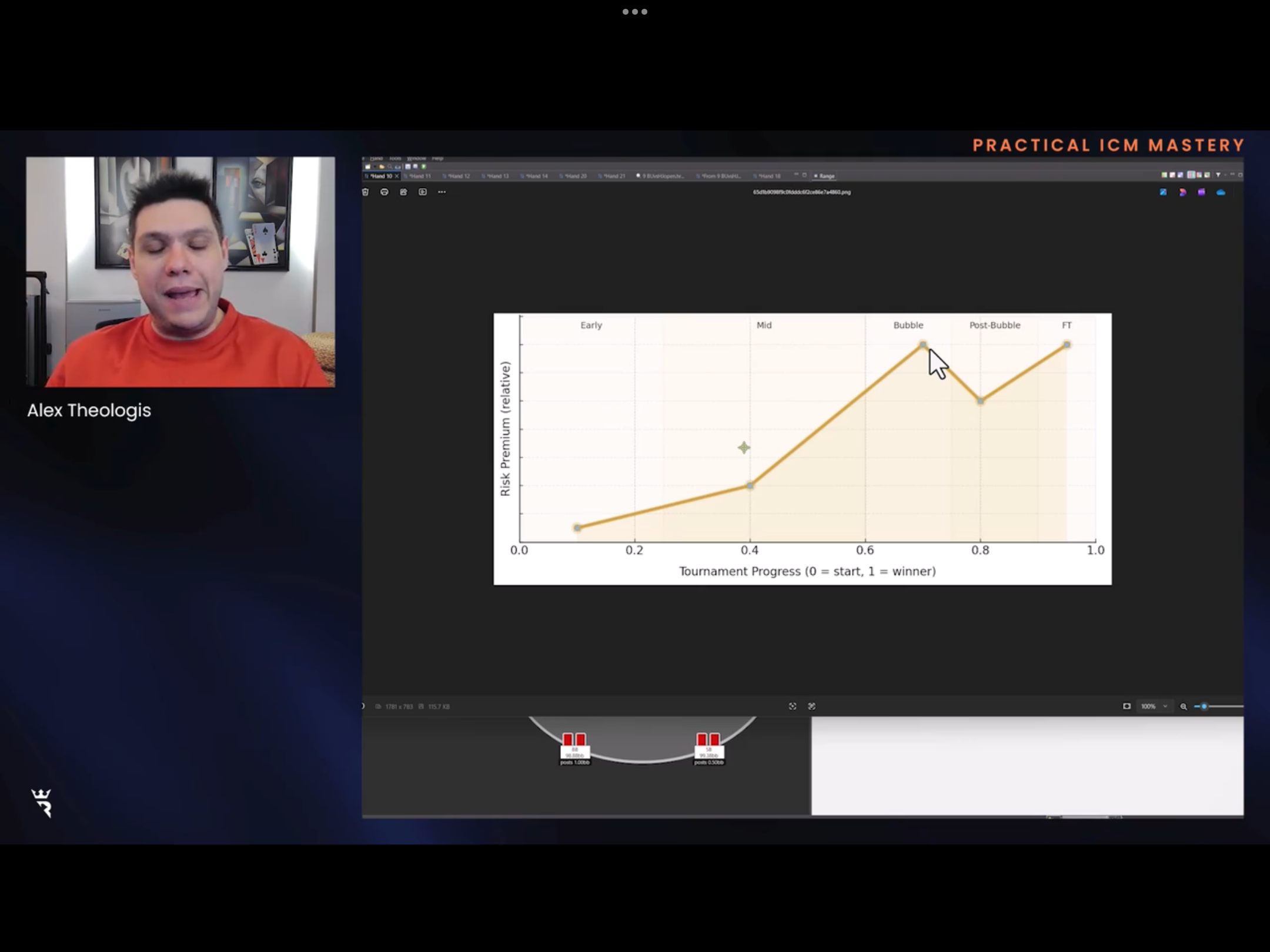
Theologis spends time breaking down this relationship between risk premium and stack sizes, showing how seemingly small changes in the tournament environment can dramatically affect optimal strategy.
Once you understand how stack sizes around you affect your risk premium, you can start identifying patterns instead of treating every ICM spot as an entirely new puzzle.
From ChipEV to ICM: Where the Differences Begin
One particularly useful aspect of the course is that Theologis starts looking at ICM before the bubble, when the differences between chipEV and ICM strategy are often much less dramatic.
In the early stages of a tournament, things can look remarkably similar to standard chipEV poker. But that doesn’t mean ICM is completely irrelevant.
Theologis first uses imaginary scenarios to demonstrate where those differences begin to appear before moving into real tournament hands.
This is a smart way to introduce the concept because it gives you a controlled environment first. You can understand the theoretical difference before seeing it play out in an actual hand.
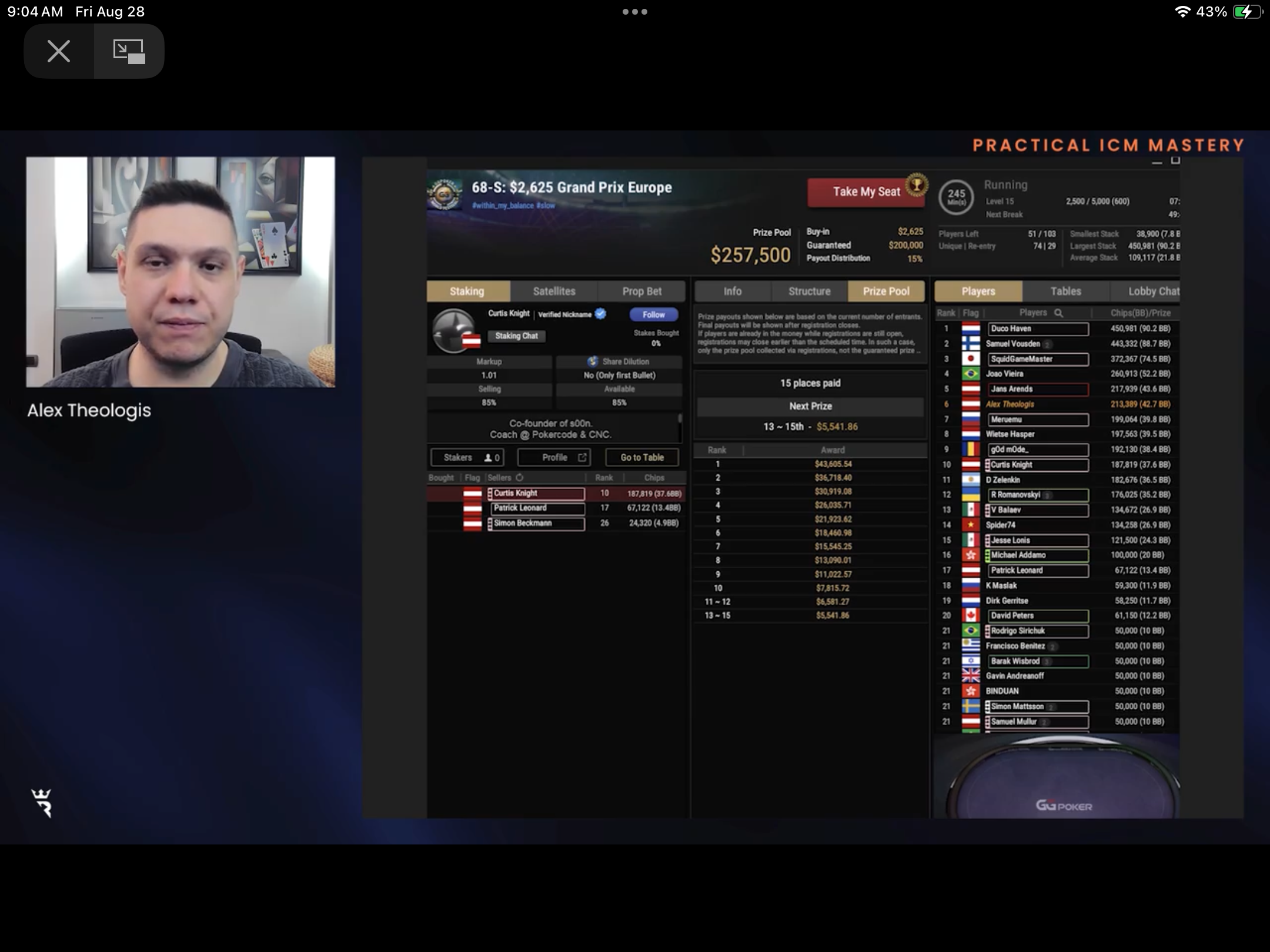
Once you get to the real examples, the practical implications become much clearer.
You’re no longer simply thinking, “This is an ICM spot.”
Instead, you can start asking the more useful questions:
“What are the stack sizes? What is my risk premium? Who is under pressure? Who can apply pressure? How does the tournament stage change the value of taking this particular risk?”
Those are the questions that ultimately lead to better decisions.
Mid-Stage ICM and the Late-Registration Question
The course then moves into the middle stages of tournaments, including a section dedicated to maximum late registration.
Late registration has become an increasingly important strategic consideration in modern tournament poker. Players routinely debate whether entering at the last possible moment is optimal, and there are legitimate arguments on both sides.
Theologis looks at why max late registration can make sense while also highlighting its drawbacks.
That’s a particularly useful inclusion because it demonstrates that ICM isn’t simply about what happens once you’re approaching the money. Tournament strategy starts being influenced by stack distribution and tournament structure much earlier.
From there, Theologis turns to real hands from the middle stages, focusing on tournaments where late registration has closed and roughly 15–20% of the field remains.
This provides another natural progression: from understanding the concept, to recognizing it in theoretical scenarios, to applying it to real hands.
Bubble Play: Where ICM Really Starts to Matter
Then comes the part of the course where things get considerably more interesting: the bubble.
Theologis divides bubble situations according to both field size and stack size, which is critical because there is no single “bubble strategy.”
A big stack approaching the bubble is in a completely different situation from a short stack. A medium stack faces an entirely different set of incentives.
The course examines big-field bubbles first, focusing on tournaments with 200 or more players, before moving into stone-bubble scenarios where the pressure becomes even more pronounced.
And this is where risk premiums really become impossible to ignore.
A player with a large stack can often put enormous pressure on opponents who cannot afford to bust. Meanwhile, shorter stacks have to be careful about taking risks that might be perfectly reasonable in chipEV terms but disastrous from a tournament-equity perspective.
The Stone Bubble Deserves Special Attention
The stone bubble section is particularly important because this is where ICM can become extreme.
Theologis explores these situations across different field sizes and stack configurations, using real hands from his own play to demonstrate how the theory translates into actual decisions.
A hand that looks like an obvious chipEV decision can suddenly become a fold.
Conversely, the player who understands the pressure being placed on everyone else can exploit those restrictions.
That makes the material far more valuable than simply memorizing a set of bubble charts.
Post-Bubble ICM: Don’t Switch Off Too Early
One mistake tournament players often make is treating the bubble bursting as the moment ICM pressure disappears.
Theologis dedicates a section to post-bubble play to demonstrate why that isn’t necessarily the case.
Once the bubble bursts, risk premiums generally decline, but the tournament isn’t suddenly back to pure chipEV.
There are still future pay jumps, varying stack sizes, and strategic consequences to consider.
The course looks at situations where players are still a significant distance from the final table and explains how the relationship between stack sizes and risk premiums changes during this period.
This is another example of the course’s practical philosophy: ICM isn’t an on/off switch.
Its influence changes continuously as the tournament progresses.
Pre-Final Table ICM
As the field gets smaller, the stakes get higher.
The pre-final table section examines situations with 2-3 tables remaining, where payout structures and stack distributions can create some extremely interesting risk premiums.
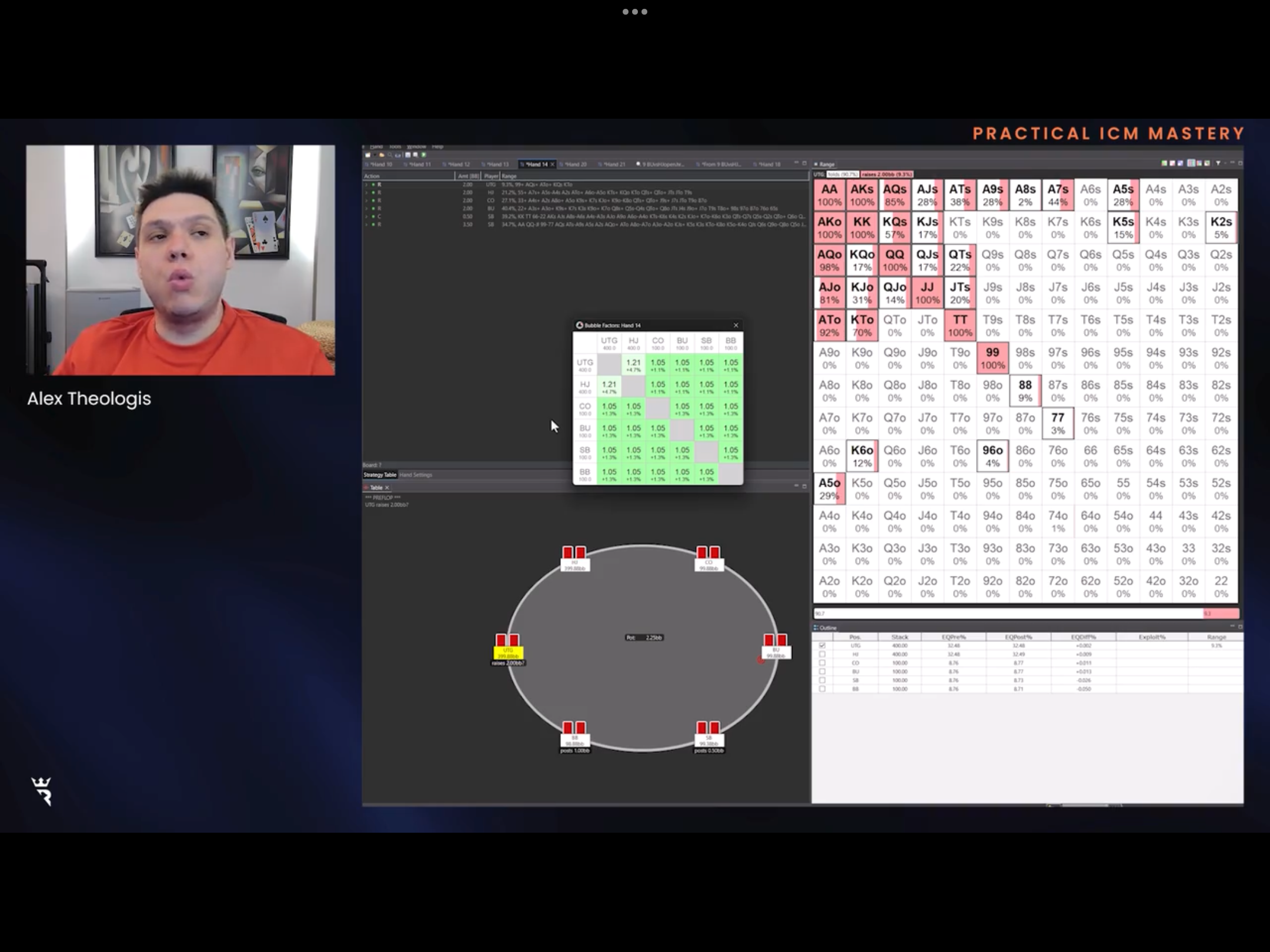
This is an especially important stage of the tournament because players are often close enough to the final table for the upcoming pay jumps to matter, while still being far enough away that there are plenty of decisions left to make.
Once again, stack size is important.
A large stack can have opportunities to accumulate chips that simply aren’t available to a short stack. Meanwhile, medium stacks can find themselves in uncomfortable positions where preserving their tournament equity becomes more important than chasing marginal chipEV gains.
Understanding those distinctions is exactly what ICM mastery is about.
Final Table ICM: Where the Magic Happens
At last, we reach the final table.
This is where ICM can have its biggest impact, and Theologis dedicates substantial attention to these situations.
The first final-table chapter focuses on blind-vs-blind situations with similar stacks.
From there, he moves into blind vs. blind (BvB) scenarios with dramatically different stack sizes, including hands played at high-stakes tournaments.
That progression is important because stack-size dynamics can completely transform what would otherwise look like identical situations.
The same applies when playing from the blinds against a raise. Theologis examines these spots with different stack configurations, allowing you to see how the underlying ICM considerations change depending on who has what to lose.
A Practical Approach to One of Poker’s Most Complicated Concepts
ICM has a reputation for being intimidating. There are calculators, simulations, equity distributions, risk premiums, stack configurations and payout structures to consider. What makes Practical ICM Mastery worth the price of admission ($999) is Alex Theologis doesn’t attempt to turn every tournament player into an ICM mathematician. Instead, he focuses on making the concepts usable.
The use of HRC gives players an opportunity to see the calculations behind the decisions, while the real-hand examples demonstrate how those calculations translate into actual tournament strategy.
Perhaps most importantly, the course is structured around the natural progression of a tournament.
That makes the course feel less like a collection of disconnected ICM lessons and more like a guided tour through tournament poker.
Most tournament players know what ICM is. Few truly understand how deeply it impacts their strategy.
Practical ICM Mastery is built to close that gap. pic.twitter.com/zMchIL4BsF
— Run It Once Training (@RunItOnce) August 26, 2026
The Bottom Line
If you play MTTs seriously, ICM isn’t something you can afford to treat as an optional piece of knowledge.
It affects how you call, how you raise, how aggressively you can apply pressure, how you defend your stack, and how you approach virtually every important stage of a tournament.
The challenge has always been turning the theory into something practical, and that’s exactly what Alex Theologis accomplishes with Practical ICM Mastery.