
In modern tournament poker, Game Theory Optimal (GTO) strategy has become the foundation for many players looking to improve. Solvers provide balanced ranges, mathematically sound decisions, and a blueprint for how poker “should” be played. But tournaments are not played in a vacuum. They are played against real opponents who make real mistakes. Many aren’t aware of GTO strategy at all. That is where exploitative play becomes one of the most powerful tools in your arsenal.
Exploitative poker is the art of deviating from theoretically sound play in order to take advantage of specific tendencies in your opponents. Whether it is a player who folds too often, calls too wide, or misplays certain stack depths, identifying and attacking these leaks can dramatically increase your win rate.
PokerCoaching.com offers a deep library of content focused on exactly this concept. Their coaches emphasize not just understanding GTO, but knowing when and how to deviate from it for maximum winning potential. Below are five standout videos that break down exploitative play across a variety of tournament situations, helping you recognize opportunities and adjust with confidence.

Attacking the Deficiencies of GTO Players – Justin Saliba
At first glance, it might seem counterintuitive to exploit players who are trying to play GTO. After all, if someone is perfectly balanced, there should be no weaknesses. Of course, no one is playing close to perfect, and certainly not in lower buy-in ranges.
Justin Saliba explains that many players who study solvers misunderstand or misapply the strategies. They may over bluff in certain spots, under defend in others, or fail to adjust to dynamic tournament conditions. These players often become predictable.

One of the key takeaways from this video is recognizing patterns in how players implement strategies. For example, some players continue to bet too frequently because they have learned that solvers encourage aggression, but they fail to adjust on boards that heavily favor the defender. Others may overfold to river aggression because they are trying to avoid making costly mistakes.
Saliba emphasizes that the goal is not to abandon theory, but to use it as a baseline. Once you understand what balanced play looks like, you can begin to identify where your opponents deviate and how to counter those deviations profitably.
WATCH: Attaching the Deficiencies of GTO Players by Justin Saliba
Shallow Stacks: Where the Money is Made – Ryan O’Donnell
Tournament poker often comes down to shallow stack play, and Ryan O’Donnell makes it clear this is where big edges are found. While many players rely heavily on push fold charts, O’Donnell shows that real world opponents frequently make significant mistakes in these spots.
A major focus of the video is how players mismanage risk. Some opponents become overly tight, folding too often in fear of busting, while others go to the opposite extreme and shove too wide without considering ICM pressure or opponent tendencies.

O’Donnell highlights how you can exploit these tendencies by adjusting your calling and shoving ranges. Against overly tight players, you can increase aggression and apply relentless pressure. Against players who over shove, you can tighten up and call more selectively with hands that dominate their range.
Another important concept is recognizing how stack sizes influence decision making beyond charts. Real players are affected by emotions, payout structures, and recent outcomes. Exploitative play at shallow depths is not just about math. It is about understanding human behavior under pressure.
WATCH: Shallow Stacks: Where the Money is Made by Ryan O’Donnell
How to Exploit the Biggest Mistakes at WSOP – Matt Affleck
The World Series of Poker attracts a wide range of players, from elite professionals to recreational amateurs. Matt Affleck uses this diverse player pool to highlight some of the most common and costly mistakes seen in large field tournaments.
One of the biggest leaks Affleck identifies is passivity. Many players, especially in high pressure environments like the WSOP, are hesitant to take aggressive lines without strong hands. These players don’t want to crawl home without anything to show for their big trip, right? This creates opportunities to apply pressure through well timed bluffs and aggressive betting strategies.

Affleck also discusses how players tend to misplay marginal hands. For example, they may call too often in spots where they should fold, or fold in situations where they are being priced in. These inconsistencies open the door for exploitative adjustments across all streets.
A particularly valuable takeaway is the importance of observation. Affleck stresses that exploitative play starts with paying attention, tracking how often opponents fold, how they respond to aggression, and how comfortable they are in different situations. The more information you gather, the more precise your exploits become.
WATCH: How to Exploit the Biggest Mistakes at WSOP by Matt Affleck
Girafanger7 Explains Exploits at Low Stakes – Bert Stevens
Low stakes tournaments are widely known for being some of the most profitable environments for exploitative play, and Bert Stevens, better known by his online poker moniker Girafanger7, breaks down exactly why. Unlike higher stakes fields, where players are more studied and balanced, low stakes games are filled with players who have clear and repeatable leaks.
Stevens explains that one of the biggest mistakes at low stakes is over calling. Many players simply do not like folding, especially when they have already invested chips in the pot. This tendency drastically reduces the effectiveness of bluff heavy strategies and shifts the focus toward value betting.

As a result, Stevens recommends a more straightforward exploitative approach. Bluff less, value bet more, and size your bets in a way that extracts maximum value from weaker holdings. Instead of trying to outplay opponents with complex lines, the goal is to capitalize on their unwillingness to fold.
Another key concept is targeting specific player types. Loose passive players, for example, can be exploited differently than aggressive regulars. Stevens emphasizes that exploitative poker is not one size fits all. It requires tailoring your strategy to the opponent in front of you.
WATCH: Girafanger7 Explains Exploits at Low Stakes by Bert Stevens
How to Crush Multiway Pots – Matt Affleck
Multiway pots are notoriously difficult to navigate from a theoretical perspective, which makes them a goldmine for exploitative play. Matt Affleck dives into these situations and shows how common mistakes become amplified when multiple players are involved.
One of the biggest issues in multiway pots is that players fail to adjust their ranges appropriately. Many continue to play as if they are heads up, leading to overly loose calls and poorly timed aggression. This creates opportunities for disciplined players to capitalize.

Affleck explains that in multiway scenarios, value hands increase in importance while bluffs lose effectiveness. Because there are more players who can call, the likelihood of someone having a strong hand goes up significantly. As a result, exploitative adjustments often involve tightening up and focusing on strong, equity driven holdings.
Additionally, Affleck highlights how players tend to misinterpret strength in multiway pots. A bet into multiple opponents is often much stronger than a bet in a heads up situation, yet many players fail to respect this. Recognizing these tendencies allows you to avoid costly mistakes while applying pressure in the right spots.
WATCH: How to Crush Multiway Pots by Matt Affleck
Turning Reads into Results
Exploitative play is where poker becomes less about memorization and more about understanding. While GTO provides the blueprint, it is exploitative adjustments that generate the highest returns in real world tournament environments.
The key is balance. You need a strong theoretical foundation to recognize what normal looks like, but you also need the awareness and confidence to deviate when your opponents give you a reason to. Whether it is attacking overly tight players, value betting against calling stations, or adjusting to multiway dynamics, every edge comes from identifying and exploiting mistakes.
PokerCoaching.com’s content excels at bridging this gap. By combining theory with practical application, their coaches provide a roadmap for turning observations into profitable decisions.
In tournaments, the players who win consistently are not just the ones who know the charts. They are the ones who know when to break them.
The World Poker Masters kicks off on May 3 with $25,000,000 in guaranteed prize pools across four weeks of tournament action until June 1, making it the largest online poker tournament series in CoinPoker’s history.
The schedule contains multiple million-dollar-guaranteed High Roller events, a new Sunday CoinMillion event, special PKO events with Patrick Leonard, CoinMasters Gold Weeks, and $500,000 worth of leaderboards.

World Poker Masters Begins Now
CoinPoker’s World Poker Masters begins on May 3, running across four weeks of action through June 1, the series features $25,000,000 in guaranteed prize pools.
The World Poker Masters schedule brings together major guaranteed tournaments, leaderboard competitions, and daily qualification opportunities through online satellites, creating the biggest event in the platform’s history.
Plenty of players have already announced their participation, including Bencb.
I am ready. https://t.co/w1wWvNrVFv
— bencb (@bencb789) April 28, 2026
CoinPoker’s application displays all of the World Poker Masters events, which have already started running.

$2.5 Million GTD Main Event
The World Poker Masters Main Event features a $2,500,000 guaranteed prize pool, with $530 Day 1 flights running every Sunday throughout the series.
Players can enter multiple flights, with only their best stack advancing to Day 2 on June 1, where the final field combines to play down to a winner.
Big Li took some time away from filming to express his excitement for the physical trophies from the event, and speculated about the materials used.
The World Poker Masters is 2 weeks away and I have some breaking news #cheesegate
Watch the video and read the thread below!! pic.twitter.com/e3NIhA4jvD— Big Li Poker (@BigLiPoker) April 22, 2026
$500,000 GTD Mini Main
The Mini Main Event boasts a $500,000 guaranteed prize pool with a $55 buy-in, featuring Day 1 flights running daily throughout the series, except Fridays.
All surviving players advance to Day 2 on June 1, creating a large-field finale alongside the Main Event.
The winner will receive a digital award to showcase permanently in their CoinPoker Trophy Cabinet.
$1 Million GTD CoinMillion
The $215 CoinMillion is one of the flagship events of the series, featuring a $1,000,000 guarantee and a two-day structure. The first day runs on the 10th of May, followed by the final day on the 11th of May.
This event is one of the many trophy events on the schedule, awarding the winner a one-of-a-kind digital award.
Regular satellites and step qualifiers run throughout the schedule, allowing players to qualify at multiple price points.
$50,000+ GTD Pads POWERJAM Bounty Tournament
Pads POWERJAM introduces new weekly bounty tournaments hosted by Patrick Leonard, starting with $20,000 and $50,000 guaranteed prize pools that scale throughout the series.
Each Sunday during the World Poker Masters, there will be $22 and $125 buy-in versions of the Pads POWERJAM, both starting at 18:05 UTC.
Alongside regular satellites and direct buy-ins, the tournament adds unique incentives, including the chance to receive one-on-one mentorship from Pads.
Aside from the POWERJAM event, Patrick “Pads” Leonard has his sights set on the physical World Poker Masters trophy, telling his followers:
“This trophy is so so good.”
This trophy is so so good https://t.co/TOUxV3Czsj
— Patrick Leonard ???? (@padspoker) April 21, 2026
$1 Million GTD CoinMasters BITCOIN High Roller
Next to two other High Roller million-dollar guarantees, the CoinMasters BITCOIN High Roller features a $1,000,000 guaranteed prize pool, with a $1,500 entry fee. Day 1 flights take place across multiple Sundays before concluding in a final Day 2.
CoinMasters will also host a Gold Weeks promotion, offering Gold Coin events every day except Fridays, from May 11 to 24. Guarantees for these Gold Weeks events will also inflate to up to $250,000.
$500,000 in Leaderboard Competitions
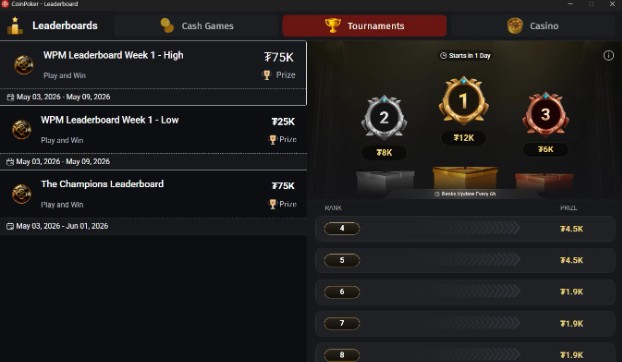
A total of $500,000 in leaderboard prizes will be awarded throughout World Poker Masters, combining $425,000 worth of weekly competitions with an overall $75,000 Champions Leaderboard.
Players earn points based on performance across eligible tournaments, rewarding consistent results across the full schedule.
About CoinPoker
Founded in 2017, CoinPoker is one of the fastest-growing online poker platforms, offering a fully crypto-compatible gaming experience alongside traditional payment methods.
The platform hosts major tournament festivals including Coin Series of Online Poker, CoinMasters, Cash Game World Championships, and now, the $25M GTD World Poker Masters.
With high-frequency rewards, innovative tournament formats, and a strong focus on player value, CoinPoker continues to expand its global poker ecosystem for players at every level.
Other Active Promotions
- CoinRewards: Weekly rewards ecosystem featuring CoinRaces, Splash Pots, and guaranteed daily cashback opportunities.
- CoinMasters: Real silver and gold-plated coins for every CoinMasters 1st place finish, plus a $100,000 poker career, and $100,000 in CoinMasters Freerolls.
- CoinRaces: 2-hour cash game leaderboards for NLH and PLO, paying out $1,000,000 per week.
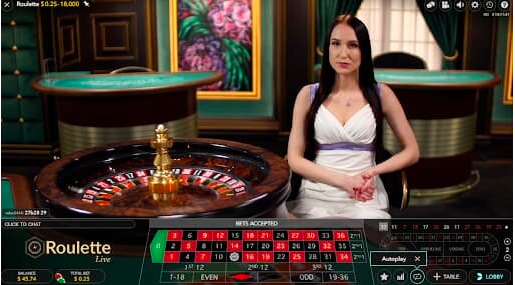
Live dealer card games bring a more realistic casino experience to your screen. You’re watching real dealers, real cards, and real-time gameplay. That added realism makes the experience more engaging, but it also means mistakes can cost you more if you’re not careful. If you’re playing from Canada, there are a few common errors worth avoiding. Fixing these can improve how long you play and how well you manage your bankroll.

1. Not Checking the Game Rules Before Playing
Many assume that all blackjack or baccarat formats follow the same rules. In reality, small differences can change how the game plays.
Some setups use different payout structures or include side bets that affect your overall return. In blackjack, for example, whether the dealer hits or stands on soft 17 can influence your decisions and long-term results. Even the number of decks in play can change how you approach each hand.
These details are usually listed in the game info section, but they’re often skipped. Taking a minute to check them helps you avoid making decisions based on incorrect assumptions.
This becomes more important when switching between different live sessions, where conditions can vary slightly each time.
2. Choosing the Wrong Table for Your Budget
Live dealer formats come with a wide range of betting limits. Some are designed for casual play, while others are built for higher stakes.
Joining the wrong setup can put pressure on your bankroll from the start. If the minimum bet is too high, even a short session can become expensive. A few losing rounds can quickly reduce your balance.
This is where many people lose control of their session without realising it.
It’s also easy to feel pushed to keep betting once you’re seated at a higher-limit setup. In practice, that often leads to decisions that don’t match your usual approach.
A better option is to start at a level that feels comfortable and gives you room to play. This keeps your decisions controlled and your bets flexible.
It’s also worth noting that higher-limit tables don’t change the odds, only the risk level. Moving up too quickly doesn’t improve your chances; it simply increases volatility.
3. Playing Too Quickly Without Observing First
The next issue is just as common. With live dealer formats, you don’t have to act immediately. You can watch a few rounds before placing your first bet, which gives you a clearer view of how the game is running.
Many skip this step and jump straight in, which often leads to rushed decisions. Spending a few minutes observing helps you understand the pace, dealer style, and overall flow of the game before committing any money.
You’ll also notice differences in table speed. Faster setups mean more rounds in a shorter period, which can drain your bankroll quicker. Slower ones give you more time between decisions and help you stay more controlled.
Watching first doesn’t guarantee better results, but it puts you in a stronger position before getting involved.
4. Ignoring Bankroll Management
Live dealer formats move at a steady pace, which makes it easy to keep playing without noticing how much you’ve spent.
Without a clear limit, it’s common to increase bets or stay longer than planned. Over time, this leads to avoidable losses.
Setting a budget before you start keeps things under control. Decide how much you’re willing to spend and stick to it, regardless of how the session is going.
Another useful approach is to break your bankroll into smaller session amounts. This reduces the chance of losing everything in one sitting and helps you stay consistent across multiple sessions.
Taking short breaks can also improve decision-making and prevent impulsive bets.
5. Letting Emotions Affect Your Decisions
The added realism makes it easier to react emotionally to wins and losses. After a losing round, some try to recover quickly by increasing their bets. Others change their approach based on short-term results. These reactions usually lead to bigger losses rather than recovery.
Staying consistent is more effective. Keep your approach steady and avoid reacting to individual outcomes.
It also helps to recognise when your decisions are becoming less controlled. Stepping away for a short time can prevent further mistakes and reset your focus.
Why These Mistakes Matter in Canada
If you’re playing at an online casino in Canada, you’ll often find different platforms and game variations depending on your province. This can affect betting limits, game rules, and overall player experience.
For example, some provinces have access to regulated platforms, while others rely more on international sites. This is particularly noticeable when switching between locally regulated platforms and offshore options, where conditions and protections may differ.
A careful approach reduces confusion and improves decision-making, especially when moving between different platforms.
What to Focus on Instead
A solid approach to live dealer play comes down to a few basics. Understand the rules, choose the right setup, and manage your bankroll properly.
You don’t need complex strategies to improve your experience. In most cases, avoiding common mistakes is enough to make a clear difference.
Consistency matters more than short-term results. Keeping your approach stable usually leads to better long-term outcomes.
Play Smarter at Live Dealer Tables
Live dealer card games offer a more engaging way to play, but they require more awareness than standard formats. Avoiding these mistakes helps you stay in control, protect your bankroll, and make more consistent decisions at the table. Over time, that approach leads to fewer avoidable losses and more stable sessions.
Cardplayer Lifestyle will be hosting its fourteenth Mixed Game Festival, a 10-day affair at Bellagio in Las Vegas, with three $3,500 BetMGM Poker Championship seats to be awarded as Grand Prizes.
We’re proud to announce Mixed Game Festival XIV, to be hosted at the fabulous Bellagio over two weeks and sponsored by BetMGM Poker. The festival will exclusively feature mixed cash games taking place from May 31-June 4 and once again from June 7-11.
Dealer’s choice cash game action will begin at 12pm each day, spread at limits as low as $4/8 and $8/16, with higher stakes available upon request.

“We’re pleased to welcome the Mixed Game Festival back to Bellagio Poker this summer!” said Craig Larson, Bellagio’s Director of Poker Operations. “We’re ready to spread two great, fun-filled weeks of your favorite mixed games at buy-in levels catered to every bankroll. We’re expecting a full house throughout the festival, so be sure to arrive by noon each day to ensure you get a seat and play where the legends play!”
All Mixed Game Festival players will be eligible for FREE parking on-site, with a minimum three hours of play (must be logged in with your MGM Rewards card).
Mixed Game Festival XIV Grand Prize Details
BetMGM Poker will be awarding a total of THREE seats to the $3,500 BetMGM Poker Championship at ARIA Resort & Casino exclusively to our Mixed Game Festival players!
The three seats will be awarded on June 2, 7, and 11, as follows:
- June 2: At some point during the day, we’ll do a blind PLO flip at each active table. The winners at each table will then move on to round 2 and do a second blind PLO flip. The winner of the second flip gets the seat.
- June 7: At some point during the day, we’ll do a random table + seat draw. The player in that seat will have to correctly answer three multiple choice poker trivia questions in a row. We will continue with the random draw + questions until we have a winner.
- June 11: At some point during the day, we’ll stage a special “chip count” competition. To be eligible, one must be seated and playing at an active Mixed Game Festival table.
The three Grand Prize winners will be able to cash in quickly on their good fortune, as the 2026 BetMGM Poker Championship is slated to take place as part of the ARIA Poker Classic starting June 29 featuring a $4 million guarantee (a $1 million increase from last year)!

“What Robbie and the Cardplayer Lifestyle team have built with the Mixed Game Festival is special. It’s 10 days of poker that really captures the community and character of poker,” said Dave Mileaf, Director of Poker at BetMGM. “Awarding three seats into the BetMGM Poker Championship at ARIA is our way of building a bridge from the felt at Bellagio straight into one of the biggest events of the summer.”
About Bellagio Poker Room
Bellagio’s 37-table poker room will be expanding once again throughout peak summer season, overflowing into the adjacent sportsbook area, to accommodate increased poker traffic. This upcoming Mixed Game Festival will be our third event hosted at Bellagio.
Watch the brief video clip below from last year to see me visually guide you directly from the main poker room podium to where our festival’s tables are located on-site.
Mixed Game Festival XIV: What’s “On the Table”?
We’ve peppered our 10-day schedule with a bevy of unique offerings and value adds that are sure to entice you:
Pizza Parties
We’ll be having a fun-filled pizza party each week of Mixed Game Festival XIV. Join us and grab a slice as cards begin to fly at noon on Monday June 1 and again the following week on Monday June 8.
It’s pizza time once again here on Day 8 of @PokerLifeMedia Mixed Game Festival XI at @BellagioPoker
We take care of our players! ???????????? pic.twitter.com/n6LiQIkDPx
— Robbie Strazynski (@cardplayerlife) June 17, 2025
Tuesday with Mori
Poker Hall of Famer and PokerGO President Mori Eskandani will be joining us for a special appearance on June 9. Last year, to our delight, he introduced a couple new poker variants to the table we had never seen before. Anyone fortunate enough to splash around with him during his session is guaranteed to love the special stories he’ll share from his decades in the poker industry!

Pokercoaching.com Meet-Up Mix
The Pokercoaching.com crew will be back in full force on Thursday, June 4th, with Master Mixed Games instructor Alex Livingston splashing around with us in the low-stakes streets as part of a special meet-up game (you can read our course review here). Also expected to make appearances and join in the fun are Pokercoaching.com founder Jonathan Little and high stakes crusher Justin Saliba. We’ll have thousands of dollars worth of prizes up for grabs, highlighted by a seat into the ARIA Poker Classic $800 H.O.R.S.E. event!

Poker Celebrity Appearances, Book Signings, and Merchandise
Over the course of Mixed Game Festival XIV we’ll be welcoming numerous poker legends and personalities who will be splashing around with us at the felt, including Poker Hall of Famers Eli Elezra and Linda Johnson, WSOP bracelet winners, Women in Poker Hall of Famers and more.

We’ll also be staging at least one poker book signing, and on top of our Grand Prizes, we’ll also be giving away plenty of merchandise throughout the duration of our festival, courtesy of premium poker industry brands like: Pokercoaching.com, RunGoodGear, D&B Poker Publishing, and Faded Spade Playing Cards.
Discounted Hotel Rates
Any Mixed Game Festival player wishing to stay on property can avail themselves of a 25% discounted room rate, courtesy of the Bellagio Poker Room. For additional details, please call (702) 693-7290.

Mixed Game Festival XIV Media Coverage
As always, Cardplayer Lifestyle will once again be publishing daily recaps that highlight all the action during our Mixed Game Festival. A Pokercoaching.com Player of the Day and RunGoodGear.com Dealer of the Day will be selected for special recognition on each day of the Mixed Game Festival and will have “their story” written up as part of our daily recaps.

Looking forward to seeing you all this summer in Las Vegas!
Got questions about our upcoming Mixed Game Festival? Contact me here.
Few post-flop weapons have aged as well as the check raise. Once dismissed in early casino days as “sandbagging” — even banned in some rooms for being unsportsmanlike — it has matured into one of poker’s most powerful tactical tools. The arrival of solvers around 2015 transformed how serious players think about the move. What used to be an intuitive trap is now a calibrated, frequency-driven action: balanced between value and bluffs, sized for maximum leverage, and deployed with surgical awareness of board texture and opponent tendencies. Modern strategy has not made the check raise less aggressive — it has made it more precise.
Understanding the Check Raise in Contemporary Poker
The mechanics are simple. A player out of position checks, an opponent bets, and the original checker raises. Standard rules permit this in virtually every form of hold’em, and checking does not close the action.
What has changed is the philosophy. Solvers showed that an out-of-position raiser should often check far more than players historically believed — sometimes 65 percent or more in single-raised pots from the small blind versus the big blind. But that passive-looking check is a setup. The check raise that follows is the real teeth of the strategy, used both for thin value and as a semi-bluff against opponents who continuation bet too widely.
READ MORE: Comparing Top Poker Solvers
Older exploit-heavy approaches treated the check raise as a “got ’em” move with monsters. Modern balanced ranges look very different. A solver-approved flop check raise on a coordinated board might include overpairs and sets alongside backdoor flush combos, gutshots with overcards, and suited connectors. Without the bluffs, the line becomes transparent and easy to fold against.
When to Use Check Raises for Maximum Pressure
Board texture is the first filter. Wet, coordinated flops — boards like 9♥-T♥-J♣ or 6♠-7♠-8♦ — are prime check raise territory because the out-of-position caller’s range connects more tightly than the preflop raiser’s, and there are abundant semi-bluff candidates. Dry, disconnected boards favor the bettor’s range and reduce the value of raising.
Position, stack depth, and opponent behavior shape frequency and sizing. Out of position is the natural home of the check raise. With effective stacks around 40 big blinds, a flop raise to roughly 35 percent of stack often commits both players by the turn — useful when you want to deny equity to draws but dangerous if your hand cannot tolerate a shove. Against opponents who continuation bet too often, frequency goes up. Against tight regulars who only barrel with strong holdings, it goes down. Across most solver baselines, flop check raising lands around 10 to 15 percent of range in standard spots.
Reading Opponents and Range Construction
The best check raise targets share two qualities: they bet too often on the flop, and they fold too easily when raised. Many recreational players do exactly this. Solver-informed regulars, by contrast, reduce continuation betting on unfavorable boards, so against them, exploiting specific player tendencies matters more than volume.
Range construction is the difference between a profitable line and a leak. Pure value check raising is exploitable; observant opponents fold every marginal hand and never pay off. Mixing in semi-bluffs — flush draws, open-enders, backdoor equity — keeps the range credible and gives weak made hands a reason to call. The reverse failure is also common: pure bluffing without enough value combos invites light three-bets. Predictability is the silent killer. Once an opponent associates your check with aggressive intent, your delayed lines lose all credibility.
Tournament Context and Online Poker Dynamics
Tournaments rewrite the math. With escalating blinds, antes, and the Independent Chip Model dictating that survival has direct monetary value, a check raise that risks tournament life carries weight no cash game equivalent does. Near the bubble or major pay jumps, marginal semi-bluffs that would print money in a cash game become folds.
Online poker tournaments compress these dynamics further. Most live tournaments begin 150 to 300 big blinds deep and finish in repeated sub-20BB push-fold spots; online MTTs hit the same milestones faster, often with blind levels of just 5 to 10 minutes in turbo formats and 2 to 3 minutes in hyper-turbos. Decision time per hand is shorter, and aggression frequencies sit measurably higher than in live equivalents.
The structural variation between online tournament environments is wider than many players appreciate. Blind speeds, payout curves, re-entry rules, and field composition all shift the optimal check raise frequency. Slow-structured high buy-in events allow nuanced post-flop play, while turbos and hypers punish anything but decisive action. Players surveying the landscape often compare platforms — some catalogued on online casino directories like kasynoonline — to evaluate how a given site organizes its schedule, what payout formats it offers (flat versus top-heavy, freezeouts versus PKO bounty events), and how its player pool skews.
The same hand can warrant a check raise on a recreational-heavy site and a check call on a tougher one. Player pool composition matters as much as the cards. Anonymous pools and shared-liquidity networks compress hand-history samples, pushing players toward population baselines and texture-first decisions.
Common Mistakes Players Make with Check Raises
Three errors recur. The first is overuse in low-equity spots — check raising marginal hands on textures where fold equity isn’t there. The second is misjudging tendencies and using one-size-fits-all sizing: a 3x raise that pressures a tight regular barely registers against a calling station. The third is ignoring table image. A player caught on two recent bluffs cannot expect the same fold equity, and observant opponents will counter-exploit by widening their continues and three-bets.
Building a Balanced Check-Raise Strategy
A durable check raise strategy mixes value-heavy combinations with semi-bluffs in deliberate proportion. Reviewing hand histories — particularly the spots where check raises were called or three-bet — surfaces leaks faster than any other form of study. Solvers, used as conceptual teachers rather than memorization tools, refine the underlying frequencies and patterns: which textures favor large sizings, which combos belong in the bluff bucket, when checking is just checking and when it is the first move of a trap. Players looking to extend the same logic to later streets can study how the river check-raise demands even tighter range balance, since fold equity drops sharply once boards fully run out.
The check raise rewards discipline. Used sparingly, with the right hands, on the right boards, against the right opponents, it remains one of poker’s highest-leverage post-flop moves.
If there are two things you need to be aware of in this highly digital age, it’s that things are constantly changing. And if you want to stay on top of these changes, you need to have strategies in place. This is especially true in a game like poker and when you’re making use of casino bonuses. These two things come together to create quite the experience but if you don’t have certain guidelines to help navigate these markets, then you’re not doing your due diligence.
A lot of players first try to understand the game of poker, nitpicking around its rules. Or they spend hours reading over the wagering requirements of casino bonuses. And doing both of these things is smart. However, if you don’t start to see the link between online poker and bonuses, then this research will only take you so far. You need to take a step back and specifically apply certain lessons to how poker and casino bonuses come together. This is how you can engage with care and tact. This is where three key strategies come into play.

Strategy 1: Use Bonuses To Extend Bankroll Stability
One of the most practical ways to use casino bonuses in online poker is to strengthen bankroll stability. Poker is a game that is pretty volatile, with many highs and lows and even strong decision-making does not guarantee short-term results. In fact, no decision can ever determine an outcome because poker is based purely on luck and chance.
But a bonus can act as a buffer. It can allow for continued participation without immediately impacting your core bankroll. This creates more breathing room and reduces pressure during sessions; however, a bonus should not be relied on. It’s meant to be something that gives you a bit more time to suss out a game, not as a saving grace. As it goes, this approach works best when the bonus is treated as part of a structured plan rather than extra spending power.
You just have to match the bonus with the game you’re playing and the situation you’re in. A game of poker comes with many different moves, so finding the suitable bonus at each step of the way is key. This can take quite a lot of know-how and experience. If you don’t feel so well-versed yet, take a look at a Wind Creek Casino promo code, for example, as this comes with clearly defined wagering requirements, so there’s no element of surprise and it allows you to engage in games using free spins and coins. This reduces the burden on your bankroll. Not indefinitely but at least for a short time. Again, please remember that these bonuses should be used as a means to extend your entertainment and nothing more.
Strategy 2: Align Bonus Use With Game Selection
Choosing the right tables or formats can influence how effectively a bonus is used. Some platforms may reward cash game activity differently from tournament play. Understanding these differences allows for more efficient use of bonus conditions. Selecting games that work with those conditions can help meet requirements without forcing unnecessary adjustments.
But please don’t get it wrong. This does not mean that you have to stop playing the poker formats that you find more interesting. More just that you need to think of the poker game with the bonus in mind. You need to be flexible and adjust stakes or table types slightly, as this can make a noticeable difference without changing your overall approach to the game. Knowing how each game contributes to bonus progress ensures that time spent playing is aligned with the intended outcome.
Strategy 3: Manage Risk While Meeting Bonus Conditions
Balancing risk is essential when using bonuses in online poker. While it may be tempting to increase the stakes to meet requirements more quickly, this can bring in a whole bunch of problems that you really don’t want to have. A more measured approach focuses on maintaining standard stakes and decision-making processes.
Key considerations when managing risk with bonuses include:
- Maintaining consistent levels rather than chasing faster progress
- Avoiding unnecessary shifts in playing style and gaming processes
- Reading through all casino bonuses requirements carefully
- Setting clear limits for both time and spending, so that you maintain responsibility
- Prioritizing decision quality over speed of completion
- Taking the time to find the right bonus for your situation
- Only using reputable, safe and secure casino bonuses
- Stopping when it feels like you’re pushing for an outcome
By using these bullet points mentioned above, you can engage in casino bonuses in a more secure, thoughtful and nuanced way. This should always be your goal.
A Strategic Approach To Bonus Integration
Casino bonuses can be useful tools in online poker but their value depends on how they are used. A thoughtful approach focuses on stability, alignment, consistency and risk management. By fully understanding how poker works and how casino bonuses work within a game of poker, you put yourself in a position to make smarter decisions.
Please remember that poker is still a game of chance and no matter how much thought you put into it, it will always remain that way. You must engage with responsibility and caution. Never lose sight of the fact that poker is only meant to be a hobby.
Being around casinos for a long time has taught me one thing for certain: bonuses are never as simple as they look. Banners are flashy, percentages inflated, and there are easy-sounding promises, but the real game sits underneath. It’s buried in the terms that most players skim through or ignore completely – and that’s where the edge is.
If you are experienced, you don’t need another beginner breakdown. What you do need is a sharper way to look at bonuses – not as “free money”, but rather a structured system you can either exploit or get trapped in. I have stopped approaching bonuses emotionally over time, and started to treat them as calculated opportunities. That changed my results more than any “strategy” ever did.

Understanding the Real Cost of a Bonus
Players focusing on the bonus size instead of the wagering attached to it is the biggest misconception I see. Until you break down what it actually requires, a 100% or 200% bonus offer sounds perfect. A wagering requirement is how many times you need to play through the bonus before withdrawing. And it’s not just a number – in practice it’s a commitment to sustained play under conditions you’re not in control of.
For example, a typical structure might look like:
- 30x wagering on deposit + bonus
- Limited contribution from table games
- Strict max bet rules
That translates to a large volume of required bets, often pushing you into extended sessions where variance is the deciding factor. That is where casinos gain the advantage – over time.
Why I Skip Most Bonuses Without Hesitation
Discipline was needed to get here, but now I reject the majority of offers I see. And not because they’re scams – but because they’re inefficient. High-percentage bonuses usually come with heavy wagering, and it’s not a coincidence – it’s a balancing mechanism. The bigger the upfront incentive, the more you’re expected to give back in play volume. So instead of chasing size, I focus on friction. Specifically:
- How quickly I can convert the bonus into withdrawable funds
- Whether the wagering requirement is applied to the bonus only or the full balance
- If the time limit forces me into unnatural play
And if any of these feel restrictive, I walk without second-guessing, which eliminates a lot of bad decisions. That’s another reason why I compare structures carefully before engaging with any new offer, especially when reviewing different types of casino bonuses.
Choosing Games With Purpose, Not Habit
There’s a very overlooked edge and it’s understanding how different games contribute to wagering. Even experienced players still slip on this, usually out of habit.
Slots typically contribute 100%, while table games like blackjack or roulette usually contribute a fraction – or maybe nothing at all. If you’re clearing a bonus on low-contribution games, it means that you’re effectively multiplying your workload without even realizing.
I have a simple, but deliberate approach I stick to:
- High RTP slots (return-to-player percentage)
- Medium volatility games that balance risk and longevity
Instead of jumping into table games, trying to outsmart the system – the one which has adjusted for this “trick” years ago, I focus on efficiency – getting through wagering in the most stable way possible.
Managing Variance Is More Important Than Winning Big
Even for experienced players, this may be the hardest mindset shift. When you’re playing with a bonus, the goal isn’t hitting a massive win. It’s to survive long enough to complete the wagering requirement. It means to stop chasing the upside and control the variance.
In practice, that changes how I bet:
- I might start slightly aggressive to capitalize on early momentum
- If I get ahead, I scale down quickly
- I avoid sudden spikes in bet size that could violate terms or wipe progress
It may not be glamorous or exciting, but it works – bonuses reward discipline much more than risk-taking.
The Hidden Details That Actually Matter
The fine print hides a lot of bonus value, and ignoring is the result of most losses. Over time, I’ve learned to focus less on the headline and more on the structure underneath.
Some of the most important factors I always check include:
- Max bet limits: Exceeding them can void winnings instantly
- Cashout caps: Some bonuses limit how much you can withdraw, regardless of winnings
- Bonus type: Sticky bonuses vs. cashable ones
- Expiration windows: Short deadlines force rushed, high-risk play
Something I rarely touch anymore are sticky bonuses in particular, and look for non-sticky ones. You’re essentially playing with restricted value if the bonus amount itself isn’t withdrawable. Even if you win, part of the balance was never yours.
Time Pressure Is a Bigger Risk Than Most Realize
Time is another factor that doesn’t get the attention it should. Every bonus has a ticking clock, and that kind of pressure quietly pushes you into bad decisions. If there’s high wagering requirements and the deadline is tight, you’ve got two options: play more aggressively than you should, or risk not completing it – and neither is ideal.
I prefer to only take bonuses that fit within my normal playing patterns. If my behavior needs adjusting to meet the deadline, it’s a bad deal. The best bonuses are those you can clear without feeling rushed or forced.
Rotating Casinos Instead of Grinding One
One of the more advanced approaches you can have is spreading your activity across multiple casinos instead of committing to a single platform. It’s not about chasing bonuses – it’s about being selective.
Different casinos have different offer structures – and if you pay attention, that creates opportunities. I’ve found value at places like Betwarts Casino, MagicWin Casino and iWinFortune Casino, but never blindly nor all at once.
The idea is to:
- Compare terms rather than percentages
- Take smaller, manageable bonuses instead of one large grind
- Move on when conditions stop being favorable
Having this approach keeps things flexible and reduces exposure to long wagering cycles. Not being locked into one system gives you more control over your play.
Knowing When to Ignore the Bonus Completely
At times, the best move is to entirely ignore the bonus and play with real funds – no restrictions, no wagering, no conditions – and it might be the most underrated “tactic” of all. It is surprisingly difficult to do, even with it sounding simple – especially when you have offers pushed in front of you constantly.
The reason it works is straightforward:
- You can withdraw at any time
- There are no betting limitations
- You’re not forced into extended sessions
How I Evaluate Bonuses Today
At this point, I have a process that is fairly consistent. Before I accept anything, I run through a quick mental checklist:
- What’s the real wagering requirement?
- Is it applied to the bonus only or the total balance?
- Which games contribute fully?
- Are there restrictions that could invalidate winnings?
- Can I realistically complete this without changing how I play?
Something doesn’t line up? Move on – there’s always another offer, and forcing a bad one is bound to not end up well.
Final Thoughts
People think casino bonuses have changed a lot, which they really haven’t. What has actually changed is how clearly you can see them once you start treating them like structured systems instead of opportunities. They are designed for extended play, introducing conditions, and slightly shifting control in the casino’s favor. Which doesn’t make them useless, but just means that you need a more clear approach instead of optimism.
It is no longer about chasing offers – at this level – it’s about filtering them. Players that consistently extract value are the ones that properly read terms, stay disciplined, and act only when the numbers truly make sense to do so.
Poker players rarely treat a first deposit as a casual step. In internal behavioral research by Gamblizard, small deposits often act as part of a testing pattern. Users check how a platform responds before committing more funds. The amount itself carries meaning. It can indicate whether a player is exploring, comparing options, or already close to trusting the site. For poker-oriented users, this mirrors familiar logic. A first deposit becomes a form of bankroll control shaped by timing, caution, and quick evaluation.

Why the $10 entry point works as a decision filter
The $10 level emerged after reviewing repeated session patterns across multiple platforms. The signal was not in the number itself, but in what followed. Sessions at this level showed similar timing, navigation, and exit behavior. The goal was not extended play. It was validation.
Further comparison of session length, bet size, and interaction speed highlighted a clear difference. This segment led to faster conclusions and fewer random actions than both lower and higher deposits. In environments structured around $10 minimum deposit casinos, this behavior becomes easier to track because the entry point aligns with a common testing range.
What gets tested at this stage:
- Payment response after deposit
- Game or table loading speed
- Stability during rapid actions
- Early withdrawal-related signals
The outcome of those rounds matters less than the time it takes to reach a conclusion. A stable experience often leads to a return with a higher deposit. Any inconsistency usually ends the session immediately.
What $1 deposits show about strict low-risk testing
A different pattern appears at the lowest level. Here, behavior shifts from evaluation to strict verification. Sessions built around a 1 dollar deposit casino rarely involve exploration. Instead, they focus on fundamentals: payment handling, rule clarity, and system response under minimal conditions.
This entry point removes financial hesitation. Attention moves directly to core mechanics. Players activate a balance, access a small part of the platform, and observe how it performs without committing further funds. The focus is not on volume, but on clarity.
Typical flow of these sessions:
- Immediate action, often skipping navigation
- One game or table used for testing
- Minimal bets to trigger system responses
- Fast exit after any delay or unclear condition
These sessions are not reduced versions of regular play. They act as a filter. A platform either meets expectations within minutes or is abandoned without a second attempt.
How poker discipline influences deposit decisions
Low-deposit behavior often reflects habits shaped at the poker table. The same principles apply: limit exposure, read the situation quickly, and avoid unnecessary risk. A first deposit becomes part of a structured decision process rather than a simple starting point.
Session flow tends to follow a repeatable pattern. Players open one or two games, place a few minimal bets, and observe system behavior. Timing and consistency carry more weight than outcomes. A short interaction is often enough to decide whether to continue.
This closely mirrors bankroll management. Stakes in poker are adjusted based on confidence and available information. In a similar way, a smaller deposit reduces exposure while key signals remain uncertain. Once those signals are clear, players return with a higher level of commitment.
FAQ: What short sessions reveal about risk control
Why do many players keep sessions short?
Session length is often defined before play begins. The aim is to collect enough signals quickly, then decide whether to proceed.
Is deposit size the main driver?
It matters, but context matters more. The pattern appears strongest when the platform has not yet been verified.
What causes early exits?
Minor inconsistencies. Delays, unclear rules, or unexpected responses lead to immediate decisions.
Do players return after leaving?
Only when early signals are stable. Clean initial interactions often lead to a second session with a larger deposit.
How does this connect to poker behavior?
The structure resembles table selection. Conditions are tested first, and commitment follows only when expectations are met.
When testing turns into real play
At some point, behavior shifts. The same users who kept sessions short begin to act differently. This change is not tied to results. It depends on whether the platform passed the initial checks.
The transition is gradual. Sessions become longer, navigation expands, and players move beyond a single game. Deposit size increases only after earlier signals prove reliable. What started as a controlled test becomes regular play.
Key triggers include:
- Consistent payment processing
- Clear and predictable rules
- Stable performance across actions
- Smooth switching between features
Once these conditions are met, testing is no longer necessary. The player moves forward with confidence.
Minimal deposits reveal more than budget limits. They reflect how players think. Early actions, short sessions, and fast exits create a consistent pattern: test first, then decide.
Internal observations from Gamblizard point to the same logic across different platforms. The amount may be small, but the reasoning behind it is structured. For poker-oriented users, this approach feels natural. A deposit becomes part of risk control, not just a way to begin.
The BetMGM Poker Championship at ARIA Las Vegas is back once again, and this year the guarantee has been increased by a cool million! Following last year’s success, the 2026 BetMGM Poker Championship will feature a $4 million guarantee, and based on the event’s ever-increasing popularity, there’s a chance the final payout might surpass $6 million.
With the BetMGM Poker Championship being the highlight of the ARIA Poker Classic summer series, action gets underway on June 29 and play continues until a winner is crowned on July 4.
As always, the buy-in will remain $3,500, but there will be two cut-price pathways for players in New Jersey, Pennsylvania, and Michigan courtesy of BetMGM Poker. The first way to win a seat in the 2026 BetMGM Poker Championship is via weekly online qualifiers. Buy-ins start at $10, and there will be two weekly finals awarding multiple seats.
The second way to earn yourself a seat in the event for less is via BetMGM Poker’s online ARIA package promotion. Players can win their way to Las Vegas via daily step satellites starting at $5 that feed into package finals held multiple times per week. That package is valued at $7,200 and includes a seat in the BetMGM Poker Championship, travel, and a stay at the ARIA.
BetMGM Poker Championship Becomes Summer Staple
BetMGM Poker’s annual event has not only become a staple fixture for the ARIA Poker Classic, which runs from May 29 to July 13, but a must-play summer tournament. With traveling players in town looking for action, the BetMGM Poker Championship has gone from strength to strength since launching in 2022.
The inaugural event attracted 343 entries and paid out $1.1 million. Just three years later, the number of entries had increased to 1,853, creating a prize pool of just under $6 million. Nguyen Le etched his name in poker folklore by winning last year’s championship.
The Vietnamese pro had to channel his inner Jack Straus when his stack was chopped down to a single chip with 11 players remaining. Much like Straus did in the 1982 WSOP Main Event, Le defied the odds to rise up and win the BetMGM Poker Championship crown and $777,777 after a three-way deal.
Value and Service Appeal to Players
Buoyed by last year’s success, the team at BetMGM has upped the ante this year. With another $1 million GTD added to the pot, there’s hope the number of entries will surpass 2,000. That would push the prize pool over $6 million, making it one of the biggest non-WSOP events of the summer.
Commenting on the championship’s recent success, Sean McCormack, Executive Director of Poker Strategy & Development at MGM Resorts, described it as a “cornerstone” event.
He went on to say that the combination of value and service has made it a tournament that players want to play.
“Combining BetMGM’s online reach with our ARIA guest experience, we’ve created something that truly resonates with today’s player and the overall championship atmosphere,” McCormack added.
BetMGM Bulks Up Its Team of Ambassadors
Adding to the guest experience will be BetMGM Poker’s newest ambassador, Michael Lavin. Like many poker hopefuls, Lavin went from playing online to winning a WSOP bracelet in 2025. The American’s maiden win at the WSOP in Las Vegas earned him $267,373 and came after his winning an online bracelet in 2021.
Alongside his new teammate, Darren Elias, Lavin will represent BetMGM Poker across various channels, including live streams and social media. He’ll also be among the many poker luminaries who ante up in the 2026 BetMGM Poker Championship in Las Vegas between June 29 and July 4.
Every poker player got their start somewhere. For some, their first game was played between friends. Others tuned in on a very special day in 2003 and watched Chris Moneymaker, at the time a total unknown, win the Main Event at the World Series of Poker. No matter where your love for the game began, it ultimately relied on familiarity with cards, suits, and ranks. This is why many poker players got on the journey not with poker, but with the many exciting card games that share its DNA.
For some, that love bloomed while playing card fishing games, while others felt it while playing computer games on their old PCs. While these games were a far cry from the thrills and bluffs of poker, they set the groundwork that poker often relies on. Still, out of the many card games available to players, few set them up for poker success quite like good old solitaire does. It offers many lessons that apply to poker, such as keeping track of cards to make the best possible move and the discipline to see a game through to the end.

The Gateway Game that Still Delivers
If you visit online forums and Reddit, you’ll find a fair number of players who’ll tell you that playing solitaire games online helps them recognize straights faster and identify nut hands. This isn’t a total surprise, as solitaire and poker both rely on a similar skill of pattern recognition.
Solitaire requires you to track what cards are available to you to avoid blocking the deck. A good shuffle can practically hand you the win, but it’s the persistence and experimentation required to win a challenging card arrangement that sets the best players apart. Above all else, solitaire teaches players that patience is a virtue.
Of course, that doesn’t mean playing solitaire is going to replace the value of the poker grind. The best way to master seeing flush possibilities, dead cards, and straight draws is to play poker and stick with it. However, even professionals like Daniel Negreanu and Phil Ivey will tell you that a mental reset is important. Rather than keep playing while tilted, it’s better to take a small break, reset, and return to the grind. For those short breaks, solitaire is the perfect way to keep yourself sharp.
A Shared Heritage, of Sorts
The way solitaire is structured will test your nerves in a similar manner as poker. Anyone who spent enough hours on that game knows the pain of an unfair shuffle that feels like it was purposefully arranged to make you lose. However, the best thing to do is to take a breath, try again, and take a different approach.
The familiarity of symbols is another plus point. It’s like the two games speak the same language with slightly different accents, and poker players have an easy time transferring their skills to solitaire and vice versa. That said, if you’re using solitaire to unwind between poker rounds, perhaps it’s best not to play it at the greatest difficulty. Solitaire is nothing if not customizable, and simpler variants can keep you sharp without tilting you further.
Solitaire As the Ultimate Training Ground
Ultimately, solitaire is the perfect companion to poker because it can set you up for success. When so much is riding on the line with every poker round, a bad card draw or a misplay can be devastating. Poker is a cruel mistress after all, and mastery requires more than knowing the best combos, as well as wisdom to recognize when you’re in a funk and that you need to back away for a bit.
Both of these can be addressed with an occasional game of solitaire. It may lack the stakes and spectacle of a proper poker game, but it delivers clarity of mind and a perfect training ground for poker pros ready to sharpen their instinct or stepping away to regroup. A few minutes is all it takes to clear the mind, restore focus, and start thinking one step ahead again.
Taking effective notes on poker hands is one of the most underrated skills in improving as a player. Whether you’re grinding online MTTs, playing live cash games, or studying away from the table, the way you capture and organize hands directly impacts how much you actually learn from them. Most players either jot down vague thoughts or rely on memory. That can be unreliable, and usually your bias will creep in. Strong poker players treat objective note-taking as part of their edge.
This guide walks through how to take clear, useful, and actionable notes on poker hands so you can consistently improve your decision-making.
Why Note-Taking Matters in Poker
Poker is a game of incomplete information. You rarely know if a decision was correct in real time. Without recording hands, you lose the opportunity to review spots objectively. Note-taking in poker helps you:
- Identify leaks in your game
- Recognize patterns in opponents
- Build a database of tricky situations
- Improve your strategic thinking over time
More importantly, it forces you to slow down and think. Writing something down means you cared enough about the spot to revisit it. This is where real growth happens.

What Hands Should You Record?
You don’t need to document every hand. That’s inefficient and overwhelming. To start, you should focus your poker note-taking on these five types of hands:
- Big Pots: Any hand where a significant portion of your stack (or your opponent’s) is involved.
- Uncertain Decisions: If you weren’t sure whether to call, fold, or raise, that’s a prime candidate.
- Close Spots: Thin value bets, marginal calls, or tricky bluffs.
- Interesting Lines: Unusual plays by opponents or yourself. Think check-raises on the turn, overbets on the river, etc.
- Emotional Hands: Hands where tilt might have influenced your decision-making.
If a hand sticks in your mind for more than a few seconds, it’s worth recording. Notes can be taken by hand if you prefer, but keep in mind that a notebook at the table is going to draw attention from your opponents. Try taking notes in your phone’s Notes app or Google Docs for concealed notetaking.
READ MORE: Jared Tendler on Poker Note Taking
The Structure of a Good Poker Note
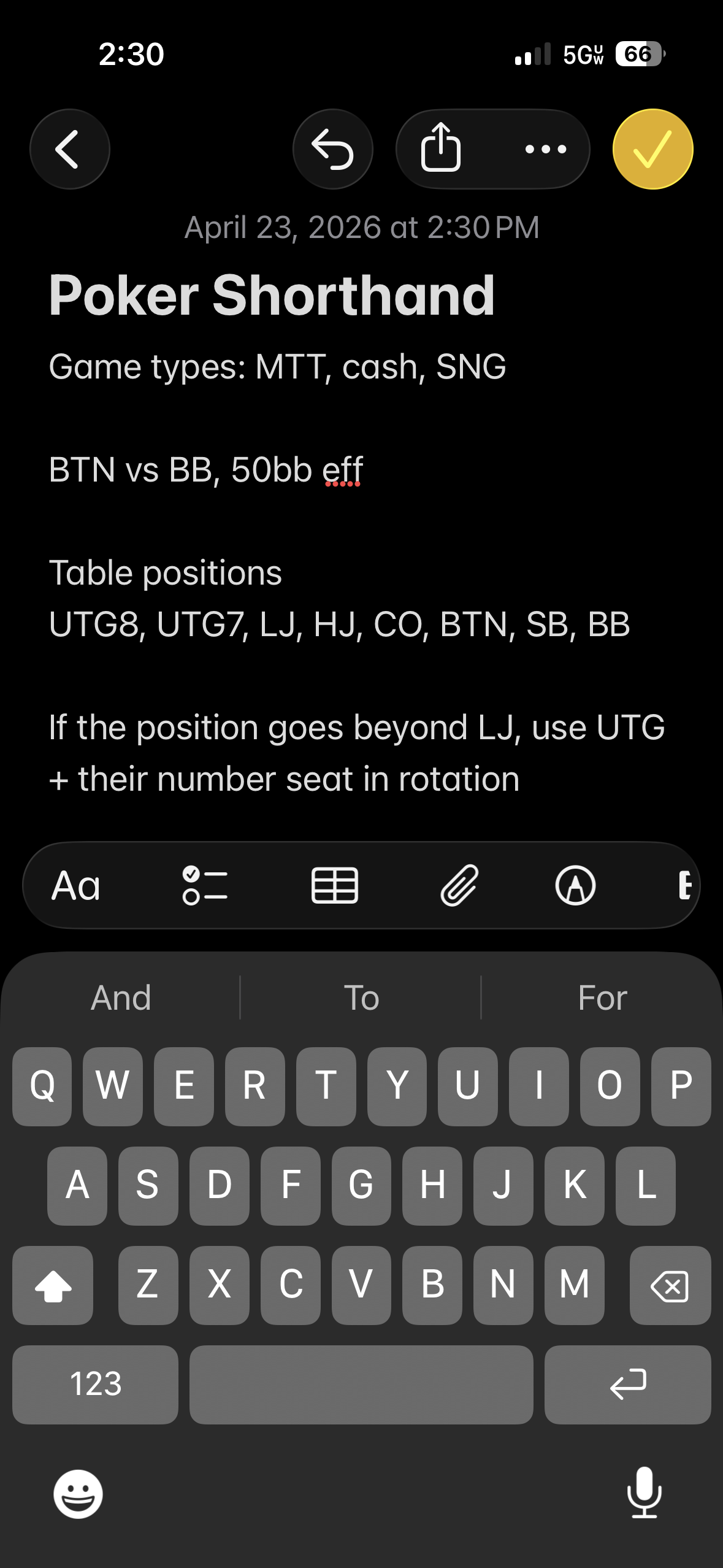
The biggest mistake poker players make is taking notes that are too vague. “Weird spot” or “bad beat” won’t offer you much to learn from. Instead, every note should follow a structured format. Keep in mind common poker shorthand so that your notes can be taken quickly and understood by other players.
1. Basic Context
Start with the essentials:
- Game type (MTT, cash, sit & go)
- Stakes or buy-in
- Stack sizes (recording the effective stack is key)
- Positions (e.g., BTN vs BB, UTG vs CO)
- Stage (early, bubble, final table, etc.)
Example: $55 MTT, 40bb effective, BTN vs BB, mid-stage
2. Preflop Action
Clearly describe what happened before the flop:
- Who opened
- Bet sizes
- Who called or raised
Example: BTN opens 2.2bb, I call BB
3. Postflop Action (Street by Street)
Break it down by street:
- Flop: board texture, bets, sizing
- Turn: what changed, actions
- River: final decisions
Example:
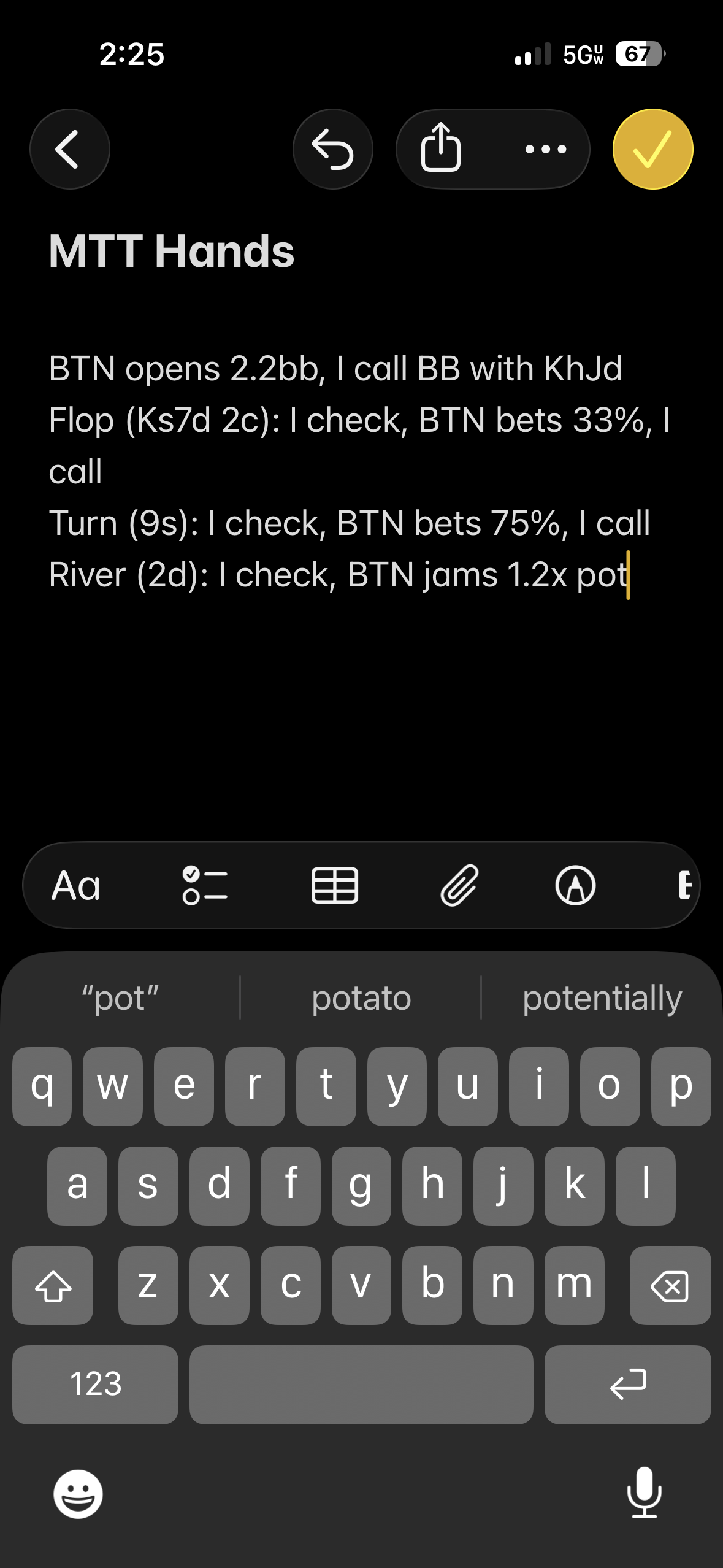
BTN opens 2.2bb, I call BB with KJo
Flop (K♠ 7♦ 2♣): I check, BTN bets 33%, I call
Turn (9♠): I check, BTN bets 75%, I call
River (2♦): I check, BTN jams 1.2x pot
If it helps you get started, you can record that bets are small, half-sized, or large in relation to the pot. But as you improve, you will want to be as specific as possible.
If you’re taking notes quickly on a phone, consider noting the card suits like so.
4. Your Thought Process
This is the most important part that most poker players tend to skip.
Write what you were thinking at the moment. For example:
- What player type was your opponent?
- What range did you assign your opponent?
- Why did you take your line?
- What were you trying to accomplish?
Example: Thought BTN had wide c-bet range on flop. Turn sizing felt strong but still contains draws. River jam polarized—struggled to find bluffs.
5. The Question
End your poker note with a clear question. This turns your note into a study prompt.
Examples:
- “Is this a call vs population?”
- “Should I be raising turn?”
- “Do I overfold here?”
Without a question, your poker note lacks direction when you review it later. Use your notes to talk through hands with other players and get their perspective on hands.
Example of a Complete Poker Note
Here’s what a strong note looks like when everything is put together:
$55 MTT, 40bb effective, BTN vs BB
BTN opens 2.2bb, I call BB with KJo
Flop (K♠ 7♦ 2♣): I check, BTN bets 33%, I call
Turn (9♠): I check, BTN bets 75%, I call
River (2♦): I check, BTN jams 1.2x pot
Thought process: BTN has range advantage on flop, so I defend. Turn sizing felt strong. Maybe value-heavy, but still includes draws. River jam seems polarized. I block Kx but don’t block missed draws.
Question: Is this a standard call vs population, or should I overfold the river?
The above note gives you everything you need to analyze the hand later or discuss it with others.
Final Thoughts
Taking notes on poker hands is a habit that separates casual players from serious ones. It doesn’t require GTO (Game Theory Optimal) strategy, just enough detail to understand the situation. If you consistently record meaningful hands, capture your thought process, and review them with intention, your improvement will compound over time.
Casino bonuses in 2026 are not what they were a decade ago. Players have, for the most part, gotten savvy to massive headline deposit match bonuses with poor terms. But these bonuses do still exist. Although the market has shifted to more regular rewards and ongoing promotions than big deposit match bonuses, there are still casino bonus terms that many players don’t really understand or look at.
Poker players are used to crunching the numbers on pot odds, expected value and much more. So, this article will take a math-based look at important bonus terms most players know about – and some others that often get overlooked.
Wagering Requirements Remain the Most Important to Look At
Wagering requirements, sometimes called playthrough requirements, tell you how many times you must bet the amount of bonus before you can withdraw winnings.
For example, a $100 deposit match with 20x wagering would need you to wager $2000. Any winnings from the bonus that are then wagered again, count towards this.
Most players know about these by now. So much so that some casinos don’t even use them any more. But, they are still fairly common. So, what’s an Expected Value (EV) way of looking at wagering requirements that not everyone knows?
First, estimate the house edge of the games you’re playing. For slots, this varies but should be between 4% and 6% although there are 98% RTP games out there.
Take the full amount you’d need to wager – 20x$100, for $2000 in this case. Then take the percentage of that amount equivalent to the house edge. In this case, average of 5%. Take that percentage of the total, in this example that would be $100.
If this is under, equal to or close to the initial bonus amount – you stand a decent chance of making a profit, depending on luck. This particular bonus of $100 matched at 20x wagering, would be equal EV. Which is good.
This is why bonuses with 40x wagering or more are often considered not good. Because they’re EV losses, relying on a lucky streak for any chance of a withdrawal at the end.
To find out all the details like wagering requirements when comparing bonus offers, players find it useful to have multiple casinos’ options all in one place. Comparison sites let casino fans see all their bonus choices side-by-side with small print terms included in an easy to read format, as well as other features of particular casinos.
Minimal Risk Bets or Advantage Play Clauses Aren’t Often Discussed
Smart poker and blackjack players know how to maximize their EV through methodical play. One bonus term that often gets overlooked but can change your bonus strategy completely is low risk betting clauses.
As mentioned above, the lower the house edge on the game you’re playing – the better chance you have of completing the wagering with a profit.
So many smart gamblers might think to do a low risk, low reward strategy such as betting red/black on a European roulette game (2.7% house edge). This should be able to grind you through the bonus requirements with little risk of losing your profits.
However, casinos have been wise to this for a long time. Try it, and you’ll likely complete the wagering to find the balance has been voided. Then you get pointed to the terms and conditions, where it says that “low risk” strategies are not allowed. This is one players often ignore, but it can make all the difference for EV advantage players.
Game Contribution Requirements Are Sometimes Vital
Another thing to consider if you’re the type of player that likes to maximize edge, is that many bonuses don’t let you play on roulette or blackjack at all. And if they do, they’ll count for less towards your wagering requirement.
This is often fine for slot players, as most slots count for 100% of the bet. But players who think – “I know basic blackjack strategy, with a bit of luck I can breeze through the bonus” – might be surprised when it takes four or five times longer than anticipated.
Which gives more of a chance for the house edge to eat away at your bonus profits.
If blackjack contributes zero to 10% of wagering requirements, for example, consider whether you mind playing it through on high RTP slots. Or, just find another bonus that isn’t as restrictive.
Time Limits are Always Important to Know
Time limits on bonuses are often overlooked. But when combined with max bet limits, they can really be a crunch that might stop you hitting an EV bonus completely.
These can range from as little as 24 hours to 30 days, depending on the casino. Obviously the more time the better, just in case, or ideally no time limit at all.
For example, consider the $2000 wagering requirement. If the bonus has a five day wagering requirement and a $1 bet limit then you’re looking at 400 spins a day – minimum. If the slot has auto spin mode this might be easier, but if not that could take you several hours. Which is not reasonable for a casual player.
Don’t ignore time limit clauses, especially if you’re taking up a bigger bonus and the bet limit is small.