
In composing the first three parts of this miniseries, I tried to break down the story of my month as a semipro mixed game player into phases. It started out with early optimism and the hope of validating a long-held belief in my poker abilities through a real-life field test. The second article covered my jumping into the mixed game waters with an initial slow and steady climb. The third article covered my next week-and-a-half of play, during which I suffered a massive downswing and then began a slow and steady rebuild (both financially and mentally) during Mixed Game Festival XII.
By the time the festival ended, my confidence was finally back. I had recouped losses and was back in the black for the trip. What came next was a deliberate pause from poker as I headed to Los Angeles to spend the weekend with my extended family. From there, I headed back to Vegas, returning to the grind that would once again test my discipline and everything I had been “trying to do right.”
If I had to sum up the weeklong stretch of the of the trip that I’ll be covering in this penultimate installment of the miniseries, it would be that I tried to strike the perfect balance between the full-on grind and regular, normal life. Even so, sometimes (as the Hebrew saying roughly translates to): “the operation is a success, but the patient dies.”

Days 17-19 | November 21-23: Resting and Recharging in Los Angeles
The drive from Las Vegas to Los Angeles felt like more than just a change of scenery. As I made my way west, I leaned into something deeply personal and sentimental, listening to and singing along with the music I loved as a teenager back when I lived in LA. It unlocked a part of me that doesn’t surface very often, as my life has changed quite drastically from the years when I was an “LA boy.”
Shabbat with my aunt, uncle, and cousins was grounding in a way that poker simply cannot be. Spending time with some of my closest relatives was exactly what I needed. I rested deeply. I slept well. I ate food that didn’t just taste amazing, but that also brought back memories from my youth. As much as I love the game, it was refreshing to not just have “poker, poker, poker” be the constant focal point of my day.
Poker Calls Twice, But I Let the Phone Ring… and Slept in the Car
On Saturday night, after going out for pizza with my cousins, I had a familiar dilemma. It was late, but I still had plenty of energy, and the Commerce Casino poker room (where I’ve made some great memories) was only 20 minutes away. A little maxim I try to adhere to on my trips is “do on your trips what you can’t do at home.” At home, I don’t have a poker room 20 minutes away. As a matter of fact, Israel doesn’t have any poker rooms. I quite literally have to get on a plane if I want to visit one.
But I resisted, and am incredibly proud that I did! Here’s why:
There were no mixed games running (I checked on the Bravo Poker Live app; and, yes, I checked the Bike and Hustler, too). More importantly, the timing was wrong. Just because I had an opportunity to play didn’t mean it was the right game for me to play, the right time to play, or that I’d be on my A-game. Plus, I’d have plenty more time to play once I’d get back to Vegas. Sometimes it’s important to just say “no” and wait until next time. It felt like the mature decision.
Then, my test got a little bit harder…
I got back to my aunt and uncle’s house to find that I had accidentally been locked out. It was well after midnight, and they (and all my cousins) had gone to sleep. Not wanting to wake anyone up, I once again faced the temptation to go play poker all night rather than sleep.
For any normal, sensible person, the choice would be obvious. For a poker player, not so much. ????♂️
Luckily for me, good sense won out… and I slept in the car.

“Yihiye beseder” means “It’ll be alright”
A Glorious, Relaxing Sunday
That I had somehow gotten into such a ridiculous situation was downright comical. I actually laughed myself to sleep. It wasn’t the greatest of sleeps (I woke up a couple times to start the car and blast the heater for a few minutes), but all’s well that ends well. My aunt, uncle, and I had a good laugh when they woke up in the morning and saw my text messages. They let me in, and I managed to snatch another couple hours of shut-eye in a proper bed.
What followed was one of the most relaxing days I’ve had in years: A late breakfast with my aunt and uncle, an hour long visit with my rabbi (he’s been my spiritual advisor for 30+ years, ever since I was his student in ninth grade), a solo lunch at a great Chinese restaurant, and a few unhurried hours spent chilling at a local public park where I had made many a memory as a kid. It was an ultra-rare day where I had nothing planned and just “let the day come to me.”
It felt like a gift. No rushing. No schedule. No work. No social media doomscrolling. No defaulting to YouTube or Netflix. Just mindful presence. It was just perfect. All of that culminated in an awesome family BBQ at my cousin’s house that felt like an early Thanksgiving.
I set out back towards Las Vegas that night with a full stomach and a full heart; my mental and spiritual batteries had been topped off. I was filled with gratitude for the weekend that had been and with excitement for the days that awaited me in Las Vegas. The four-hour drive back that night passed in a flash. Rather than feeling the emotional drop that can follow such a high, I felt energized. Refreshed. Ready to return to a city I love and make the most of the remaining time I had as a semipro mixed game poker player.
No matter how many times I do this, it’s just as exciting every time.
I ❤️ you, Las Vegas!
???? pic.twitter.com/ou4jPhpyBg
— Robbie Strazynski (@cardplayerlife) November 24, 2025
Day 20 | November 24: Back to the Grind, Back to Reality
This day felt like it marked the beginning of my trip’s home stretch. It was time to shift fully back into play mode, but before hitting the felt, I eased back into the day responsibly. I caught up on some work, did laundry, went for a walk, and sat down to eat a proper lunch.
Again, all of that might sound utterly trivial and simple, but it’s so easy to just throw good habits out the window and slip into bad ones. The path of least resistance is always so much more tempting than committing to the discipline of a healthier routine. I’m glad to say that I won that battle!
Part of an A-Game mentality in poker and in life is developing and sticking with routines.
During the first part of this trip I went for a walk every morning.
It was rainy throughout my Mixed Game Festival.
It’s so easy to NOT get back on the horse.
Discipline FTW ????????♂️???? pic.twitter.com/wwGjpeBTbf
— Robbie Strazynski (@cardplayerlife) November 24, 2025
Poker-wise, the day ended up being a marathon. I logged 15 hours of play across Wynn, Resorts World, and Orleans. The first session, marking my return to the $20/40 streets, sadly couldn’t have gone worse. Once again, I could not get anything going. Despite playing patiently and making the right moves and decisions, I just couldn’t win. Bad cards. Bad draws. Zip. Zilch. Nada. Honestly, it felt at though I was cursed specifically in the $20/40 game. I got crushed and lost the remainder of what Eli had given me to play with. That ended up being my fifth and final $20/40 session for the trip.
As I walked out of the room utterly deflated, I sent Wynn floorman Chris Schmiz the message below. My hopes of having monster sessions in the big game were dashed. At least the trip wasn’t coming to an end on a sour note though. There was still plenty of poker left to play.

Indeed, dropping down to $8/16 changed everything. It was as though the storm had suddenly dissipated and the skies were sunny once again. My card distribution didn’t feel especially favorable; just normal. Booking a modest win helped my confidence return, and frankly it was astonishing how quickly my mood shifted.
I suppose that even though I’ve played (and have won) in plenty of $20/40 (and higher) sessions, things are just different when playing fully in my comfort zone. I don’t know how to fix/change this situation other than to keep taking select shots at playing higher and slowly making those stakes an extension of my comfort zone. Thankfully, again due to Eli’s incredible generosity, my strikeouts in the higher stakes games didn’t negatively affect my own bankroll.
When the game broke, rather than make a dumb decision to play $1/3 Texas Hold’em (yes, this still had to be an active decision), I drove over to Orleans and late-registered a $150 HORSE tournament. Much like the disciplined decisions I had made earlier in the morning, this was the better, smarter move. I flew to Vegas to be a semipro mixed game player, after all, so I had to stick to that path.
I fought and bobbed and weaved my way to ninth place out of 40! Alas, only the top five finishers made it into the money.

Mixed game tournaments demand patience and a stubborn refusal to quit. Every chip must be treasured, and they’re so important to have for the inevitable downswings so that you can then build up and maximize your rungood when it eventually comes. Mine never arrived though, nor did the $2,016 first place prize money that I had my eye on. Dang, that would’ve made such a big difference in so many ways.
Part of me wanted to jump right back into a cash game, but I realized that I was bummed about not having cashed in the tournament and thus wouldn’t be playing my A-game. So, instead, I walked upstairs to catch a movie (Running Man). That decision mattered a lot.
Post-movie, I felt great… so then I returned to the tables for what ended up being an all-night $8/16 Omaha 8 or Better session. I did so because I genuinely wanted to play, not because I was tilted. I walked away eight hours later having won a little more than a rack ($230) and deeply aware and grateful that I was living the Cardplayer Lifestyle I had dreamed about for years.
Day 21 | November 25: Running on Empty and Loving It
Oh, you thought I went to sleep after that all-nighter? Well, you’d be incorrect.
I quit playing at 9am and went straight to Bellagio to discuss plans with Craig Larson for a future Mixed Game Festival. The meeting went great (Gdwilling, it’ll be happening next summer!) and afterward I enjoyed a wonderful “celebratory” lunch before finally grabbing a short one-hour nap and taking a much-needed shower. The one thing I didn’t do was go for my daily walk… alas, I’m only human. ????♂️

Salmon, broccoli, hash browns, and cantaloupe taste amazing when you’re celebrating life rungood
Then, it was straight back to the poker tables. I headed to Resorts World where I played eight hours of $8/16 mix. I wouldn’t have pushed myself if I didn’t feel on my A-game, but I honestly felt absolutely fine. Three cheers for youthful energy! I stayed disciplined, avoided spew, and managed to accrue about a rack and a half of profits before finally calling it a day. Being awake for 36 hours and still playing solidly felt surreal.
“This is heaven,” I remember thinking. The camaraderie. The comfort. The rhythm of the room. “I can order food. I can get a massage. I am nowhere near tired of poker. I’m surrounded by friends with whom I love spending time playing. I want to do this forever!”
Up to that point, when on my own dime in the lower-stakes mixed games (aside from the one major mistake of playing heads-up against Ruth earlier in the trip) I had been a pretty consistent cash game winner for three weeks. That felt validating, despite tournament buy-ins eating into what remained of my profits. Eventually, if you keep at it, the tournament breakthroughs are bound to come as well and balance out all the red ink. Surely, I’m destined to have more than $380 in lifetime winnings on my Hendonmob page, right?!
With all of that said, and the consistency and my mistakes all accounted for, reality matters. I feel plenty comfortable playing in $4/8 and $8/16 mixed games, but it is not a stake you can realistically support a family of five on, especially if you factor in tournament variance. That, in turn, reinforced what I’d being aiming to achieve with the trip: “semipro” status. It just makes so much sense to me. Low-stakes mixed game poker, when played well, can be a meaningful supplement, but not the sole pillar. Having it as “something extra” beyond my regular revenue streams makes the entire experience healthier, emotionally and financially.
Day 22 | November 26: Respecting the Grind, Then Failing at It
After a great night’s sleep, I headed to Aria to play in a $9/18 mix.
On my way there, I had some time for some broader reflection. Having been working in the poker industry for so long, I already had a ton of respect for the grind. For the players who do this every day. For those who depend solely on poker income. Now “in it” myself for the first time, that respect had only grown. The discipline, mental fortitude, and emotional resilience required are enormous, especially for tournament grinders and mixed game players with limited options versus their Texas Hold’em-playing counterparts.
Plus, you also have to manage overhead costs relentlessly. Accommodation, food, transportation, rake, and GTO use of the comps you earn while playing all matter. Every leak adds up. Those leaks naturally also include not tilting away your chips at the tables, or spewing away any hard-fought profits in the casino pits.
All of that is hard enough to do when you’re winning, but that much more challenging when you’re losing and still have to show up to play the next day. Some days you’ll break even and sometimes days and even weeks might go by and you’ll have “nothing to show” for all that effort. That’s exactly what the grind is: showing up every day, slowly and steadily “chipping away” and trying your best to make money, and remaining as disciplined as possible throughout. It really is, as the saying goes, “a hard way to make an easy living.”
Ironically, on the very day I was thinking most clearly about discipline, I once again abandoned it.
First time playing $9/18 mix… Let’s see what all the fuss is about ????
Cc: @ARIAPoker pic.twitter.com/TTEoXmL9jH
— Robbie Strazynski (@cardplayerlife) November 26, 2025
The Tilt Cometh, and Taketh Away
I started fine, then for some inexplicable reason just loosened up and began playing poorly. By four-and-a-half hours in, I was down two racks ($600) and should have thrown in the towel. Instead, I rebought. I played better after that, but wasn’t hitting and continued bleeding until the game broke with me down $800. Very frankly, I had run cold, but that was compounded and the situation exacerbated overall by my having tilted, not remaining patient, and not quitting earlier.
That’s when I really should’ve stopped for the day. But no. I doubled down on my mistake while in the precise mindframe to worsen the loss both quantitatively and qualitatively. I drove to Orleans hoping to win some back. Four hours later, I had blown another $400 playing $8/16 Omaha 8 or Better and $4/8 Limit Hold’em. It was pure spew and a massive self-inflicted blow to my bankroll. It takes so much time and effort, and good decision making and rungood to make $1,200 playing low-stakes mixed game poker. I had completely blown it all over the course of two sessions on one rotten day. Starting off the day with 12 hundred dollar bills in your wallet and ending it with an empty wallet just makes you want to cry.
This was my low point of the trip. The only saving grace at that moment was that the following day was Thanksgiving. Honestly, it was pretty hard to be in a thankful mindset after the catastrophic day I had had at the felt.
Day 23 | November 27: Thanksgiving, Perspective, and Partial Redemption
I had gone to sleep resolved to abstain from playing poker the following day. Thanksgiving would be spent with Eli and his family, and I intentionally brought no cash with me to the meal in order to avoid any temptation of heading straight to play poker from there. It was a wonderful experience and exactly where I needed to be.
Grateful today for so many, many things… among them, one of the best friends a guy could ever have.
❤️ you @elielezra1 — thank you for making me feel like part of the family!
Happy Thanksgiving, everyone! pic.twitter.com/WJRTpoDnEk
— Robbie Strazynski (@cardplayerlife) November 27, 2025
After the meal, I spent several hours in front of my computer catching up on projects that had started to pile up. That, too, is part of being a semi-pro. Poker cannot come at the expense of everything else. Only at 11pm, with a clean desk, did I head out to play poker again.
I started out at Orleans playing $4/8 Omaha 8 or Better, ran cold, and lost just over a rack ($115). On the drive back, I finally gave in to temptation and stopped at South Point to jump into a $1/3 No Limit Hold’em game and “try to win back the $115 I had lost.”
To be clear, there’s nothing wrong with Texas Hold’em, and I’ve played tons of it over the course of my life. But this trip was about being a mixed game semipro. Nonetheless, the session went pretty well. In just under an hour, I managed to profit $150 and smartly get up from the table. While it didn’t come anywhere close to making up for the day before, it felt good to book the win. Plus, frankly, just one “Hold’em slip up” in a month isn’t too big a deal for a mixed game semipro.
One Week Left To Go
It felt like déjà vu. After just over 160 hours of playing poker, I (once again) had essentially zero to show for all my effort. Two horrific sessions over the course of one shitty day of poker had wiped out all the progress I had made over the previous week. It just goes to show how cruel the game can be. The game doesn’t care that you “do everything right an overwhelming percentage of the time”. You’ll sometimes get punished, harshly, for your mistakes. Even when you’re disciplined. Even when you rest and eat healthy and exercise. Bottom line, when discipline mattered most, I slipped hard and paid dearly for it.
With just one week left in Las Vegas, the question now was simple and heavy: Could I recover financially and mentally from my biggest self-inflicted loss of the month? Or would this mistake define the trip?
Be sure to check out the fifth and final installment in this miniseries to find out.
Robbie Tracker: 161 hours of poker played | $40 overall profit
It is a truth universally acknowledged that learning any game from scratch feels uncannily like falling down a rabbit hole where the rules are written in a foreign language. Poker, with its blend of psychology, probability and risk, can overwhelm the newcomer at first glance. Yet a curious revolution is well under way in the digital world: players across the United States and beyond are embracing free online poker sites as serious venues for developing skills, learning betting strategies and experiencing realistic tournament formats without spending a single cent. The online poker industry’s growth tells its own story: globally, the market was valued at about USD 5.3 billion in 2024 and is projected to reach USD 11.4 billion by 2030.

In this gentle surge toward skill and strategy, it is easy to forget how steep the learning curve once was. But for those who feel cautious or curious, poker online is exciting in the context of free play environments where any player can dip a toe into the game’s many variants and formats without risk. These sites offer familiar Texas Hold’em games and Sit and Go tournaments with no financial stress attached, allowing players to practise the same decisions they might face in a real money game.
In addition to playing the game, free platforms for poker have forums and chat mechanisms whereby beginners and experts share insights regarding the ranking of cards or positional play. Such forums provide an opportunity to build confidence through social interactions with others who may have had similar play situations whereby they rant about poor card luck rather than viewing video tutorials on playing.
Poker Platforms That Put Practice First
When players go searching for free online poker, they are rarely looking for spectacle. What they want instead is substance. The most useful platforms tend to share a handful of reassuring qualities: busy tables, varied opponents, and game structures that resemble real poker rather than simplified imitations. A healthy player pool matters more than glossy design, because learning thrives on variety. Facing the same predictable patterns soon dulls the senses, whereas encountering different styles of play sharpens judgement and encourages adaptation. In these lively environments, players learn not by instruction alone but by observation, adjustment, and the quiet accumulation of experience.
The best free poker platforms offer formats that mirror genuine play, from regular cash-style tables to scheduled tournaments with rising blinds. This allows players to practise essential decisions such as when to call, raise, or fold, and how to manage chips as pressure builds. Mobile accessibility and social features also play their part, making it easier to drop into a game and to exchange thoughts with fellow players. What emerges from these spaces is akin to an apprenticeship, where strategy is absorbed gradually through repetition and reflection.
Learning Without the Sting of Loss
To a newcomer, phrases such as pot odds and stack size can sound forbiddingly technical. Pot odds are simply the ratio between the current size of the pot and the cost of a contemplated call, and understanding them helps you decide whether a call is profitable in the long run. Stack size refers to the number of chips you hold relative to the minimum bets. Free play platforms let you practise these ideas without worrying that an errant move will hurt your bank account. A misplayed hand in free poker feels, quite literally, costless, and that liberty encourages curious players to push beyond timid play and explore strategy broadly.
There is growing evidence that this risk free environment is nurturing a new generation of poker players who approach skill development methodically. As industry analysts note, many players begin in free play modes and then transition to real money games once they feel equipped with a foundation of experience. In the mid twenty first century it is not unusual for players to spend significant hours analysing past hands, comparing outcomes, and checking community feedback before ever tipping the first real bet onto a felt. This gradual and reflective approach stands in contrast to the old model where one might feel compelled to plunge straight into stakes that felt far above one’s comfort level.
Realistic Game Dynamics and Tournaments
One might wonder whether free poker play feels truly reflective of competitive dynamics found in regulated environments. The short answer is yes and no. Free games typically do not involve financial risk, but they often replicate realistic structures such as blind level increases, Sit and Go and multi table tournaments, and even leaderboard based progression. In this way free platforms serve as simulators where you can experience the ebb and flow of tournament life — from early patience to late stage aggression — without worry about monetary loss.
This sort of practice matters because poker is not a game of isolated decisions but a tapestry of linked choices that accumulate over sessions. For example, understanding how aggression in early blinds can be tempered by survival instincts in later stages is a nuanced lesson that many players only internalise after repeated play. Free poker gives that repetition without expense, and large communities ensure the randomness of opponents mimics the variety you would encounter in real stakes tables. Furthermore, because free play communities often host live discussion or even hand reviews, you can learn collaboratively in an environment that feels supportive rather than intimidating.
Bitcoin casinos have seriously stepped out of the niche corner they used to occupy. What started as a playground for crypto nerds has turned into something way bigger. Normal people are catching on, and honestly, who can blame them? Quick withdrawals, better bonuses, and you don’t have to deal with your bank asking a million questions about what you’re doing with your money. But here’s what’s interesting: this boom isn’t happening everywhere at the same pace. Some places are crushing it, while others are only just figuring out what Bitcoin casinos are all about.

North America: The Powerhouse
North America has long played a central role in the online gaming market, so the growth of Bitcoin casinos in the region comes as little surprise. According to expert analysis on Bitcoin casino trends, platforms that attract North American players tend to prioritize fast crypto transactions, transparent game mechanics, and broad access to established casino titles rather than novelty features alone. Many of these sites emphasize reliable payouts, familiar formats such as slots and table games, and payment systems built around Bitcoin’s speed and low friction. This combination of technical stability and player-oriented design has helped position North America as a key hub for Bitcoin-based gambling activity.
Europe: Playing It Smart
Europe’s got this wild contradiction going on. You’ve got some of the toughest gambling regulations on the planet living right next door to crazy-high crypto adoption rates. Places like Malta and Estonia figured out how to thread the needle; they built systems that keep players safe without crushing all the innovation. Estonia’s especially cool because they’ve basically turned into this testing ground for blockchain casinos, showing everyone else that you don’t have to choose between rules and progress. European players end up winning because they get solid protection and access to awesome features like live dealers and multi-currency options. Not a bad deal.
Asia-Pacific: Mobile Mania
Want a glimpse of where all this is headed? Check out Asia-Pacific. The growth numbers are kind of insane. Countries like the Philippines and Vietnam have these huge populations that basically live on their phones, shopping, socializing, and gambling, all of it happens mobile-first. Bitcoin slides right into that lifestyle like it was designed for it. Everything’s instant, the apps work beautifully, and nobody’s sitting around waiting for some slow bank transfer to clear. The operators know what’s up, too; they’re building mobile experiences that feel native, not clunky. This region isn’t just growing steadily; it’s about to explode.
Latin America: Fixing What’s Broken
Latin America flies under the radar sometimes, but that’s a mistake. The region deals with some real headaches when it comes to regular banking, fees that’ll make you cry, and currencies that sometimes feel like they’re held together with duct tape. Bitcoin just fixes those problems. Players in Brazil and Argentina are flocking to crypto because it genuinely works better than what they had before. Fast deposits, no insane bank fees, quick withdrawals, it’s practical, not trendy. Kind of like how mobile payments jumped straight past traditional banking in parts of Africa. People aren’t waiting for the old system to get its act together.
What’s Around the Corner?
This story’s far from over. Africa’s smartphone numbers keep climbing, and digital payments are becoming everyday stuff there. Eastern Europe’s got tech-savvy people stuck with banking systems that can be frustratingly slow or unreliable. Both regions could turn into massive Bitcoin casino markets if operators approach them right, make crypto deposits dead simple, and offer games people actually want to play.
Bitcoin casinos have genuinely transformed online gambling. North America, Europe, and the Asia-Pacific are running the show right now, but Latin America and Africa? They could easily steal the spotlight next. Smart money says watch those markets closely, that’s where things are going.
Bitcoin casinos will grow where they actually solve problems, not where there’s just hype. Think places with terrible banking systems or strong mobile usage. The winners? Platforms that are easy to use, trustworthy, and play nice with local rules.
When we left off in Part 2 of this miniseries, my maiden journey as a semipro mixed game player still felt “pristine”. What I mean by that is that overall everything was going well; smoothly and steadily in the right direction. I had settled into a rhythm, logged a healthy number of hours at the tables, and felt that I had proven to myself that I could hang in the Las Vegas mixed game ecosystem. My results were okay, but more importantly, my process was working and decision-making felt sound.
What followed next, however, was a reminder of how fragile momentum can be in poker. One day you’re stacking everyone else’s chips; the next day you’re the one getting stacked. Over the next few days, my bankroll took a rollercoaster ride that caused me to go on some sharp emotional swings. Thankfully, the waters calmed some after that, as I managed to begin the rebuilding process during Mixed Game Festival XII. This was not the prettiest stretch of poker I played. But it may have been the most important.

Day 7 | November 11: A Brutal Reality Check
The poker session started exactly the way you want one to begin. Sitting in the $20/40 mixed game at Wynn, I found myself coasting and up $600 within the first hour. Decisions were simple, the cards were cooperating, and everything felt easy and straightforward.
Then, suddenly, everything unraveled — and I mean everything. For the next 3.5 hours, nothing went right. Strong draws bricked repeatedly, my opponents consistently hit their draws, and I made a couple of avoidable (and costly) mistakes in Badacey and Badeucey. Here’s a free poker strategy tip: aim to make a good “dugi” first; the low ought to be secondary in priority. ????♂️
A small bet plus a big bet or two per hand adds up, and when you’re just not winning and have to keep on putting those chips in to try and make your draws, you’ll start running low on chips pretty quickly, even in a fixed limit mixed game. By the time I knew what had hit me, not only was the $600 profit gone, but so was my entire $1,000 buy-in. Thankfully, I at least had the wherewithal to get up and cut the session short rather than chase the loss.
I took a break to try and mentally reset from the whopper of a losing session. I went to visit Eli, who was playing in his big mixed game. We broke down a few key hands, and I did my best to learn from his analysis. I would have kept sitting on his rail, but then I got a text message from my friend Ruth Sun.

Ruth had been trying to get an $8/16 game together for that evening, but her efforts had not borne any fruit. She asked me if I’d be interested in playing her heads-up. Eager to get back to playing, I happily accepted the invite. While I always enjoy spending time with Ruth, poker-wise it turned out to be a catastrophic error on my part.
We played a triple draw mix (A-5, 2-7, and Badugi). Each of those is a single winner game, and of course hands play out faster when heads up. Ruth is a good, aggressive poker player. Unfortunately (for me), Ruth also happened to go on a sun run. She literally could not lose, no matter what I did, no matter what she did… the poker gods were definitively on her side. Frankly speaking, I got my ass handed to me. I had bought in for three racks, and I got thoroughly dismantled by Ruth’s unstoppable heater. It happens; that’s poker sometimes.
To compound my error further, however, when I very clearly should’ve waved the white flag and accepted the loss, I proceeded to buy in again for the last $370 I had in my wallet. Surely fortunes would turn back in my favor at least a bit, right?
I ended up losing that, too. My entire $970 profit accrued from the trip to that point got wiped out in one fell swoop.
Thus, after having played more than 36 hours of poker on my trip, I found myself right back where I started (breakeven), with nothing tangible to show for all the time and effort invested. On top of that, I was now also significantly down on Eli’s stake in the $20/40 sessions.
Emotionally, it was a difficult spot to be in. I can’t lie: it was really hard to pick myself up after those two poker sessions. I had gone to Vegas to try and make money playing mixed game poker. It’s tough to invest so much time and effort into an endeavor and have a big fat $0 staring back at you in the “results” column.
Even so, I tried to summon up some resilience. While driving out of Resorts World, I clung to the fact that even after the bottom had fallen out from under me, I still wasn’t down for the trip. I just had to start over. If I had built a profit once already, surely I could do it again. The real danger was letting frustration push me into bad habits, whether at the table or away from it.
Sticking to my routine of getting a good night’s sleep, decent nutrition, exercise walks, getting my regular work done and learning my daily page of Talmud all mattered that much more. Those fundamentals are what allow me to play my A-game. So, I leaned hard on that structure and focused on being grateful that I had both Miriam and Eli with whom to talk things through.
I also made what felt like a GTO decision: the following day I would shift gears and play in a tournament.
Day 8 | November 12: Tournament Mode as a Mental Reset
I woke up feeling genuinely pleased with my decision to play the $600 TORSE tournament (it was an event on Allen Kessler‘s “Chainsaw Mixed Series of Poker” schedule at Planet Hollywood). If I busted, the cash games would still be there. Perhaps this was my chance to make a deep run and a nice score. Maybe I’d be the last player standing? Eli went 50/50 with me on the buy in, and his continued faith in me was a confidence booster.
Tournament poker, however, brings its own emotional challenges. I noticed my mood fluctuating more than it should have as the swings came and went, something I need to work on managing better. Still, it was encouraging to feel completely unintimidated despite a tough table that included accomplished mixed game winners like Nicholas Milgrim and Quinghi Pak. Even in a relatively modest buy-in event, the field can be very strong when you’re playing mixed game poker.
Sounds like it’ll be a fun one…
Let’s give it a go ???? https://t.co/SBnzAm6HtI pic.twitter.com/TCJEEkIwup
— Robbie Strazynski (@cardplayerlife) November 12, 2025
Unfortunately, I busted after four hours.
When considering what to do next that day, I felt that the smart decision would be to remain in tournament mode, so I then headed to Orleans where a $150 O/E event (half Omaha 8, half Stud 8) was underway. Unfortunately the cards remained uncooperative, and I exited significantly earlier than I would have liked.
On the plus side, participating in both tournaments was “good for business”, as I handed out plenty of flyers and did my best to spread the word about Mixed Game Festival XII, which was set to kick off a few days later. I was quite literally surrounded by my target audience. 🙂
Anyhow, at 7:30pm I found myself at another decision point. This time, I chose discipline over “degeneracy”. Rather than find a cash game to jump into, I went out for a nice dinner, and used the rest of the evening to catch up on work before going to sleep early.
The day’s results were disappointing, but I went to sleep truly upbeat and in a good mood, for I had made optimal decisions all day long. The cards are out of my control. Decision-making is not. So long as I kept making good decisions, eventually the rungood was bound to arrive, and I’d be primed to make the most of it.
Day 9 | November 13: A Long Grind, a Near Collapse, and a Short-Handed Save
I woke up ready to get to work at the felt. Day 9 brought an 8.5-hour $20/40 session at Wynn that, well… was pretty brutal. Cooler after cooler. Boats losing to bigger boats. Missed draws in Stud 8, Badugi, and Badacey. Folding correctly only to watch what would’ve been my miracle cards arrive on later streets. Even when I bluffed, I got hero-called by hands that had no business continuing. If you’ve played any poker for long enough, you know what that feels like.
Have you ever gone through an entire orbit of Badugi and not have been dealt/drawn even a single spade?
Asking for a friend ???????????? pic.twitter.com/GRyf4FxVyI
— Robbie Strazynski (@cardplayerlife) November 13, 2025
I wasn’t playing poorly though, so I added on to my stack for a third rack of chips. My patience eventually paid off. A massive Badugi pot and a timely Stud hand brought me back to $1,350 and for a moment it felt like good momentum had returned. Then it disappeared again just as quickly. An hours-long rough stretch dropped me almost all the way down to the felt. I nearly busted, but somehow managed to stay afloat. Then the game went short-handed, and that thankfully saved my session.
Over the next two hours, I managed to spin my stack all the way back up to roughly $1,200 before the game finally broke. It was not a pretty 8.5 hours, but it was a reminder that adaptability, steely nerves, and staying cool under pressure matters just as much as the cards you’re dealt.
Later that night, I played a short $8/16 session and once again nearly gave it all away (including an additional $150 on top of my $400 initial buy-in) before recovering as the table thinned. I ended the day tired, still slightly down, but oddly energized. Managing to “only” lose $300 in the big game and a little over $100 in my game practically felt like a win. On the other hand, I knew I wouldn’t be playing any higher-stakes sessions for another 1.5 weeks (until after the conclusion of Mixed Game Festival XII), so I was starting to feel some pressure to record better results.
In any event, after about 50 hours of poker for the week and being down a few hundred dollars, the looming Shabbat break felt not just welcome, but necessary.
Days 10–11 | November 14–15: Stepping Away for Shabbat to Reset
I used the short Friday (Shabbat started at about 4:20pm) to finish up all my publishing, editing, regular work obligations, and festival preparation that had inevitably slipped during the grind-heavy first week of the trip. After barely sleeping Thursday night, I crashed hard and enjoyed a deeply restorative Shabbat that helped clear both my mental and physical fatigue.
With Mixed Game Festival XII about to begin, I felt obligated to switch into “host mode”. Even so, knowing I’d have dozens of hours of poker ahead of me, I set a goal of ending up at least slightly profitable each day. I knew a string of wins would do wonders for my confidence and serve well to replenish what had been lost from my bankroll to (hopefully) bring me back into the black for the trip.
Days 12–16 | November 16–20: Rebuilding at Mixed Game Festival XII
In a sense, every Mixed Game Festival kind of feels like “one long day”, so that’s how I’ll be treating it as part of this write-up. Over the five-day stretch, I played 60 hours of $4/8 and four hours of $8/16 mix. That’s a LOT of poker!
Moving into Resorts World on Sunday felt like stepping into my natural habitat. Hosting, playing, greeting players, answering questions, and managing giveaway and table seating logistics all day long is demanding, but it is also energizing. Being in “host mode” presents a unique challenge from the poker playing perspective though. It’s so easy to let my focus slip or be distracted when actually playing. This has happened to me numerous times across past festivals. This time, I wasn’t about to let it happen again. I reminded myself that even during a low-stakes mixed game festival, every chip matters!
Thankfully, I played well right from the get-go, stayed disciplined, and ended the first day with over three racks of profit ($320); a great start!
Each day followed a similar rhythm. I prioritized self-care where possible, including a short morning Jacuzzi session, relatively healthy eating, and pacing myself.

The Resorts World Jacuzzi stays open in the winter! On the one festival morning that it wasn’t cold and rainy, I managed to get in a delightful hour there.
On Day 2 of the festival, I managed to win just over five racks ($535), which felt incredible! Some more modest wins on Days 4 and 5 of the festival (recaps here and here) allowed me to rebuild my confidence and reinforce good habits. This proved true even though the profits came slowly and I kept having to jump from table to table so as to ensure I got play time in with all festival participants.
There were naturally some frustrating stretches of treading water and tougher spots I found myself in when I played in the $8/16 game against stronger opponents, but I adjusted well and kept losses to a minimum, down about a rack and a half on Day 3.
Everyone in this picture is here at @PokerRoomRWLV because of Mixed Game Festival XII ❤️
Two “beginners” $1/2 ladies A-5/2-7 tables going plus two $4/8 mixes and one $8/16 mix.
And we haven’t even started today’s giveaways yet ????
Come join us for all the fun! ???? pic.twitter.com/JJeQH478u1
— Robbie Strazynski (@cardplayerlife) November 19, 2025
By the end of the five-day festival, I had rebuilt steadily. No white hot heater. No miracle run. Just solid play, good decisions, and incremental profit; exactly what I needed. The approximately $1,200 I managed to win overall felt like a million bucks. I was riding high.
I’d be remiss if I didn’t mention one other very special moment that occurred on Day 3 of the festival: a player approached me, thanked me for running the festival, said “you’re doing a great job,” and handed me a $20 tip. My jaw dropped. That had never happened before. Honestly, that $20 was the most meaningful money I held in my hands throughout the entire trip.
Leaving Las Vegas on Solid Ground
Mixed Game Festival XII was thankfully not just a business success. It was exactly the kind of poker week I needed at that point during my month as a semipro mixed game player. It stopped the bleeding, rebuilt my confidence, and was when I proved to myself that I could grind patiently through a myriad of “distractions” without abandoning my discipline as a player.
With the festival behind me, I packed up, said my goodbyes, and headed to Los Angeles to spend the weekend with my aunt, uncle, and cousins. The timing felt right. Poker-wise, I was back on track, my mindset was healthy, and was happy to have a break for some “real life” before heading back to Vegas for the second half of my poker-playing trip.
You can read all about that in the penultimate installment of this miniseries.
Robbie Tracker: 120.5 hours of poker played | $720 overall profit
Run It Once Training has once again brought back its Annual Elite Sale, and for poker players serious about improving their game in 2026, this represents the best value of the year. For a limited time, you can save $200 on a full year of Elite membership, which works out to a 50 percent savings compared to paying the monthly rate over 12 months. Plus, you’ll get an additional 10% off when you use our exclusive code: CPL10.
As part of the Run It Once Annual Elite sale, you’ll gain access to one of the most comprehensive poker training ecosystems. The company is constantly adding training videos (two new ones every single day!) aimed to give dedicated players everything they need to make meaningful progress at the tables. Now is the best time of year for you to benefit from that and get the most bang for your poker training buck.

What Elite Membership Includes
Run It Once Elite offers the largest video training library in poker (9,500+ videos and counting!). Members receive access to content covering a wide range of formats, stakes, and skill levels, taught by some of the most respected players and minds in the game — over 180 poker pros have prepped material for the company over the years.
READ MORE: Run It Once Training — A Comprehensive Review
Beyond video training, Elite membership also includes interactive seminars, in-depth bootcamps, structured mini courses, guided study challenges, and monthly Q&A sessions with top professionals. The platform is designed not for passive watching, but rather for structured, ongoing improvement.

Exclusive Bonuses for Annual Elite Members
The Annual Elite Sale also adds extra value on top of the discounted price. Players who sign up during the promotion receive access to three exclusive bonuses designed to complement their training:
- Annual Elite members receive a free year of PokerGO access, giving them the ability to watch high-level poker content alongside their studies.
- Members also get the opportunity to have their play reviewed by a Run It Once Training professional, helping identify leaks that may otherwise go unnoticed.
- In addition, members can choose one of several Run It Once gifts valued at up to $330.
January Events to Kickstart 2026
Elite members can expect big things from Run It Once Training in 2026, and the company has already announced a couple new initiatives for January.
The first is the Crush 2026 Bootcamp, which begins on January 13th. Company founder Phil Galfond will be joined by several of Run It Once’s most popular Elite coaches for this special event, all aimed at helping players start the year on the right foot. Access to the bootcamp is automatically included with Elite membership.
During the first week of January, Run It Once will also release a brand-new Mini Course called Your Road To Midstakes. This course is designed to help players move up in stakes through focused, topic-specific study. Like all Mini Courses, it is included as part of the Elite membership and emphasizes deep insights delivered in a concise format.
Run It Once Annual Elite Sale Pricing
The Run It Once Annual Elite Sale offers $200 off the standard annual price, bringing the cost to $1,199 instead of $1,400. As mentioned, this reflects a 50 percent savings compared to paying for Elite on a monthly basis for an entire year.
And don’t forget to also input our exclusive promo code: CPL10 to get an EXTRA 10% off the price!
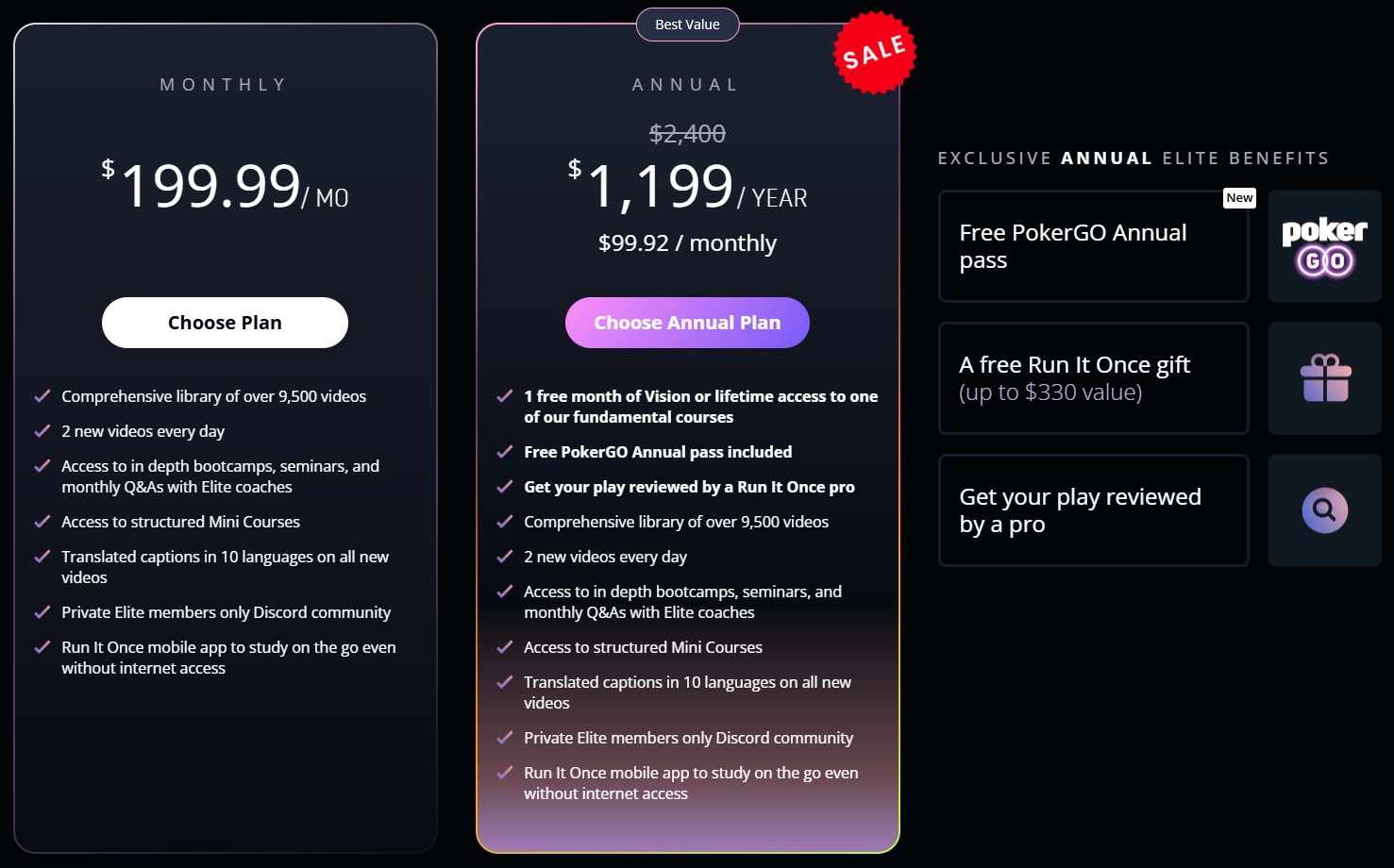
Between the discounted annual price, the added bonuses, and the January training events, this is literally rhe best opportunity of the year to become a Run It Once Elite member. For players ready to take their poker studies seriously and commit to real improvement in 2026, this offer is well worth it.
Don’t wait to super max late reg on this one! The promotion runs from now through January 15, 2026.
For a long time, poker books have been one of the primary sources of knowledge for those wanting to improve at the game. Over time, the book format has largely been replaced by other types of content, such as training videos and podcasts, to the point where some would argue books have become obsolete. At the end of the day, however, that just boils down to your preferred way of studying and consuming information. After going through Jonathan Little’s latest (work) book, aptly entitled The Complete Poker Workout, I can say that there is nothing obsolete or outdated about it.
If you’re someone who likes to study at your own pace and take your time absorbing the information, The Complete Poker Workout is great. It is filled with practical hand examples and explanations from one of the world’s best poker coaches. So, as far as the value you’re getting is concerned, you can’t go wrong.

The Complete Poker Workout at a Glance
Jonathan Little’s The Complete Poker Workout isn’t your traditional poker book. It’s actually a workbook that requires active participation from the reader. If you were expecting a strategy book that you can read through, hoping some of it will stick, this one isn’t for you.
This book consists of 100 tournament hand examples, and each example is given in a quiz format, where you’re asked to make a decision on every street. You get to choose one of four options, and right below that you’ll find what the right answer is, coupled with a detailed explanation as to why.
According to Little, the guiding principle for the book was to provide readers with the feeling of actually playing hands, which is one of the best ways to learn the game. The upside, of course, is that you don’t have to put any money on the line. Plus, you’ll get instant feedback, allowing you to fix gaps in your strategic approach to the game.
Of course, not all situations in poker are perfectly clear-cut. Sometimes, there is more than one answer to a specific question, and when this is the case, Little points it out and offers an explanation as to why.
In addition to the text describing the action, The Complete Poker Workout is full of diagrams showing relevant positions. This is very helpful as it saves you the mental energy of having to paint the mental picture of the table and positions. Diagrams show cards, stack sizes, and the size of the pot, so all information crucial to making a correct decision is available at a glance.

A Book that Facilitates Engaged Learning
Those who are familiar with Jonathan Little’s work and his PokerCoaching.com platform already know that his model relies heavily on active, engaged learning. His latest book represents a continuation of that approach.
The focus is on tournament hands, as this is the format Little knows best, which means that you’ll come across different scenarios. Sometimes, you’re playing with 300+ big blinds effective; some examples will have you in a spot with 40 – 50 big blinds, while other hands focus on short-stack strategy, all the way down to 15 big blinds.
In the 100 hands the book tackles, Little tries to encompass the reality of tournaments, covering different stack sizes and having you play from different positions.
Regardless of the spot, each example takes you through the entire hand, breaking down every decision point. Every hand starts with preflop action and goes from there, just the way it works in real life. In poker, you don’t get to skip on a decision just because it’s too complicated or you don’t like any of the options.
Little has done a fine job selecting hands that are a bit “out there,” too. It’s not that hard to play a hand where you flop a strong top pair, and the board runs clean to the river. But what do you do with a turned second pair after floating a flop? Or how do you get value from runner-runner two pair? How should you navigate your decently strong top pair against multiple players? This workbook will help you answer those questions.
Who Is The Complete Poker Workout For & Does It Work in 2026?
What makes The Complete Poker Workout a very valuable book that you’ll want to add to your library is the author’s experience. Most accomplished tournament players could pick 100 hands and break them down street by street, but this book’s strength is in the hands Little selected; he did an excellent job of choosing scenarios that are often confusing and put players in tough spots.

It is his experience as both a player and a coach that allowed him to do so. On one hand, he knows from his own experience what these difficult spots look like. At the same time, he’s been teaching poker for years and is also aware of what questions constantly come up.
It’s also great that every hand is a mini-lesson in its own right. This gives you full freedom to study at your own pace. You can go through as many or as few examples as you like on any given day and come back to the book at a later date to pick up where you left off (or go through the same hand to see if you’ve internalized the lessons).
The book’s excellent Table of Contents allows you to quickly skim through different hand types for hands that describe spots that you usually struggle with. Just by looking at this short description, you’ll know the stack size, the position, and the type of scenario (value betting, bluff-catching, defending, etc.).
So, who is this book for? I’d say anyone who wants to become a better tournament player. The examples brought forth show you a wealth of options you have in different situations, and force you to think about every single decision, just like you’d have to do at the table.
In the world where other types of poker training have largely taken over, The Complete Poker Workout still works. In fact, it may be a better option than many video courses out there (or at least it can complement them well), exactly because you can’t zone out! The only way to approach this book is by actively participating in it.
While you’re learning about specific spots, your ability to think critically about poker hands will develop as well. This will help make you a better poker player overall, and that’s a nice side-effect of The Complete Poker Workout (whether intended or not).
The bottom line is, this book is well worth the $24.95 price tag, even if you only use it occasionally to go through a few hands or you want to use it as a benchmark for knowledge acquired through other sources, such as training videos. At the very least, realizing you still need to work on certain spots will cost you far less than learning the hard way.
The first week of my month as a semipro mixed game poker player was supposed to be about easing in to the new daily poker routine, finding my rhythm, and settling into the dual life of work-by-morning and poker grind-by-night. What it actually became was a test of emotional control, discipline, and learning to accept the unpredictable nature of mixed games.
My wins arrived in bursts, my losses in waves, and at one point an impulse to gamble challenged my resolve to have the discipline required of a semipro. The week started off by offering the familiar comfort of a steady upward climb and drove home a number of lessons that I knew I’d need to internalize as my month as a semipro mixed game poker player began to unfold.
Day 1 | November 5: Hoisting Anchors and Setting Sail
After arriving late the previous night, I spent the morning taking care of work and errands; an intentional anchoring before diving into poker playing mode. Among the other “anchors” I cast was setting off on an hour-long morning walk. I knew that I’d be spending a ton of time indoors sitting, so getting the fresh air and movement would provide a critical and healthy balance. Plus, the 82-degree weather was absolutely gorgeous!
I’m proud to say that I truly stuck to the exercise walks throughout the trip, getting in an average of four per week. That, along with my 100 push-ups per day and learning my daily page of Talmud helped provide a rudimentary framework for my days.

By afternoon, I was at Resorts World, reconnecting with my poker media friends working at the North American Poker Tour (NAPT). It was interesting; obviously a fully familiar scene for me, but I wasn’t there to work or cover the event. I was in Vegas to play poker. By evening that itch was too strong to ignore.
So, I drove out to South Point for a “warm-up session” to play $4/8 Omaha 8 or Better. My goal was simple: try to double my $200 buy-in. But that’s easier said than done. While I didn’t get there in a quantitative sense, I did achieve a good result, namely that I played disciplined, patient, and composed – the version of myself I was determined to be throughout the month that would follow.
For three hours I hovered around -$130, but I didn’t panic, chase losses, or self-destruct. Eventually a little rush of cards arrived, and because I hadn’t spewed off the rest of my stack (I wouldn’t have bought back in if I had lost all my chips), I was “still around” to capitalize on the upward momentum. I surged up to +$80 and, more importantly, actively recognized when the momentum was ending. I picked up and left with a small $50 win. It was my first reminder of the month that a “win in discipline” could be even more meaningful than a win in dollars.
Day 2 | November 6: Meeting the Mentor, Taking Shot #1
I woke up from a bad night’s sleep with a headache and nausea. Not exactly prime poker-playing condition. Even so, in my excitement to be in Vegas and with a desire to hit the tables, I convinced myself that “sometimes you just have to play through it.” In retrospect, I realize that “sometimes your body’s telling you to sit this one out.”
Before heading out to play, I had a rendezvous with my friend and mentor Poker Hall of Famer Eli Elezra. I’m experienced enough to realize that regularly playing $20/40 on my own dime would constitute poor bankroll management, so when Eli offered to stake me in higher stakes mixed games (just like on my brief four-day Vegas trip in September) I snap-accepted.
Thus, in my $20/40 sessions I’d be “freerolling” and giving Eli half my profits, while I’d be “on my own” when playing for any stakes below that. I know exactly how fortunate I am to be in such an awesome spot, and Eli knows just how grateful I am for the immensely generous staking opportunity.

With that, I headed to the Wynn to play in my first $20/40 session of the month. I bought in for my customary two racks ($1,000), quickly went up $200, and then proceeded to bleed it all back and then some through missed draws and a touch of frustration-induced looseness. I added on for $500, steadied myself, climbed back up to $1,250, then slipped again. After 5.5 hours, the game broke and I booked a $420 loss. It wasn’t a disaster by any means (equivalent to losing $84 in a $4/8 game), but it wasn’t the way I wanted to kick off the higher-stakes sessions.

To help the adrenaline wear off, I then headed to the NAPT Players Party. Trying to forget about the losing session, I knew I had to “flip the switch”. I was in Vegas as a semipro, not a full-time pro. Networking and maintaining my poker industry relationships matters a lot. Even though I hadn’t had any official plans to be spending too much time at the NAPT, I knew that utilizing the opportunity to see people, have conversations, and be part of the scene was the right call.
Barely 48 hours into my trip, I then made my first real mistake. After the party ended, I felt the temptation to play a little more, so I decided that the $4/8 Omaha 8 game at South Point would be the right low-stress fit. That wasn’t the mistake though. It was what I did after seeing the game was full. Instead of just leaving, I donked off $50 playing video poker ($30) and roulette ($20). Poof! Day 1’s win had evaporated.
Walking back to the car, I swore to myself that it would be the only non-poker gamble of the entire trip. While that didn’t prove entirely true (I gave in to my video poker impulses for another $10 a couple weeks later), I’m proud that I stuck to my guns and didn’t really fall into any gambling traps throughout my month as a mixed game poker semipro.
Days 3-4 | November 7-8: Resting, Relaxing, and Making Good Decisions
While poker might be on my mind 24/7, I always take a step back from the felt (and everything else) on the Sabbath. Beyond that, ahead of my trip, I had resolved not to play on Fridays since in the winter months the onset of Shabbat is so early in the day (around 4:20pm). On the flip side, with Shabbat ending so early (around 5:30pm) I knew I’d have some great playing opportunities on Saturday nights.
Indeed, I spent a wonderful and relaxing Shabbat with my friends. Beyond their kind hospitality, it was also my first exposure to the orthodox Jewish community in Summerlin. Just as with the daily morning routines I had crafted, having a “proper Shabbat” at the end of the week served to help keep me grounded in reality despite the vastly different poker life I was leading.
I turned my phone back on when Shabbat ended to see a message from my friend Ruth Sun (more about her in the next installment…) that she was organizing an $8/16 game at Resorts World. So I locked up my seat and headed there to play.

I bought in for two racks ($400) and over the next four hours I played smart, relaxed, and disciplined and won $500. Even though I still had tons of energy, I made the decision to quit the game at midnight. That’s something I essentially never do in my home games because they represent my only chance to play each week. In Vegas, however, there’s always more poker to play the next day. That makes it a lot easier to quit a session. Plus I needed to make sure I didn’t get into a bad habit of falling behind on my regular work responsibilities. That choice (leaving a good game because long-term discipline matters more) felt like another quiet victory.
Just because you’ve made the right decision many times in a row doesn’t mean that doing so “the next time” gets any easier. Choosing wisely is never a given, especially with poker games running 24/7 in Las Vegas, so doing so is an achievement that ought to be celebrated. Moments like these ended up happening fairly regularly; in a sense, they defined my trip… but I didn’t always make the right decisions.
Day 5 | November 9: Achieving the Perfect Balance
Knowing that I had an $8/16 game scheduled to start at 4:30pm ensured that I would use the time beforehand optimally. So, the day began with some “regular, normal life” balance: an article published, a newsletter sent, picking up my “poker aunts”, Women in Poker Hall of Famers Jan Fisher and Linda Johnson from the airport and spending some quality time with them.
Then, my game got cancelled… then revived… then postponed… then finally confirmed for 7pm. Here’s why all of that is important to mention: mixed games aren’t like Texas Hold’em. You (unfortunately) can’t just expect the game to be running all the time, even in poker’s Mecca. You also can’t just show up and expect to have a seat. You need to cultivate relationships with other players and poker room managers. You need to invest in being communicative. You need to have a relatively flexible schedule.
A seat in a mixed game isn’t a guarantee; it’s a privilege that requires coordination. Often, keeping your schedule as open as possible so as to prioritize playing and guarantee yourself a seat in the game means you’ll have to be willing to forego other activities. Otherwise, you run the risk of being “shut out” and not having a game to play in. That would suck. I didn’t travel 7,500 miles to sit on the sidelines. I came to play!
A good old $8/16 mix at @PokerRoomRWLV … win or lose, it’s a very happy place, indeed ???? pic.twitter.com/WvrnU4luKR
— Robbie Strazynski (@cardplayerlife) November 10, 2025
The game ran 5.5 hours. I played very well, even though the first four hours were brutal: no cards, no traction, down to $100 from my original starting stack of $400. But I once again was able to keep my emotions in check, tell myself to wait for the momentum shift, and be ready to pounce if and when it finally came. Thankfully, it did, and I managed a massive $800 positive swing over the next 1.5 hours. Then, around midnight, I again made the right decision: it was time to quit and head to sleep. There was more poker to play tomorrow.
Day 6 | November 10: You’ve Gotta Handle the Swings
After getting my work done in the morning, I had a lovely pizza lunch with a friend from Israel who happened to be in town. I then headed back to the Wynn for my next $20/40 session. It turned out to be nine hours long. After about two hours, I had lost nearly my entire $1,000 starting stack. Frankly speaking, I just wasn’t playing well. Luckily, I managed to scoop a huge badugi pot with my final chips at risk, giving me back a full rack to work with.
That’s the thing about having some single-winner games as part of a mix; while it’s still a fixed limit variant of poker, your situation can fluctuate wildly!

Within 1.5 hours, I managed to claw my way back to even. Over the next couple hours, it was an absolute rollercoaster: I ran up my stack to $1,300, fell all the way back to $580, and then — with the help of a couple HUGE Action Razz pots (just like Razz, but you must be holding a paint card for your hand to qualify) — I made it back to breakeven.
While the rollercoaster was the story of the session, the other highlight was getting to play with a couple of old school poker legends, namely Cyndy Violette and Ted Forrest. Cyndy is a regular in the game, but Ted’s appearance (see below) was a surprise. I’ve played with Cyndy before, and I had also gotten to play with Ted before in an $80/160 mix, but the thrill of getting to mix it up with the old school poker legends that I used to watch on TV never gets old. It’s an exceptionally cool part of the Vegas mixed game experience.
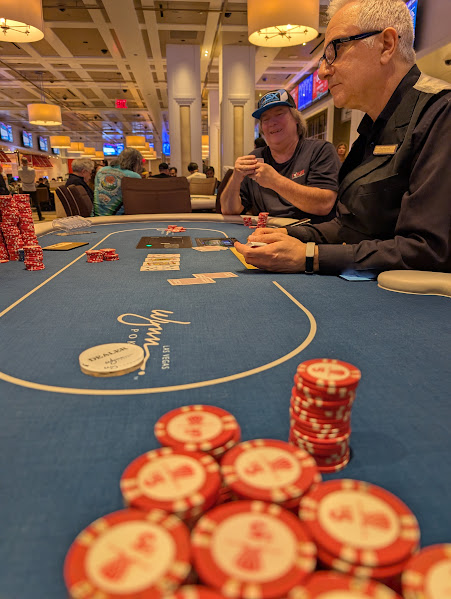
After all was said and done, the game broke with me up $35. I felt a variety of emotions racking up, chief among them relief. I couldn’t have known it at the time, but that $35 win would unfortunately represent my best performance of the trip in the $20/40 game…
Having logged a solid week in the black, I was in for quite the rude awakening in the next day’s mixed game sessions. Unbeknownst to me, absolute freefall was on the immediate horizon.
You can read all about that in the third installment of this miniseries. Buckle up; it’s going to be a wild ride!
Robbie Tracker: 31.5 hours of poker played | $970 overall profit
Almost as soon as I got back home to Israel from my summer trip to Las Vegas, I began planning for the next one. Specifically, I started working on putting together what would become Mixed Game Festival XII. Truthfully though, I had “bigger dreams,” far beyond “just” hosting another five-day poker event. I wanted the next Vegas poker trip to be longer. I needed it to be longer.
My poker-writing inspiration Brad Willis once said something that has always stayed with me: “A lot of the best writing comes from people who have been in the middle of the experience they are writing about.”
For 16+ years I’ve written about the game, promoted mixed games, interviewed the people who play them, and watched countless others live the poker-grinding life I’ve (not so secretly) envied. I was always the tortoise — patient, deliberate, watching, and dreaming. While so many others were playing poker at the tables, I worked alongside them… and carved out whatever precious little time I could to play. As it happens, I’ve felt that some of the best writing I’ve done has been about the special experiences I’ve had as a player.
READ MORE: The Low-Stakes Player Who Swam with the Sharks in the $80/160 Mix
But my kids used to be a lot younger, and my priorities were exactly where they needed to be. Now the circumstances are different. My kids are older, more independent, and I’m 44 years old. I’m no longer content just writing about poker world anymore. I desperately want to be a part of it as a player, too.
As such, you could only imagine my elation as I booked my trip to Las Vegas for November 4-December 4. This was really happening! I was going to have the opportunity to live the life of a semipro mixed game poker player for an entire month!
OMG. Wow, what an incredible start to the trip…! #upgrade ????
Maybe someone at Delta saw it was my birthday yesterday? ????
When you’ve got a 7,500-mile trip to take, this is just a WHOLE other level of travel!
So grateful ???? not gonna take a single moment of this for granted. pic.twitter.com/VyGmS8GUVB
— Robbie Strazynski (@cardplayerlife) November 4, 2025
The Poker Dream I Finally Let Myself Prioritize
Thus, beyond hosting and promoting the latest Mixed Game Festival, I headed out to Las Vegas aiming to see if I could really do it — to live, at least temporarily, as a semipro mixed game poker player.
Playing poker is just something that I love to do. I’ve longed for this for years: the rhythms of the grind, the challenge of the games, the camaraderie of regulars who share this passion for poker and live a “Cardplayer Lifestyle.” More importantly, as I wrote back in September, I’ve started cultivating a more professional mindset when I play, and I believe I have enough skill to compete “on the big stage in Vegas” and win.
Early this year, I declared my intention for 2025 to be my “year of volume.” Prior to departing on this trip, I had logged more hours this year than any year before — something that would have seemed absurd to me a decade ago. But the goal wasn’t just to play more. It was to play seriously, to test myself, to see if poker play could contribute something meaningful to my family’s income.
In 2024, I played 545 hours of poker.
I decided to make 2025 “the year of volume”.
I have played 581 hours of poker this year… and I’m about to embark on a month-long trip to Vegas.
I turn 44 years old today, and I’m just so grateful and in love with the game. ❤️ pic.twitter.com/eLmqTvIwLT
— Robbie Strazynski (@cardplayerlife) November 3, 2025
Thankfully, I wasn’t risking anything dramatic besides simply not being home for a month. But even that involved some sacrifice. My wife, Miriam, carried that weight with love and optimism, giving me an extraordinary amount of support and space. She hoped — right alongside me, from 7,500 miles away — that I’d win, that I’d prove my theory to be true, and that I’d come back feeling fulfilled. She is the one who made this whole experiment possible, and she deserves enormous thanks.
My Documentary Approach: How This Miniseries Came Together
From the beginning, I knew that if I wanted to truly capture what a month as a mixed game poker semipro feels like, I needed to document it in real time. So I did my best to be disciplined and professional throughout the trip.
During each day — whether I played umpteen hours of poker or none at all — I jotted down little notes. Sometimes I snapped a picture. Other times I recorded voice notes, to be sure I’d remember the exact tone of how I was feeling. The point was to preserve the details while they were still fresh in my mind. To capture the emotions I was feeling before they got diluted or diminished by hindsight or rose-tinted lenses.
At the end of every day — whether that “end” came at 11 p.m., 3 a.m., 5 a.m., or even 7 a.m. the next morning — I sat down and turned those notes, pictures, and voice recordings into diary entries. The process was cathartic. The consistent documentation of what happened at and away from the felt each day during my trip helped me unwind, decompress, and make better sense of everything.
The 9,000+ words I drafted over my month in Las Vegas served as the clay that I ended up molding into this five-article miniseries. There’s no fanciful reconstruction from memory weeks later. No romanticizing. No airbrushing. No forgetting or intentional omission of critical details. Just the reality of what it’s like to spend a month battling, studying, grinding, trying to find the right balance, and living the mixed game poker life.
Where I Fit in the Mixed Game Poker Ecosystem
I’m obviously not the first person to take a shot at playing poker semiprofessionally. But I think there’s some uniqueness in what I attempted: namely playing low-stakes mixed games, as opposed to no limit Texas Hold’em.
For further context, I’ve built my bankroll over the years overwhelmingly playing low-stakes mixed game poker; very slowly and steadily. Typically I only play once a week, in my home game, for approximately 5-7 hours. Thus, one week of dedicated play (e.g., 8-10 hours per day) in Vegas would equate to “a couple months” of what I usually play.
I’ve never had any big tournament wins or “inordinately huge sessions” (for good or bad). Sitting at just under the five-figure dollar mark, I figured this was enough to take with me to Vegas for sessions at limits ranging from $4/8 to $9/18, perhaps play in the occasional low buy-in mixed game tournament and, if things went well, perhaps take a couple shots at $20/40.
In a best-case scenario I had hoped to approach $5,000 in winnings, which would be amazing! In a worst case scenario I envisioned losing about half my bankroll, which would suck. Hitting either of those extremes would be difficult, given the nature of mixed cash games, and neither extreme would make a massive difference to my life, which is something I’m supremely grateful for. At the end of the day, I aimed to be a semipro; i.e., that any poker winnings would be in addition to revenues I’d earn from my regular work. And if I’d lose, it would only affect my bankroll and not my family’s financial situation.
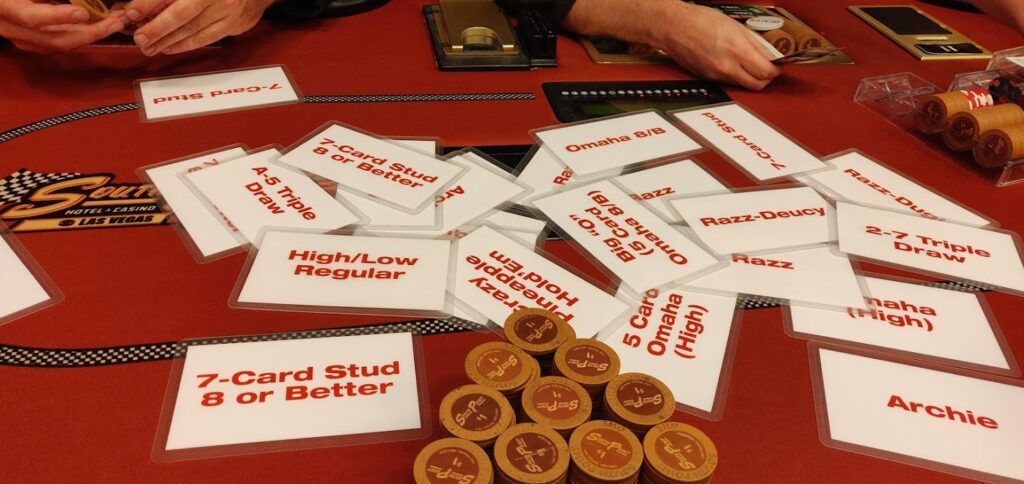
Against Whom Did I Play?
Over my month in Las Vegas, I’m fairly certain I didn’t encounter any full-time professionals regularly playing the lower-limit games I was mostly in. I don’t believe it’s financially feasible to make a full living at stakes lower than $20/40. But semipro? Supplementing other income? I believed that to be entirely possible.
I believe that most of the mixed game players I shared the felt with fell into a few categories:
- vacationers testing the mixed game waters
- retirees playing to stay sharp, social, and energized
- self-employed players or those with flexible income streams
- locals squeezing in a session before/after work
I also felt that while the atmosphere was certainly different when I was playing in tournaments, or on the rare occasion that I wasn’t playing in a mixed game, there was one noticeably common trait to pretty much everyone I played with in the mixed cash games: joie de vivre. The low-pressure-but-serious vibe of these games fits perfectly into a healthy, active, social life.
All of us were having fun, trying to win each other’s money, and aware of how fortunate we were to be playing a game we loved “on a random Monday afternoon”. More than once I caught myself thinking and hoping: “maybe this could be what my retirement will look like someday?”
What This Miniseries Will Aim to Capture
This five-part miniseries will tell the full story of my month in Las Vegas: the ups, the downs, the breakthroughs, the setbacks, the grind, the fatigue, the joy, the uncertainty, and my ever-present gratitude running through all of it.
Frankly speaking, this trip wasn’t just about poker. It was about finally giving myself permission to chase a dream I’ve held on to quietly for years and discovering what happens when you put yourself directly in the center of the experience.
I can’t wait to share it with you. (Click here to read article #2 in the miniseries)
Finally learned my lesson and remembered to get a window seat…
…and was rewarded with the most glorious view ????
Few things get my heart going like this amazing city.
Let a wonderful month begin!
Ah… Las Vegas ❤️ pic.twitter.com/aXfh13bKVn
— Robbie Strazynski (@cardplayerlife) November 5, 2025
Why does the same player who correctly folds to a river bet at $25/$50 call the identical spot at $1/$2?
The answer reveals poker’s most exploitable edge: human decisions optimize brain reward, not chip EV.

Brain Reward as Final Common Pathway
Poker decisions emerge from two forces running in parallel. One is strategic calculation: pot odds, ranges, and frequencies. The other is the brain’s reward system.
While we may consciously think in terms of EV when we compute pot odds and ranges, our final decision is filtered through how we expect different outcomes to feel. This includes the relief of avoiding a loss, the satisfaction of a good fold, the thrill of a successful bluff, or the validation of a hero call.
I’ll refer to this internal payoff as the expected “brain reward” (sometimes called neural currency). It is the final common pathway where all inputs converge and a decision is made.
Crucially, the expected brain reward often differs from the actual brain reward. For example, we may expect “getting unstuck” to feel like a huge win, only to discover that once it happens, the emotional payoff is far smaller. Both of these differ from chip EV. What matters is that the expected brain reward is what drives the decision in real time. Stronger players tend to align this expectation more closely with EV, but it is never eliminated entirely.
Importantly, this is not just about emotion. Many disciplined players suppress emotional impulses well, yet still deviate from chip EV–optimal lines for practical reasons such as avoiding an ATM trip, preserving a final buy-in, or locking up a winning session. Brain reward includes all sources of utility beyond chips, whether emotional, practical, or personal.
Asymmetric Indifference
This leads to Asymmetric Indifference: systematic deviations from GTO equilibrium that are not mistakes, but rational optimizations based on brain reward rather than pure chip EV.
These show up in two common ways.
- Individual asymmetry: A player’s brain-reward priorities create consistent personal deviations. Folding a slightly plus-EV spot to avoid variance or stress is not irrational. It is an optimization of comfort over chips.
- Role-reversal asymmetry: The same player may have different indifference points depending on whether they are betting or calling, because the psychological framing of risk is different in each role.
This asymmetry creates exploitable gaps that game theory alone cannot predict.
The Push-Away Exploitation Framework
As an example, a GTO river strategy often tries to make opponents indifferent. Against humans, that goal is misplaced. Instead, we should exploit brain-reward-driven deviations by pushing opponents away from their indifference point in our favor.
Example 1 – Value betting against calling stations
GTO indifference: A 50% pot bet makes them indifferent between calling and folding.
Their brain-reward indifference point: Because calling and being right feels good, they may not reach indifference until around a 70% pot bet.
Optimal exploit: Bet 65% pot.
Result: They continue calling with worse hands while you extract more value. You are deliberately not making them indifferent. You are keeping them in their calling zone.
Example 2 – Bluffing against risk-averse nits
GTO indifference: A large bet is required to make bluff-catchers indifferent.
Their brain-reward indifference point: Fear of calling and being wrong may push that threshold much lower, perhaps around 40% pot.
Optimal exploit: Bluff 45% pot.
Result: They fold hands that are theoretically profitable calls but we lose less when they have a hand that would have called a larger bet.
Principle: Identify where an opponent’s brain-reward indifference point lies, then size your bets to exploit the gap between that point and GTO.
Dynamic Indifference Points
These indifference points are not fixed. They shift with fatigue, recent wins or losses, and session dynamics. After a bad beat, some players call too much. Late at night, others fold far too often. The exact threshold moves, but it rarely disappears entirely. The edge you’ll get at the felt comes from noticing where that threshold sits right now.

Conclusion
Asymmetric Indifference explains why GTO beats humans but not maximally. Humans do not optimize Nash equilibrium. They optimize brain reward. Every player has discoverable indifference points shaped by psychology, context, and comfort with risk.
The goal in poker is not to make opponents indifferent to your maneuvers. It is to recognize where their indifference point differs from the math and push them away from it until the mistake costs them chips.
GTO seeks balance. As poker players, we should seek to exploit the imbalance between mathematical indifference and human brain reward indifference.
CoinPoker has just kicked off its biggest poker tournament series ever. The $10,000,000 guaranteed Winter Festival will run from December 26 through January 26. It is split into three stages, delivering turbo events, satellites with extra tickets, and CoinPoker’s biggest guarantees. The festival offers $200,000 in added value through satellites, leaderboards, and Second Chance Flipouts. The series is fully accessible via mobile web, ensuring players can join from anywhere on any device.

What is CoinPoker’s Winter Festival?
CoinPoker’s Winter Festival offers a wide range of tournament formats and buy-ins. It consists of three stages: Holiday Turbo Mini Series, Fresh Start Week, and Winter Masters Series.
The festival features No-Limit Hold’em and Pot-Limit Omaha events, as well as turbo and deep-stack structures. At its core is a huge $10,000,000 in guaranteed prize pools.
Players can join the action anytime, anywhere, through CoinPoker’s mobile web platform.
Holiday Turbo Mini Series (Dec 26–30)
The festival opens with a five-day turbo tournament series. These events offer fast-paced action, making them ideal for players who want to play poker over the holidays.
With Second Chance Flipouts, players can pick up tickets to the lucrative Winter Masters Series starting in January. Play three Holiday Turbo Mini Series in one buy-in tier (low, medium, or high). By doing this, players instantly qualify for Second Chance Flipouts, paying out $5,000 in tickets a day, but $10,000 in tickets on Sunday, the 28th.
Nobody is limited to a single tier of Second Chance Flipouts. For example, if you play three low-tier tournaments, three medium-tier tournaments, plus three high-tier tournaments, then you’ll get three Second Chance Flipout entries.
CoinMasters will be temporarily adjusted to 8-minute levels. In addition to that, the guarantee of its flagship tournament, the CoinMasters – BITCOIN event, will be boosted to $125,000.
Fresh Start Week (Dec 31–Jan 7)
The Fresh Start Week serves as the transition between the Holiday Turbo Mini Series and the Winter Masters Series.
From December 31 to January 7, players can look forward to boosted prize pools in New Year’s Edition tournaments, and satellites awarding a total of $30,000 in free entries.

Additionally, New Year’s Eve and New Year’s Day special tournaments provide $20,000 in added value, with $10,000 in Winter Masters Series tournament tickets available in each event.
CoinPoker designed the Fresh Start Week to give players with smaller bankrolls the chance to play for huge guarantees by building hundreds of satellite entries for the Winter Masters Series.
Look for $50,000 of added value during this week, $30,000 in satellite tickets and $20,000 from New Year’s Eve/Day events.
Through these two channels, CoinPoker can send even more players to the Winter Masters Series without increasing satellite buy-ins.
Winter Masters Series (Jan 8–26)
The Winter Masters Series is the pinnacle of the Winter Festival, bringing together millions in prizes and countless satellite seats built up during the first two stages. This will be the biggest tournament series in CoinPoker history, and even the CoinMasters – BITCOIN is boosted to $150,000 for every Sunday (an extra $25,000 guaranteed).
All the seats players win in the first two stages will flow straight into stage three’s headline NLH and PLO events. The schedule includes 6-max events, turbos, classic structures, PKOs, and deep stacks, with tournaments running from 11:00 AM to 10:00 PM UTC for global accessibility.
Three Main Events
The series is headlined by three Main Events:
- $500 High Tier Main Event with $250,000 GTD
- $75 Mid Tier Main Event with $75,000 GTD
- $15 Low Tier Main Event with $20,000 GTD
Major events such as CoinMasters and the Sunday Cup will feature boosted guarantees throughout the series.
$100,000 Winter Masters Leaderboards
During the Winter Masters Series, CoinPoker will host $100,000 leaderboards to add even more value. Each player’s best 10 tournament results can rank them on the leaderboards, meaning performance is rewarded, rather than volume.
Just for playing, these rewards can stack up in a big way, regardless of which buy-ins players choose.
To keep things fair for different stakes, leaderboards are split into tiers:
- $10,000 for Low Tier Buy-Ins
- $50,000 for Medium Tier Buy-Ins
- $60,000 for High Tier Buy-Ins
All winners will receive tournament tickets from the leaderboards, which they can use to enter huge events on CoinPoker like Sunday Specials, CoinMasters, PKOs, or other daily MTTs.
$200,000 in Added Value
The Winter Festival also provides $200,000 in added value through special leaderboards, Second Chance Flipouts, and free seats via exclusive online satellites.
How to Join the CoinPoker Winter Festival?
Joining the CoinPoker Winter Festival is straightforward and requires no opt-in. All benefits, such as satellite entries, tickets, and Second Chance Flipouts, are activated automatically.
Tickets are credited directly to poker accounts, while players with Second Chance Flipout entries are registered one hour before the start time.
With CoinPoker’s mobile web platform, players can effortlessly join and track all their entries conveniently.
About CoinPoker
CoinPoker is the fastest-growing online poker site and the home of the high stakes, trusted by pros worldwide. Built with a strong focus on integrity and performance, the platform offers fair and transparent gameplay alongside a packed tournament schedule featuring flagship events such as the Coin Series of Poker (CSOP) and the Cash Game World Championship (CGWC):
CoinPoker also supports fiat deposits in more than 25 countries, making it easily accessible to a global audience. To explore the platform in more detail, watch the latest YouTube video. New players can now get a ticket to a high-value $5,000 freeroll by using the sign up code MOBILE.
Active CoinPoker Promotions for Poker Players
- 150% Welcome Bonus up to $2,000: Kickstart your CoinPoker career.
- Fast and Furious: Fast-paced action and large 7-2 bounties.
- Seven Deuce Game: Play the action-packed Seven Deuce Game online.
- CoinMasters: $250k in total prize pools, including a $100,000 poker career.
Media Contact: [email protected]
As the online gambling industry continues to expand, many Canadians are eager to explore the excitement of online casinos. However, it’s essential to understand how these platforms operate legally.
A fundamental aspect of online casinos is the licenses they must obtain to ensure fair play and player protection. In this article, we will delve into the various licenses required for online casino operators and why they are crucial for a safe gambling experience.
Understanding online casino licensing
Online casinos operate under strict regulations, which vary by jurisdiction. These regulations are designed to protect players and ensure that the operators comply with the law.
The licensing process generally involves thorough vetting by regulatory bodies, ensuring that the casino platform adheres to specific operational standards.
In Canada, online gambling falls under provincial jurisdiction, meaning that different provinces may have distinct licensing requirements.
For example, some online casinos may hold licenses from local authorities, such as the Alcohol and Gaming Commission of Ontario, while others may opt for licenses from international jurisdictions known for their robust regulatory frameworks.
These international licenses often include those from the United Kingdom Gambling Commission (UKGC), the Malta Gaming Authority (MGA), and the Kahnawake Gaming Commission, among others.
Key licenses for online casinos
When choosing an online casino, players should look for specific licenses that indicate a reputable and legally compliant operator. Here are some of the most recognized licenses that online casinos often have:
- United Kingdom Gambling Commission (UKGC): This is one of the most respected regulatory bodies worldwide. Online casinos licensed by the UKGC must comply with stringent regulations regarding fairness, security, and responsible gambling practices
- Malta Gaming Authority (MGA): The MGA is known for its comprehensive regulatory regime that ensures operators provide a safe and fair gaming environment. Casinos with an MGA license are regularly audited for compliance, making them a trusted choice for players
- Kahnawake Gaming Commission: Based in Canada, the Kahnawake Gaming Commission has been issuing licenses since 1996. It is particularly popular among online casinos targeting Canadian players, as it allows operators to provide services within a regulated environment
- Gibraltar Gambling Commissioner: Similar to the UK and Malta, Gibraltar’s licensing authority ensures that operators meet high standards for safety and fairness. This license is well-respected in the online gambling community
The Isle of Man Gambling Supervision Commission also issues licenses to many of the iGaming industry’s most trusted casino operators.
The importance of licensing for players
Licensing is crucial for several reasons. First, it assures players that the casino website operates under a strict regulatory framework designed to protect their interests. Licensed operators are held accountable for their actions, and players have avenues for recourse if any disputes arise.
Second, licensed online casinos implement measures to safeguard player data and transactions. This is particularly important in an age where cyberattacks are prevalent, and for Canadian players, choosing a licensed iGaming platform with computer-generated and live dealer casino games can provide peace of mind regarding the security of their personal and financial information.
Lastly, many jurisdictions require licensed online casinos to promote responsible gambling practices. This includes offering self-exclusion options and providing information about gambling addiction resources, ensuring that players can enjoy their gaming experience safely.
Conclusion
To sum up, understanding the licensing landscape of online casinos is essential for anyone looking to engage in online gambling, especially if you are a Canadian player. Players can rest assured that they are participating in a legitimate and fair gaming environment by choosing licensed online casinos.
Always check for the appropriate licenses before enjoying the thrill of an online casino, as this can significantly enhance your gambling experience while keeping you safe and secure.
Cancun and the resort cities to the south of Playa del Carmen and Tulum, are popular tropical vacation spots, located in the southeast of Mexico on the Yucatan peninsula. Cancun is an easy flight from Europe and the Americas, and a very popular site for conventions and holidays. The entire area is known for picture-perfect beaches, resorts, beautiful fresh water cenotes, and year-round warm weather. So, as you might imagine, it can be quite appealing to play poker in Mexico.
The area is also known for extensive Mayan ruins. The largest Mayan ruin in the area is two hours west of Cancun at Chichen Itza. Tulum has a beautiful ruin overlooking the Gulf of Mexico. The third ruin is about 40 minutes west of Tulum in Cabo. It is massive, with nearly 3 miles of pathways to and from different ruins, and includes the tallest pyramid in the Mexico. Many travelers visit the area just to see these amazing representations of the ancient Mayan culture. I traveled there for all of that, and to play poker.

Just about 45 minutes to the south of Cancun is the resort community of Playa del Carmen (PDC). It, too, has beautiful beaches, many resorts, cenotes, and a vibrant nightlife. Though the beaches aren’t quite as spectacular as Cancun’s, and the nightlife not as filled with high-end nightclubs, it has a more laid back vibe that many prefer.
Between the two resort cities is a 50-mile stretch of beach known as the Mayan Riviera. On it are enormous, and often highly expensive and exclusive, beach resorts. About 45 minutes south of PDC, and 90 minutes south of Cancun, is the city of Tulum. It, too, is a very popular vacation destination, known chiefly for the two sites of extensive Mayan ruins: Tulum and Coba.
In addition to these three cities on the Yucatan Peninsula, there are also two well-known and frequently visited islands: Isla Mujeres and Cozumel. Isla Mujeres is right off the coast of Cancun, while Cozumel is 10 miles off the coast of PDC.
Beautiful though the beaches are, once the sun goes down, tourists and residents alike look to other activities to keep them engaged. There’s barhopping of course, and nightclubbing too, to be sure. But for some of us, nothing quite completes a great day like a session on the felt. Fortunately, for those of us who play poker, there are a few options in the area, and I’ll be telling you about them, should you someday be interested in playing poker in Mexico.
As recently as 2023, there were nine places that regularly had poker games – either cash, tournament, or both. As of December, 2025, however, there are just three – two in PDC and one in Cancun. They are all going strong, with regular schedules of tournaments, and consistent cash games seven days a week. I visited all three during my trip to play poker in Mexico. Each has something unique to recommend it.
(Places you might see listed as having poker that definitely DO NOT have regular poker games: Dubai Palace, Jubilee, Palace, Red Casino, Red Oasis Casino, Casino Macao, Queen Casino, Jackpot Casino, Codere, Casino Broadway, Casino Bahia, Moon Palace, Sam’s Club Casino, Secrets)
Poker in Mexico: Getting Around
There is a very good public transportation system running both within Cancun and between Cancun and PDC and Tulum. There are also all sorts of group trips, guided and unguided, to the historic ruins in the area. A visitor surely does not need a car to get around. Even so, I opted for the independence of a rental car.
I found the well-known American brands to be only slightly more expensive than other local options that I knew nothing about. So I picked one of them. My mid-sized car cost about $20 per day. I followed my travel consultant’s recommendation and took the optional insurance – bringing it up to about $50 per day for everything – about what I’d pay without the option insurance for a car in Las Vegas. I found the roads very good, traffic only moderate, road signs ample and easy to figure out. Driving in and around Cancun was much like driving in the US or Canada. Parking by my convenient hotel was very easy – as there were always many empty spaces nearby.
Exchanging Money for Mexican Currency
I looked into all of the options for getting local currency. I checked out wiring money from my bank, using an ATM machine, and bringing cash. Without question, for me, the best option was to bring a couple thousand dollars in cash, changing it to pesos at a currency exchange, and using that to buy chips in the casino. If I needed more cash, I would get it at a bank from my international debit card (Revolut or Wise are each free and highly recommended).
I also discovered that it paid to shop around for the best exchange rate. Rates ranged from the best of 17.6 pesos per dollar, at a currency exchange store 5 minutes from my hotel; to 17.1 at a large bank; to 16.8 at the airport, to the very worst of 15 at the casino. When I withdrew some money, as a test, at an ATM I was charged a 100 peso fee (about $5) and got a 16.5 rate – a double whammy!
Similarly, it made sense to shop around when converting my pesos to dollars. I ended up buying back my dollars for just a couple of tenths of a peso more than I sold them for. That was a whole lot better than the rates of 18.1 and 18.5 that the nearby banks offered.
Health and Safety in Cancun, Playa del Carmen, and Tulum
Crime:
The areas I’ve described and traveled to constituted what universally considered to be the safest part of Mexico. There is very little street crime. I’d say it’s less likely you will be robbed, mugged or assaulted than in any major American city. That being said, don’t be stupid. Carry your money in a locked pocket or on the interior of your pants or jacket. Be attentive to your surroundings. And don’t flash a lot of money around in the casino.
Sickness:
You won’t need any special vaccines or pills. But the CDC cautions visitors not to drink the water, not to eat lettuce and other fruits and vegetables that may have been rinsed with tap water, and to be careful of ice made from tap water. That being said, I’ve traveled to Mexico many times. I’ve had my share of lettuce and tomatoes on tacos, in soup, and even in a side salad. I’ve never gotten sick. Maybe I’ve just been lucky. But I do have a few suggestions to help you strengthen your immune system while visiting Mexico.
- Drink LOTS of bottled water. I buy a case of liter-sized bottles and drink 3 or 4 every day – in addition to anything else I might drink. Many people get sick because of dehydration. Drink a lot of water and stay healthy.
- Have at least one bowl of “caldo de pollo” (chicken soup) a day. It worked for my grandmother – who fed it to us when we were sick; and it seems to work for me as a prophylactic in Mexico!
- If you do get sick, you can buy your drugs at a “farmacia”. You can easily get those that require a prescription in the US. Prices for Lomotil, Imodium, Acidophilus, cortisone cream, antihistamines, and antibiotics are very reasonable – and usually less than what you’d pay in the US.
Cancun Poker Rooms
Palace Casino
Website: https://www.palacecasino.mx
Address: Av Tulum Esq Jabali, Av. Labná con, Colonia Centro
Hours: 5:00 PM – 2:00 AM
Phone: +52 55 7885 5001

The Palace poker room, up on the second floor of this small casino on the edge of the Centro district of Cancun, on the way to the hotel zone, offers a daily tournament at 5:00 PM (though you should check directly with the casino, as schedules change regularly). When I was there it was a $300 MX hold’em tournament, with 20-minute blinds, 20,000 in chips, and a $10,000 MX guaranteed prize pool. They had four full tables, and the tournament lasted until about 1:00 AM. I entered, busted out in about 90 minutes (playing hyper aggressively), and noticed a very casual, friendly, drinking, loose, and passive playing style. I conferred with a regular, who told me that this is the loosest tournament he knows of anywhere.
Cash games can start any time after 5:00 PM. They are typically $25/50 NLH/PLO or straight PLO, with a $2,000 minimum (roughly $100 US) and $10,000 (roughly $500 US) maximum buy-in. There was one game of each running at 5:30 PM when I was there my first night, and just the “mixed” game the second time I was there – starting at 7:00 PM. By the time I left at 11:00 PM there were two NLH/PLO games going and a list for a third. Though the doors of the casino officially close at 2:00 AM, and no new players will be admitted after that time, players already in the game continue often until 6:00 AM, with some games going until 9:00 AM, I was told.
I played in the NLH/PLO game one night, and observed another game that I never got called for my first night. There was a nice mixture of casual drinking gamblers (who played very slowly), and a few American tourists who were good but not great players. The house dealt about 18-25 hands per hour of hold’em and no more than 10-18 hands of PLO. As I said, it was a slow game. Still, for a skilled player, playing their best game, I think it would be profitable even with the rake. It was for me!
The games were not heavily raked by non-US standards – roughly 5% up to $150 MX (about $8 US). The dealers were good but not great. They didn’t make any obvious errors while I was there, neither flashing cards nor misdealing, but they engaged in regular conversations with the players – further slowing the games I played in or observed. On a few occasions, I had to urge them (nicely – as I was clearly an outsider) to continue with the deal.
There is a nice small restaurant, just downstairs from the poker room, with a wide variety of options, including soup, tacos, rice dishes, and desserts – and beverages of all sorts. Many players ordered food and ate at the table (further slowing the game). Also, as it happens, this casino is located in the heart of the area’s Jewish neighborhood. There is a highly recommended kosher restaurant, Yaffo Kosher Street Food, nearby. There are also all sorts of other meal options, including Middle Eastern, Italian, burgers, tacos, seafood, and Mexican, all within a 10-minute walk.
One word of caution: Whether officially allowed or not, there is quite a bit of cigarette smoke in the room. (This is true in all of the Cancun-area poker rooms). It’s not nearly as thick or annoying as it was back in the day, when smoking was allowed in US rooms, but it is more than just noticeable.
If you’re looking to stay at a very clean and inexpensive hotel near the poker room, with easy access to all public transportation, and a short walk to many restaurants, check out Ambiance Suites. I had a very pleasant stay there. It is literally right next door to the Palace casino.
Playa del Carmen Poker Rooms
Winpot
Address: Av. P.º Central Supermanzana 52 Manzana | 1 Lote a1, Col, Nuevo Centro Urbano, 77723
Hours: 3:00 PM – 3:00 AM
Phone: +52 984 109 2166
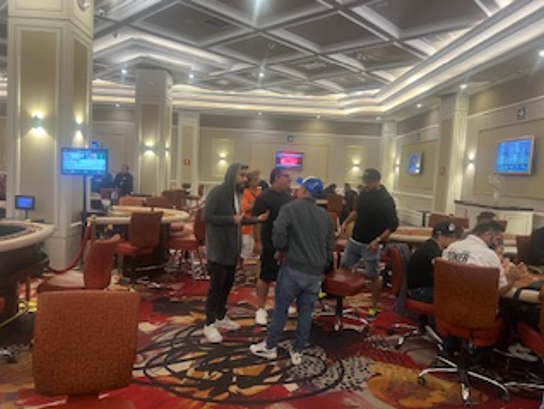
This room has a regular cash game and daily tournaments. The tournaments range in entrance fee from $300 MX to $1,000 MX or more for monthly or seasonal events that include small regular satellites.
The cash games are either No Limit Hold’em or dealer’s choice. They begin typically by 7:00 PM, when enough players to start a game have busted out of the 5:00 PM tournament. The games have $25/25 blinds, with a $1,000 to $5,000 buy in. The mixed game is PLO (4 or 5 card), NLHE and Mata Ace. Mata Ace is a game that began in Mexico that is being spread around the world now. It’s a mixture of stud and hold’em.
The rake at Winpot is roughly 5% up to a maximum of $150 MX.
Winpot is a modest-size casino in a mall on the south end of PDC. The table game area is located on the first floor off of a slot room. The poker room does not appear to allow smoking (reports differed). I did not see anyone smoking. But a lot of smoke enters the room through the doors to the smoking slot area. The smoke is more than just noticeable. I found it annoying – if not as awful as the smoking rooms used to be back in the day.
I visited there twice and watched some tournament action. Players were animated, vocal, and seemed to be having a great time. I’d say the chief vibe of the game was fun. I was eager to play – especially because of their variant Mata Ace that I had never played, but I was too impatient to wait until the cash game began.
Grand Riviera Casino
Address: 10 Avenida Nte. 105, Gonzalo Guerrero, 77720
Hours: 3:00 PM – 2:00 AM
Phone: +52 984 803 2703

I played two sessions at this small and unassuming casinos in the center of PDC, right by the large square and municipal building. I enjoyed my time there and would go back.
Poker begins at 3:00 to 3:30 or so, with a $5/10 blind no limit hold’em game, with a $500 MX (about $25 US) minimum and $1500 MX (about $75) maximum buy. At 4:00 sharp the stakes go up to $10/25 with a $1,000 to $5,000 buy in spread. And at 9:00 PM it changes again to $25/50 with a $2,000 to $10,000 buy in spread. The rake in all three games is the same, and the same as the other area poker rooms: roughly 5% up to a $150 MX maximum.
On the two occasions I played, the game was filled with extremely casual players from all over the world. Once, a player left the table, and his little dog jumped up on his seat as if to play. Weird and cute!

I met three players from Italy, two from France, a guy from England, two from the United States, and the rest from different parts of Mexico. Many of them were clearly just gamblers having their hand at poker for a change. They’d walk back and forth between the Ultimate Texas Hold’em house game and at the roulette table when they weren’t in a hand. There was a lot of limping and checking and very little if any 3- or 4-betting. It was a very comfortable (and profitable) place to spend a few hours. I managed to play tightly and win a few bucks.
The room also had a couple of promotions I had not seen before. I got it all in for about $60 with Kings. A player with 66 called me and then drew a flush. Alas. But then the house shouted “Hold on! You win the bad beat.” The bad beat award was $250 MX (about $15). It wasn’t really a bad beat, as it turned out, but an Aces or Kings cracked promotion. I had seen Aces cracked but never Kings cracked. Go figure!
They also did something else that I had heard about in home games but never seen in a casino. After about one round, at about 3:45 PM, the house walked over to the table with a life-size bust of Darth Vader. Everyone at the table said, “THE GHOST IS HERE!”

“The ghost” is a widow hand – played for $250 after the big blind. The ghost blind straddles all in to $250 MX and gets a hand. Thereafter players can call or raise, with the ghost hand in until the showdown.
Players are free to bet on latter rounds, creating side pots if they are not all in. If the ghost wins, then the ghost takes their portion of the pot, and it leaves the table at the end of the hand. The money comes back into play an hour later as a straddle equal to whatever the house won. This continues until the house loses, in which case the entire pot is awarded to the winner. When the ghost loses it does not enter until the following day. But if they keep winning, the total they have won becomes the new straddle. I was told that it once got up to $40,000 MX ($2,000 US) one evening before the pot was finally won by a player.
Poker in Mexico: Summary
Three poker rooms in the area: two in Playa del Carmen, one in Cancun. All start in the late afternoon or evening and go until the wee hours – overnight if necessary for seated players. The games are usually no limit hold’em, though the Palace has regular PLO, and Winpot has dealer’s choice including a local variant called Mata Aces. If cigarette smoke in any quantity is a serious problem then you probably can’t play here. That would be a shame, because the games are extremely good, the players generally extremely friendly, and the rake is not prohibitive.