
After all the excitement we saw on Day 5 of Mixed Game Festival XIV, including the Pokercoaching.com Meet-Up Game, appearances by Lon McEachern and Norman Chad, and an $800 HORSE tournament seat giveaway, there was a short break in action over the weekend.
By all accounts, that two-day break was perfectly timed, as players turned out en masse for the Day 6 action on Sunday, creating the busiest day of the festival so far. There were four tables going from the very start, with an unprecedented FIFTH(!) one opening within an hour.
There is no doubt that it was the allure of mixed games that attracted players to Bellagio, first and foremost, but the fact that there was another major giveaway in the cards certainly helped. One player would walk away with a $3,500 seat in the 2026 BetMGM Poker Championship, and that’s kind of added value you don’t find every day on The Strip.

By the time of the giveaway, there were three $4/$8 and two $6/$12 games going, and the atmosphere in the room was simply electrifying. But, unlike the first time, this time around, it wasn’t just luck that would determine the winner. Instead, the players’ knowledge of the game they so love was put to the test.
Poker Trivia Takes Center Stage at Bellagio
When the moment came, there was a random table and seat draw for the ticket giveaway. Whoever was occupying the seat drawn would have to answer three poker trivia questions correctly to claim the Championship ticket.
We have FIVE dealer’s choice mix tables running here on Day 6 of Mixed Game Festival XIV at @BellagioPoker!
Three $4/8s and two $6/12s!
Major $3500 @BetMGMPoker Championship seat giveaway happening soon. 💰
To say it’s an exciting day would be a major understatement. 🥳 pic.twitter.com/WrU1gnWzfP
— Robbie Strazynski (@cardplayerlife) June 7, 2026
The first draw did not produce a winner, as the player who was picked unfortunately stumbled on the very first question and couldn’t produce the correct answer. He received a consolation prize in the form of a RunGoodGear Mixed Game Festival T-shirt, but the grand prize remained up for grabs.
Table and seat cards were then reshuffled, there was a new draw, and, this time around, it was Barry H. from Manhattan in the hot seat. Barry demonstrated a high level of poker and MGF trivia knowledge, as he correctly answered three multiple-choice questions in a row, bagging himself a $3,500 entry into the upcoming BetMGM Poker Championship. He’s pictured in the winner’s photo above, alongside festival host Robbie Strazynski and Bellagio Poker Director Craig Larson.
Even with the giveaway done and dusted, the action continued strong at the Bellagio, as everyone was having a lot of fun and was in no rush to leave the premises. The mixed games continued across five tables for a whopping 10 hours, and even as the clock struck midnight, there were still three games going.
Pokercoaching.com Player of the Day: Jeremy Privett
A math and US history teacher hailing from north Alabama, Jeremy Privett, is our today’s pick for the PokerCoaching.com Player of the Day.
Jeremy comes out to Las Vegas for the World Series every year, and he loves playing mixed games, but the usual $20/$40 stakes offered at most places are a bit too high for his bankroll. This is why he was excited to hear people talking about the Mixed Game Festival at the WSOP and had to come across the street and see it for himself.

Poker has been a part of Jeremy’s life for a long time, as he learned how to play Omaha when he was just a boy, and practiced his general poker skills on one of those old-school entertainment system video poker games. He’s been familiar with the stud games as well, and after the Moneymaker boom, he also picked up Texas Hold’em.
He enjoys playing mixed games, but, unfortunately, there aren’t many casinos that spread them regularly these days, and there are no casinos whatsoever in Alabama. So, when he’s itching to play, he has to drive for at least three and a half hours to Tunica, Mississippi.
What he loves the most about the game is the camaraderie and having a good time at the tables, and that you get much more of that playing a mix. His message to everyone out there who might be hesitant is to come out and give it a try at low-stakes, and they just might be surprised at how much they’ll enjoy it!
Jeremy also loves his day job as a teacher, as it allows him to see people grow and reach their goals, and his math knowledge certainly comes in handy at the tables. In his spare time, in addition to playing poker, he loves watching football and playing fantasy football.
RunGoodGear Dealer of the Day: Vinicio Jurich
If there is one thing that Las Vegas is not short on, it’s interesting stories about people you’ll come across here. Vinicio Jurich, our RunGoodGear Dealer of the Day, has a story of his own, showing that this city often has a magical grasp on those who visit it.
Vinicio moved to Vegas about five years ago, at the height of the pandemic. He is originally from Buffalo, New York, where he had been working the same job since high school, hanging out with the same people all the time, and he was feeling a change was in order.

So, when his friend, a YouTuber, told him he was going to Vegas for a while and he was looking for roommates, Vinicio jumped at the opportunity. Having played poker growing up, Vinicio was interested in what Sin City had to offer.
He spent a few months playing poker, mostly recreationally and with mixed results, and then, as fate would have it, he met his girlfriend. This incentivized him to extend his stay.
Then, one of the dealers at Planet Hollywood told him about the dealer school that could open new opportunities for him. As he was considering whether this was a worthwhile investment, he came across his friend from Buffalo, who arrived in Vegas and was attending that very school! He figured this was enough of a sign to give it a go.
Vinicio spent the next two months acquiring his dealer stripes. After he graduated, he went for a WSOP audition as the Series was happening at the time, and he got his first gig as a dealer. Not long after, the Bellagio was looking for new dealers, and he applied and got the job.
Vinicio says all the people he met along the way over the last few years, and all the experiences he had while in Las Vegas, were very transformative. Before coming here, he was mostly introverted, spending most of his time inside and playing computer games. He tells us that he took that initial trip to Vegas, driving on an expired learner’s permit.
Although a lot has changed, he still enjoys playing video games to unwind. Lately, Fall Guys has been his favorite choice, in part due to the fact that his girlfriend took a liking to the game, so they can enjoy it together.
As for his hidden talents, Vinicio shares that he can sing pretty well, but he has a pretty serious case of stage fright, so he is only able to perform for the people he knows well.
This is his second time dealing at the Mixed Game Festival, and he finds that players are very welcoming to the dealers and always ready to help when someone’s not familiar with a particular game variant. From a player’s point of view, this also represents a good opportunity to expand his horizons and explore options beyond the usual NLHE and PLO options.
Pizza Party, Take Two!
The Mixed Game Festival doesn’t have hard stop limits. There is no telling how long into the night (or morning) the action will continue, but we can officially say that Day 6 was the busiest one so far.

For Monday, June 8, we have another pizza party coming up. Pop over to Bellagio around noon and have a slice or two to get some much-needed fuel before you get on the grind.
As always, seat reservations are open, so call (702) 693-7291 to put your name on the list for $4/$8 or $6/$12 and help us get Day 7 underway in style. We are now into the second half of Mixed Game Festival XIV, but there are still some exciting things coming up, so stay tuned!
A little birdie just told me that @PokerCoaching_‘s @rumnchess will be making an appearance early in the day at @BellagioPoker for Mixed Game Festival XIV.
Also, I understand that there will be pizza 🍕
A couple great reasons to come and join us 😀
Call 702-693-7291 pic.twitter.com/u3rTPskSOB
— Robbie Strazynski (@cardplayerlife) June 8, 2026
Every summer during the World Series of Poker in Las Vegas, while thousands of players are chasing bracelets and dreaming about six- and seven-figure scores, another conversation occasionally and quietly makes its rounds through the poker rooms. It happens in the hallways at the Horseshoe, over drinks at Bellagio, and at poker tables across America and the world where players have been grinding together for years. The topic isn’t that last big hand or their latest bad beat. It’s the Poker Hall of Fame where the following questions are often raised.
- Who’s In the Poker Hall of Fame — and why does it matter?
- Who are the Poker Hall of Fame inductees still raising eyebrows?
- And finally: Who are the biggest Poker Hall of Fame snubs?
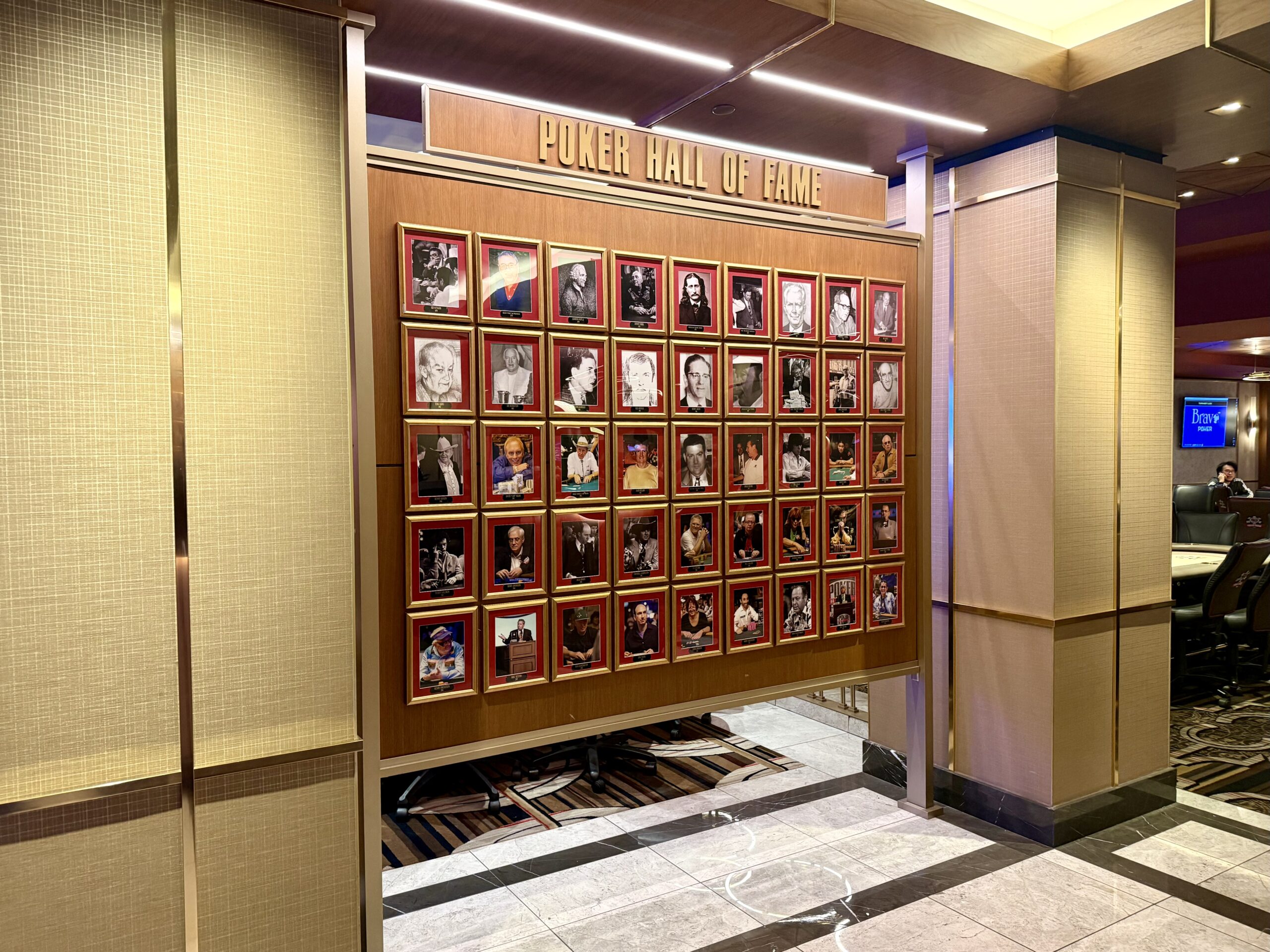
The Poker Hall of Fame is supposed to represent the very best the game has produced — players who’ve stood the test of time, pioneers who helped build the game, and the personalities who carried poker from smoky backrooms to a worldwide stage. But like poker itself, the Poker Hall of Fame isn’t always as straightforward as it looks. Ask 10 poker players who deserves to be there and you might get 10 different answers. In fact, some of the most interesting discussions in poker begin the moment someone asks a simple question: “How did that guy get in before this guy?”
In this three-part miniseries, we’re going to take a closer look at the Poker Hall of Fame. We’ll start with who’s already in and why their place in poker history matters. Then we’ll explore some of the inductions that still raise a few eyebrows around the table. And finally, we’ll talk about the names many players believe belong in the Poker Hall of Fame but, for one reason or another, are still waiting outside the door.
Because if there’s one thing poker players love — almost as much as the game itself — it’s debating who really deserves to be remembered as one of the game’s legends.
Poker Hall of Fame: Who’s In and Why It Matters?
Visiting the Poker Hall of Fame at the Horseshoe Casino Poker Room in Las Vegas can feel a little like stepping into poker’s inner sanctum. It’s a place deeply connected to the game’s history and to the larger-than-life personalities who helped turn poker into the worldwide phenomenon it’s become. To the casual visitor, it may look like just another well-designed display along the Las Vegas Strip. In the background the chips are clicking, cards are in the air and players are staring each other down across tan felt. But to a true poker aficionado, there’s something more to be seen, more to be felt.
Along one wall near the entry is a display of gold-framed photographs of the men and women who make up the Poker Hall of Fame. These are the people — certainly some are legends — whose names echo through the history of the game. It’s poker’s attempt to define its own history — to decide who shaped the game, who elevated it, and who left a mark big enough that the game simply wouldn’t look the same without them.
The list reaches back to the earliest days of card playing from rule-maker Edmond Hoyle to folk hero Wild Bill Hickok. Then it moves on to the more modern era of poker and Las Vegas, when names like Johnny Moss and Nick Dandolos were helping turn the game from a backroom pastime into something much bigger. The timeline marches forward through the decades — past the road gamblers and cardroom legends, into the tournament pioneers, and eventually to the television-era stars who helped carry poker to a global audience… the ones we often hear mentioned today.
Looking at the display you begin to notice something interesting. Some names make you nod instantly. There’s no debate, no hesitation. Of course they belong there. Others make you pause for a moment. And then there are a few that cause seasoned poker players to quietly tilt their heads and think, “Well, wait a second.” Because whenever human beings are responsible for choosing who deserves immortality, the results are rarely perfect.
My First Poker Hall of Fame Experience
I remember the first time I stood in front of that wall at it’s old location at Binion’s Gambling Hall in downtown Las Vegas. It was 2015 and looking at those faces felt a little like staring at a living timeline of the game itself. Some of them represented legends I’d read about long before I ever moved to Las Vegas, or even played the game of poker. Others were players I had watched on television. A few were people whose names I’d heard discussed in poker rooms late at night — the kind of stories that get told between hands when the chips are stacked high and the coffee has gone cold. As I stood there looking at that wall, one thought kept coming back to me. Poker history isn’t just written in poker books. It’s written in stories, arguments, and sometimes even a little controversy.
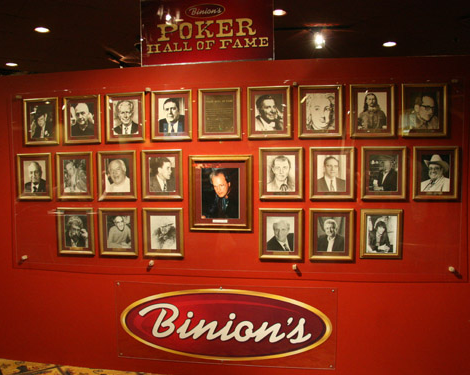
Over the years, the Poker Hall of Fame has produced not only legends, but debates, surprises, and a handful of decisions that still spark conversations in poker rooms around the world. Which brings us to the question at the heart of this series: Who’s in… and why does it matter?
History of the Poker Hall of Fame
Before we talk about the players themselves — the legends, the eyebrow-raisers, and the snubs — it helps to understand how the Poker Hall of Fame works in the first place. The Poker Hall of Fame, established in 1979 by Horseshoe Casino founder Benny Binion, was originally created as a way to honor the most influential figures in poker while also giving fans and players another reason to visit the casino during the growing excitement surrounding the World Series of Poker.
At first, the Hall included only a small group of legendary figures — players whose reputations had already become part of poker folklore. Over time, the criteria evolved, but the spirit remained the same. To be inducted as a player, candidates are generally expected to have stood the test of time, played at the highest levels of the game, competed against top competition, and earned the respect of their peers. Non-players — those who helped grow the game in other meaningful ways — may also be considered. Each year, the process generates debate among fans, media members, and players themselves. And each year one, occasionally two new names are added to the list, meaning that wall at the Horseshoe poker room will continue to grow — one photograph (maybe two) at a time.
But the bigger question is this: Does the Hall always get it right? In this first article, we’ll look at the players whose place in poker history feels almost unquestionable — the legends whose names helped define the game. Because before we talk about controversies or snubs, it’s worth starting with the people who remind us exactly what greatness in poker looks like.
The Legends — The Names Everyone Agrees On
Every Hall of Fame, sports and otherwise, has its debates. But every Hall of Fame also has its no-brainers — the names so deeply connected to the game that their inclusion feels inevitable. Poker is no different. Long before television cameras arrived and long before online poker created a new generation of stars, there were players whose reputations spread the old-fashioned way — by word of mouth, whispered stories, and stacks of chips pushed across the felt in smoky cardrooms.
One of the earliest and most important names on that wall is Johnny Moss. Often referred to as the “Grand Old Man of Poker,” Moss represented an earlier era of the game — the road gambler who traveled from town to town looking for action. His reputation for toughness and stamina was legendary. When the first World Series of Poker was held in 1970, as a cash game event, Moss was voted the champion by his peers, a fitting tribute to a player who would go on to win the 1971 and 1974 WSOP Main Event.
Another towering figure in poker history is Doyle Brunson. To many players, Brunson was poker royalty. His long career spanned decades, bridging poker’s old underground gambling culture and its modern televised era. Brunson won ten World Series of Poker bracelets, two of them Main Event wins. He went on to author the groundbreaking strategy book Super/System, which pulled back the curtain on high-level poker thinking and changed how many players approached the game. For generations of players Brunson’s influence extended far beyond the table. His presence in the Hall of Fame feels less like an honor and more like a historical necessity.
Then there was the unforgettable Stu Ungar. Ungar’s talent was so extraordinary that even hardened professionals spoke about him with awe. A prodigy originally known for dominating the game of gin rummy, Ungar brought that same razor-sharp mind to Las Vegas poker and captured three World Series of Poker Main Event titles. Many who watched him play believed they were witnessing the greatest natural card player who ever lived. His life, tragically short and troubled, only deepened the legend that surrounds his name and his place today in poker’s Hall of Fame.
Another player whose place in the Hall of Fame is rarely if ever questioned is Johnny Chan. Chan’s back-to-back World Series of Poker Main Event victories in 1987 and 1988 cemented his place in poker history. His calm demeanor at the table and relentless competitive drive made him one of the most feared tournament players of his era. For many fans, Chan also became a cultural icon after his memorable appearance in the poker film Rounders, where a famous scene introduced a whole new generation to the mystique of high-stakes poker.
And then there are the players whose dominance helped define the modern era of the game. Few names command more respect today than Phil Ivey. Often described by fellow professionals as the most complete player in the world, Ivey built a reputation for extraordinary instincts, fearless decision-making, and success across nearly every form of poker. His performances in both tournaments and cash games has earned him admiration from amateurs and professionals alike. For many observers, Ivey represents the bridge between poker’s old-school legends and the new generation of elite players.
These are the kinds of names that anchor a Hall of Fame. The players whose accomplishments are so widely respected that their inclusion rarely sparks argument. But even here, something interesting begins to happen. Because the deeper you look into the history of the Poker Hall of Fame, the more you realize that not every decision has been so universally accepted. And that’s where things begin to get a little more interesting.
In the next part of this series, we’ll look at a few of the inductees who, fairly or unfairly, still manage to raise a few eyebrows whenever their names come up in poker conversation. It’s a reminder that even in a game built on skill, judgment, and reputation, the line between legend and controversy can sometimes be surprisingly thin.
World Poker Masters concluded after generating almost 578,000 registrations across 781 completed tournaments and awarding more than $48,000,000 in prize pools across Main Events, High Rollers, CoinMillion, CoinMasters tournaments, trophy events, and leaderboard races. The biggest poker tournament festival in CoinPoker history produced some of the largest prize pools and tournament fields the site has ever seen.

World Poker Masters Becomes CoinPoker’s Biggest Tournament Series Ever
World Poker Masters concluded on June 1, 2026, after weeks of high-stakes action across Main Events, High Rollers, CoinMasters tournaments, leaderboard races, satellites, and trophy events.
Featuring $25,000,000 in guaranteed prize pools, the festival ultimately awarded more than $48,023,300 and became the largest tournament series in CoinPoker history.
Over 43 million hands were played, while 81,876 in-the-money finishes were recorded during the festival. Across 781 tournaments, players registered 578,251 entries.
Immediately after the series, CoinPoker thanked its community and announced that it would be increasing its weekly tournament guarantee by $2,000,000.
Hi everyone,
World Poker Masters has officially come to an end, and the level of support the community showed throughout the series was incredible to see.
From the beginning, World Poker Masters was built to be the biggest and most ambitious tournament series CoinPoker had ever… pic.twitter.com/AM22ERpT6k
— CoinPoker (@CoinPoker_OFF) June 2, 2026
Now that the World Poker Masters is finished, 59 players will receive their trophies, as well as a digital version for their CoinPoker Trophy Cabinet. The winner of the Main Event will be awarded a unique trophy that stands out from the rest.
‘dsfgdsgdsgd’ Wins World Poker Masters Main Event
The $2,500,000 guaranteed World Poker Masters Main Event served as the flagship tournament, running across multiple Day 1 flights before the final on June 1.
Players battled through opening flights and satellite qualification paths, with over 5,000 entries from all Day 1 flights contributing to a final prize pool of $2,730,000.
dsfgdsgdsgd secured the World Poker Masters Main Event title, earning $300,270 and capturing one of the biggest victories of the series.
The runner-up was m3rryf3llow, winning $225,290, while Bucko94 finished third for $171,420.
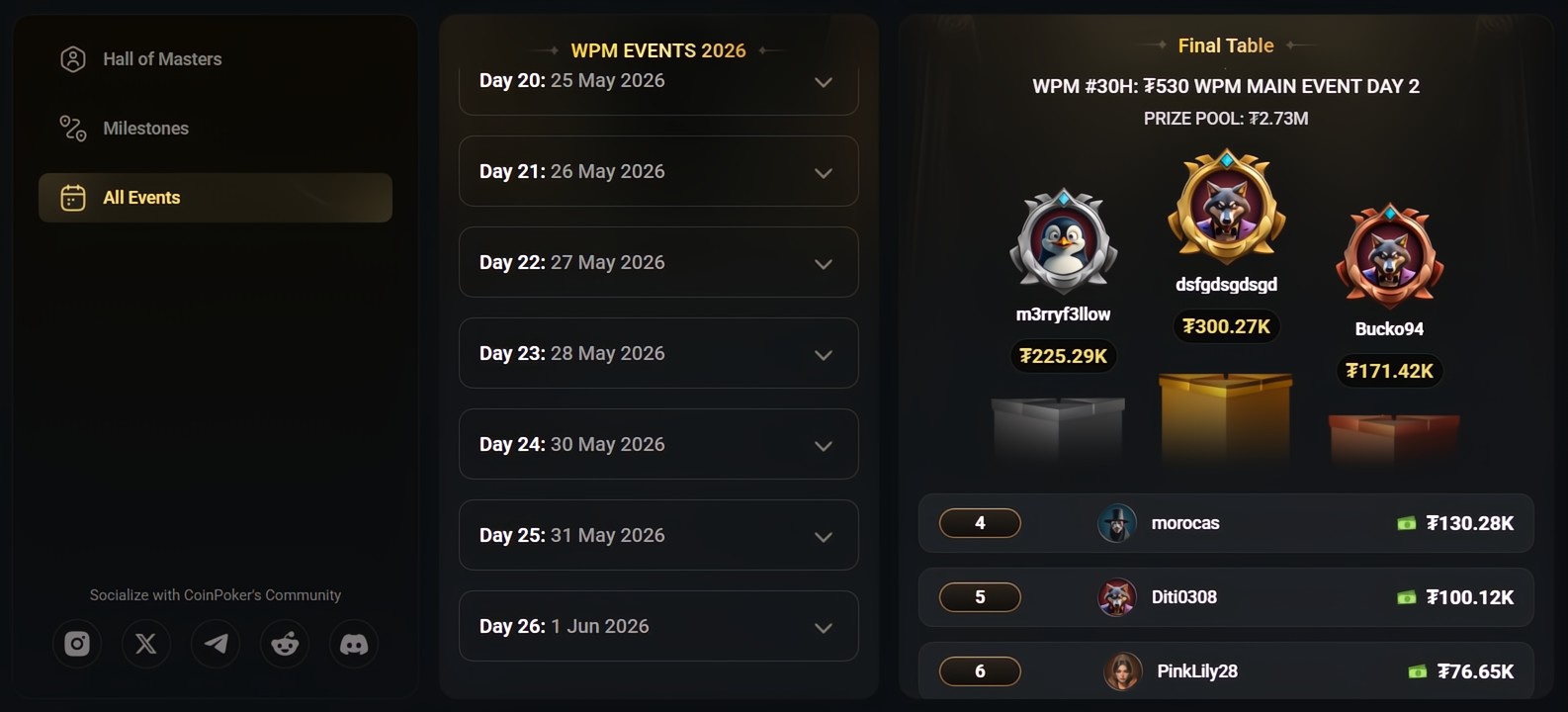
A look at the winners of the Main Event from inside the CoinPoker app
The Main Event champion also received a one-of-a-kind World Poker Masters trophy commemorating the victory.
FlushPuppy Wins Mini Main Event
The $500,000 guaranteed Mini Main Event produced another major turnout during the final week of World Poker Masters.
The tournament drew 3,772 entries and awarded $846,790 in prize money.
- Player FlushPuppy claimed the title and $60,560 in prize money.
- Runner-up dragonslayer17 collected $63,540, slightly more than FlushPuppy, likely due to a deal made during the heads-up portion.
- Third-place finisher mexicali23337 earned $41,570.

A look at the winners of the Mini Main Event from inside the CoinPoker app
The Mini Main Event was one of the most accessible headline tournaments on the World Poker Masters schedule, with daily Day 1 flights running throughout the series.
Super High Roller and CoinMillion Produce Massive Scores
The $25,500 Super High Roller took place on May 25 and became one of the defining events of the entire series, producing a massive $1,800,000 prize pool from the 72 entries.
High-stakes regulars featured in the field, including Tony G, JamesWynn, LLinusLLove, DavyJones922, Barak Wisbrod (“iWasOnly17”), and Bobby James Poker (“BJPCoin”).
amr1diab secured the Super High Roller title and $544,320 for the victory, while runner-up Lukabrate earned $354,960 after reaching heads-up play. DKaladjurdjevic completed the podium in third place for $236,880.
Winning the Super High Roller event made amr1diab the biggest event winner from a single event.

The top six winners from single events during World Poker Masters
$215 CoinMillion Tournament
Earlier in the month, the $215 CoinMillion ran on May 10 with a $1,000,000 guaranteed prize pool and one of the largest fields of the series, with 4,278 entries.
Player DaniC1994 captured the CoinMillion title and collected $126,500 for their victory.
The runner-up was loveandpeace with a $78.7K second-place prize. WayguSausage finished in third place for $54.9K.

A look at the winners of the CoinMillion tournament from inside the CoinPoker app
A spokesperson for CoinPoker hinted that “CoinMillion will likely be returning soon,” possibly taking a quarterly spot in the tournament schedule.
World Poker Masters Satellites Generated Major Value
Satellite qualifiers continued producing major scores throughout World Poker Masters, with players converting low-cost entries into some of the biggest payouts of the series.
In total, players won 16,038 satellite tickets worth $2,984,875 across the festival.
Among the biggest satellite success stories were:
- DonLaM0cz, winning $63,525 in the $5,200 Monday High Roller
- junglebird, earning $62,067 in the $5,200 High Roller
- tako9999, securing $47,700 in the $250 2nd Chance
CoinPoker Ambassadors and Pros Post About World Poker Masters
CoinPoker ambassadors continued highlighting the scale and success of World Poker Masters throughout the series.
Following the Super High Roller, Bobby James Poker posted on X while tagging Guinness World Records, writing:
“History Made. First person to PLAY let alone Final Table a $25,000 poker tournament 35,000 feet in the air.”
History Made @GWR
First person to PLAY let alone Final Table a $25,000 poker tournament 35,000 feet in the air. @CoinPoker_OFF how does the Vegas trip start off like? LIKE THIS pic.twitter.com/2XqlB4PisI— BobbyJamesPoker (@BobbyJamesPoker) May 25, 2026
High-stakes tournament coach Bencb celebrated the conclusion of the series, highlighting that World Poker Masters awarded more than $48,000,000.
Ben posted:
“Our First World Poker Master has been a huge success! Almost 2x the GTD. prizepool … $48,000,000 (guarantee was $25,000,000) … We just got started!”
Our First World Poker Master has been a huge success!
Almost 2x the gtd. pricepool … $48,000,000 (guarantee was $25,000,000)
And @CoinPoker_OFF is increasing weekly guarantees by $2,000,000
We just got started! 🚀🚀🚀🚀 https://t.co/VXc8WyFweP
— bencb (@bencb789) June 2, 2026
Fellow CoinPoker ambassador Patrick Leonard also praised the World Poker Masters schedule during the final days of the festival, writing on X:
“Most sites have stopped running big guarantees now WSOP has started, but we keep going for another Sunday. So proud of our offering now. Great schedule for all buy-ins.”
GL GRINDERS! Most sites have stopped running big guarantees now WSOP has started, but we keep going for another Sunday. So proud of our offering now. Great schedule for all buyins 👨🍳👨🍳 pic.twitter.com/Tvz2DenJDW
— Patrick Leonard 🫡 (@padspoker) May 31, 2026
About CoinPoker
CoinPoker is an online poker platform that supports both cryptocurrency and traditional payment methods, including bank cards, Apple Pay, Google Pay, and Luxon Pay. The site offers cash games, including NLHE, PLO, Short Deck formats and more, major tournament series, and ongoing player promotions across a wide range of stakes.
Its schedule features major series such as the Coin Series of Poker, CoinMasters, and World Poker Masters, alongside daily rewards systems and unique tournament giveaways, such as the Road to Triton promotion. Focused on player value, accessibility, and transparency, CoinPoker continues to grow its international poker community. The site is also available as an iOS poker app.
Other Promotions
- CoinRewards: A $1.5M+ weekly rewards system featuring CoinRaces, Splash Pots, cashback, and guaranteed daily promotions.
- Road to Triton: CoinPoker is teaming up with the Triton Poker Series and sending a player to the Jeju series this year with a $25,000 Super High Roller ticket, all flight expenses, and a stay in a 5-star hotel during the series.
- 150% Welcome Bonus: New players can unlock up to $2,000 in bonus funds through tournaments and cash game play.
Stats determine how players are perceived in contemporary gaming. When assessing performance, people frequently start by looking at win rates, rankings, kill-to-death ratios, and leaderboard positions.
Players’ reputations are shaped by these indicators, which also affect how soon they receive praise or criticism.
However, statistics by themselves don’t provide a complete picture.
Every statistic represents a player who must cope with pressure, adjust to frequent updates, and maintain consistency in fiercely competitive settings. They also control their own, their teams’, and viewers’ expectations. Knowing this human aspect gives many fans a crucial perspective.

More Than Just Numbers on the Leaderboard
Game statistics can be used to condense performance into digestible numbers. They show trends and improvements, allowing players to evaluate their performance against others. But these figures don’t always present the context needed to fully understand why performance fluctuates.
Rankings and win rates are not necessarily declining. It could be the player changing roles, playing with new updates, or competing against stronger opponents after matchmaking changes. During long gaming sessions, players may become tired and lose time reacting and making decisions. These factors are rarely visible in raw data but significantly impact outcomes.
As a result, only statistics can provide quick answers that do not account for the complexity of competition. The numbers provide the result but do not explain the journey behind the result.
The Mental Pressure Behind Every Decision
Players must make quick decisions under pressure in competitive gaming, frequently with little room for error. This experience is somewhat similar to that of an online casino, where every choice has immediate repercussions and results are promptly disclosed.
Focus, risk assessment, and the capacity to maintain composure in the face of ambiguity are required in both circumstances.
Visibility is the primary distinction. Competitive players perform in front of sizable crowds, while decisions in an online casino are usually made in private.
Even casual gameplay can be broadcast to large communities, tournaments draw thousands of viewers, and matches are aired live. This degree of exposure allows for the recording, sharing, and repeated analysis of every error in addition to its immediate experience.
Consequently, players must develop strong mental resilience. They need to maintain focus even when under criticism, recover quickly after mistakes, and manage the expectations placed on them by fans, teams, and sponsors.
The ability to stay composed during high-pressure moments often separates consistent players from those who struggle to maintain performance over time. Mental strength becomes just as important as mechanical skill in achieving long-term success.
The Grind Before Recognition
Before a player can reach the top or break into the spotlight, he needs to spend time practicing and improving. It takes several months before they can expect to make a game in a competitive setting.
During this time, the gamer might have to balance playing with school or work. Social activities may be limited, and the future may be uncertain. But many continue to invest time and effort to improve and possibly compete at a higher level.
The early stages of a player’s development are vital in shaping their mindset: discipline, consistency, and resilience will be required to perform at higher levels. When players show up on leaderboards, they represent not only their current ability but years of preparation and effort.
Setbacks That Shape Performance
Performance in competitive games is rarely consistent. Players often face:
- losing streaks
- ranking drops
- difficulty adapting to new updates
- burnout from continuous play
These challenges can directly affect stats, but they also contribute to growth.
Players who respond well to setbacks often:
- adjust their strategies
- improve decision-making
- refine mechanics
- Rebuild confidence over time
What may look like poor performance in stats can actually be part of long-term development.
Life Beyond the Game
Performance can depend not just on the skills a player performs within the game but also on factors outside the game, like rest, mental health, and even family. Performance can suffer when these are neglected. Organizations have begun to encourage and provide routines, mental health resources, and training programs for their players, recognizing that regularity and well-being are crucial to sustained performance.
Why Stats Don’t Tell the Full Story
In professional gaming, statistics are still a useful tool. They monitor development, offer standards, and enable insightful player comparisons. They do not, however, fully account for all of the variables that affect performance.
There are factors that go beyond numerical statistics, such as the pressure to make important judgments, personal struggles, ongoing adaptability to changing gaming conditions, and the work needed to get better. Every statistic shows a result, but it doesn’t tell the whole tale of how that result was attained.
Viewers can gain a deeper understanding of competitive players by looking behind the metrics. This method acknowledges not just the outcomes but also the effort, perseverance, and process that lead to those outcomes.
A high-stakes summer in Las Vegas now asks more of you than just a solid three-bet range. It pushes you to think carefully about your finances before you even sit down. With one of the most crowded tournament schedules poker has seen, your ability to manage a bankroll isn’t optional; it shapes how long you last.
The 2026 summer poker calendar brings an intense volume of play and it can drain even well-prepared players. You’re not just dealing with cards and opponents; you’re managing swings, entry fees and daily costs. Without a clear plan, it becomes easy to lose control of both your money and your focus.

Navigating the 2026 Schedule Density
The scale of this year’s action is hard to ignore. There are more than 95 bracelet events scheduled at Horseshoe and Paris Las Vegas alone. That kind of volume forces you to make decisions every single day about where your money goes. You can’t play everything, even if you want to.
This is where many players slip. Without structure, buy-ins and expenses start to blur together. If you jump into every $1,500 No-Limit Hold’em event on impulse, you’ll likely feel the strain long before the schedule wraps up.
The numbers behind these events show why discipline matters. According to the official 2024 WSOP Results, the Main Event generated a $94,001,300 prize pool (WSOP.com, July 2024). The rewards are massive, but so is the competition chasing them.
Predicting Trends and Field Strength
It’s not just your own play that matters. The environment around you can shape your experience just as much. Understanding how many players are entering events and how strong those fields might be gives you a quieter but valuable edge.
Some players are also turning to alternative prediction platforms to track broader betting sentiment during major events. For example, Covers recently highlighted the Polymarket promo code, which offers users a trading bonus for exploring the platform’s real-world prediction markets. The promotion reflects how prediction-based platforms are increasingly positioning themselves alongside traditional sports and entertainment betting experiences, especially as mobile access continues expanding in 2026. On Polymarket, users track probabilities tied to real-world outcomes, including tournament participation and industry trends.
By watching how these markets move, you can get a sense of expectations before the cards are even dealt. If there’s a strong belief that the Main Event will break attendance records, you can prepare for larger crowds, longer waitlists and tougher competition.
It shifts the conversation from guesswork to a more measurable sense of sentiment, helping you plan your days with greater clarity.
Tactical Bankroll Management for the Grind
Your bankroll is the one thing you carry into every event, so how you treat it matters. It’s easy to get caught up in the energy of Las Vegas, but that’s often when mistakes happen. A clear structure helps you avoid emotional decisions.
One approach many players rely on is the 100-buy-in rule for their average stakes. If you’re focusing on $1,000 events, that means having a $100,000 cushion. It’s not about being overly cautious; it’s about giving yourself room to handle variance without pressure affecting your play.
There are also practical habits that can keep you grounded during a long series. Swapping percentages with other players can reduce your exposure to swings. Tracking every buy-in and result through dedicated apps helps you stay aware of where you stand.
Keeping a separate “life roll” ensures your day-to-day expenses never interfere with your poker decisions. Even something as simple as registering early can help you avoid unnecessary stress and fatigue.
Leveraging the Modern Betting Experience
When you step away from the poker room, the broader betting environment offers a different kind of pace. Sportsbooks in 2026 have become more than just places to place wagers. They’re designed as social, high-energy spaces where you can reset mentally.
You’ll find a wide range of markets, from summer baseball to European football, all running alongside the poker schedule. For some players, placing a bet becomes a way to stay engaged without the same level of pressure as a tournament hand. The rise of mobile access means you don’t even need to leave your seat to interact with these markets.
Still, the key is balance. It’s easy to let one form of action bleed into another. Keeping clear boundaries ensures that these moments remain breaks, not extensions of the same financial risk you’re already managing at the tables.
Protecting Your Mental and Physical Capital
A summer in Las Vegas is demanding in ways that go beyond poker. You’re dealing with long hours, constant noise and a cost of living that can quietly add up. If you’re not tracking those expenses, they start to eat into your overall plan.
Data from the Las Vegas Convention and Visitors Authority shows the average daily room rate reached $187.31 in 2024 (LVCVA, March 2024) and prices have continued to trend upward. That means your accommodation, food and transport all need to be factored in before you arrive.
The 2026 schedule rewards preparation. If you approach it with a clear plan, realistic expectations and attention to both your finances and wellbeing, you give yourself the best chance to last the distance.
A poker room can lose margin long before it loses players. Extra vendor fees, slow launches, weak reporting, and payment friction all add pressure. That is why choosing a casino aggregator should be treated as an operating decision, not a content shortcut. The right choice helps teams balance speed, control, risk, and player experience.

Where the Setup Breaks
The weak point usually appears during a peak moment. A Sunday tournament series, a major boxing card, or a holiday casino campaign can push wallets, game feeds, bonus rules, and support teams at once. If the content layer is patched together, one provider outage can create settlement delays, frozen balances, or messy dispute trails.
The same risk appears when operators expand from poker into slots, live dealer tables, crash games, or crypto payments. More content can improve retention, but it also creates more contracts, reporting formats, promotional rules, and fraud signals. A casino aggregator should reduce that load. If it only adds another dashboard, the team inherits more noise.
Evidence Snapshot Operators Can Verify
Regulated operators already know that technical control is not optional. The UK Gambling Commission’s Remote Gambling and Software Technical Standards require licensed remote gambling and software businesses to meet technical and security expectations, including controls linked to supplier relationships, logging, change management, testing, and secure development.
Payments add another layer. PCI DSS defines baseline technical and operational requirements for protecting payment account data, while FATF guidance warns that virtual assets can create specific money laundering and terrorist financing red flags. For operators, the lesson is practical: payment choice, fraud monitoring, and audit records must be designed together.
The Operator Fit Checklist
Use the “Peak-Ready Aggregation” test before signing. It keeps the conversation away from glossy game counts and closer to the daily objects your team must operate: wallet ledger, bonus engine, risk rules, provider feeds, and support logs.
- Ask how the vendor handles provider downtime during live campaigns.
- Run a load test across login, wallet, game launch, and cashier flows.
- Check whether reporting separates game provider, jurisdiction, currency, and campaign.
- Review how bonus abuse, chargebacks, and suspicious crypto activity are flagged.
- Test migration steps with real content categories, not sample games.
- Confirm audit logs show who changed limits, rules, payouts, and integrations.
- Ask what support sees when a player disputes a round or payment.
The Trade-Offs Are Real
A strong casino aggregator can simplify content access, but simplicity has a cost. Operators may give up some direct control over provider negotiations, custom mechanics, or release timing. That trade-off can be valid for a lean team entering new markets. It can be less attractive for a mature brand with deep provider relationships and unusual game rules.
There are also daily tensions. KYC protects the business but can hurt conversion. Fast payments improve trust but attract fraud pressure. Personalization can lift engagement but must respect privacy rules. Real-time changes help marketers, while auditability protects compliance teams. The best vendor conversation makes these tensions visible before the contract is signed.
What Operators Can Build With NuxGame
NuxGame fits operators that want broader casino content without turning every provider launch into a separate integration project. Its online casino game aggregation approach is designed around content access, provider connectivity, and operational control. That can help teams move faster while keeping focus on wallet performance, reporting quality, and risk readiness.
For crypto-led brands, payments and back-office control matter as much as games. Operators evaluating NuxGame bitcoin casino software should look at how crypto payments, player management, fraud checks, and reporting connect with the wider stack. The outcome to seek is not “more features.” There are fewer operational gaps during real traffic.
A Practical Next Step
Before choosing a casino aggregator, run one rehearsal this week. Pick a peak scenario, such as a tournament final plus a live casino promotion and crypto withdrawal spike. Ask every shortlisted vendor to show the same flow from player login to dispute record. The best answer will reveal how the system behaves when margin, trust, and control are under pressure.
Matt Affleck has become one of the most respected tournament coaches on PokerCoaching.com thanks to his ability to combine modern strategy with practical execution. With years of experience as a professional poker player and coach, Affleck teaches concepts in a way that feels approachable without taking shortcuts.
Affleck’s coaching videos stand out for their balance between technical strategy and real-world application. Some coaches focus entirely on solver outputs, others rely mostly on experience and intuition. Affleck blends both approaches. As an experienced veteran, he understands not only what strong plays look like, but why they work in tournament environments.
Whether he’s discussing game theory, mathematical strategies, aggressive postflop play, or mental prep, Affleck consistently delivers lessons players can immediately apply to their own games. Below are five of the best PokerCoaching.com training videos from Matt Affleck.

1. How to Warm Up for Your Session
Tournament preparation is often overlooked, but Affleck explains why a strong pre-session routine can dramatically improve performance.
In this lesson, he discusses how reviewing hand histories, studying key concepts, and mentally preparing for variance can help players stay focused throughout long tournament sessions. Rather than jumping directly into games distracted or emotionally unprepared, Affleck encourages players to create routines that improve discipline and concentration.
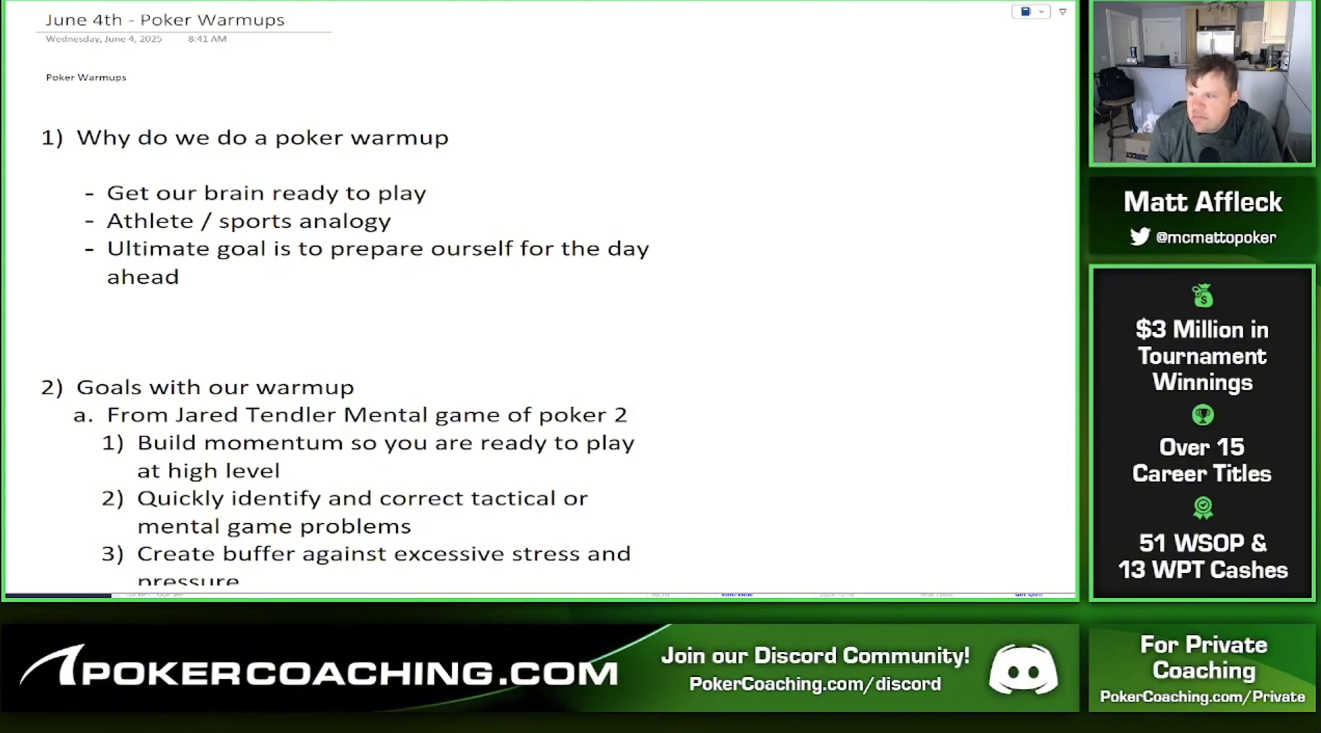
One of the best parts of the video is its focus on emotional control. Tournament poker naturally comes with frustrating swings, and Affleck explains how preparation can prevent players from spiraling after bad beats or difficult stretches.
He also touches on energy management and maintaining focus during long grinds, especially for online players multitabling several events at once.
For players struggling with consistency or mindset issues, this video provides a simple but highly effective framework for better tournament preparation.
WATCH: How to Warm Up for Your Session
2. How to Use Peak GTO to Level Up
Sometimes it feels like modern tournament poker revolves around GTO concepts, but many players feel overwhelmed when studying solver outputs. Affleck does an excellent job simplifying the process in this breakdown of PokerCoaching.com’s Peak GTO tool.
Rather than encouraging players to memorize endless charts, Affleck focuses on pattern recognition and understanding why certain strategies work. He demonstrates how studying common spots repeatedly can improve intuition and decision-making during real gameplay.

One of the strongest themes throughout the lesson is the relationship between theory and exploitation. Affleck explains that learning baseline GTO strategy allows players to recognize when opponents are deviating and how to punish those mistakes effectively.
The video also serves as a strong introduction for players new to solver work. Affleck keeps the lesson practical and approachable instead of overly technical, making advanced concepts feel far more manageable.
For tournament players wanting to sharpen their technical understanding without getting lost in solver complexity, this lesson is a great starting point.
WATCH: How to Use Peak GTO to Level Up
3. Winning Without Showdown in 3-Bet Pots
Aggression is critical in today’s poker games. In this lesson, Affleck explores using aggression as a way to win 3-bet pots without showdown.
Many players rely too much on showdown value while underestimating how much money strong tournament players win through pressure and fold equity. Affleck explains how stack-to-pot ratios and range advantages create profitable opportunities for aggression in 3-bet pots.
Throughout the video, he discusses continuation betting, delayed aggression, and understanding which board textures favor the preflop aggressor. Rather than teaching reckless bluffing, Affleck emphasizes applying pressure intelligently against the right opponents.

Another major takeaway is how population tendencies influence profitability. Many tournament players become uncomfortable in 3-bet pots and overfold in difficult situations. Affleck demonstrates how disciplined aggression can exploit those tendencies consistently.
The lesson ultimately shows how important controlled pressure is in tournament poker, especially against opponents unwilling to defend aggressively enough.
For players hoping to improve their postflop aggression and overall tournament presence, this video is packed with valuable insights.
WATCH: Winning Without Showdown in 3-Bet Pots
4. PKO Tournament Math
One of the biggest challenges in PKOs is balancing chip EV with bounty value. In this lesson, Affleck explains how bounty incentives influence calling ranges, reshoving decisions, and overall aggression throughout different stages of a tournament.
Like always, Affleck finds a way to simplify complicated concepts. Instead of overwhelming viewers with heavy calculations, he focuses on practical guidelines players can apply quickly during gameplay.
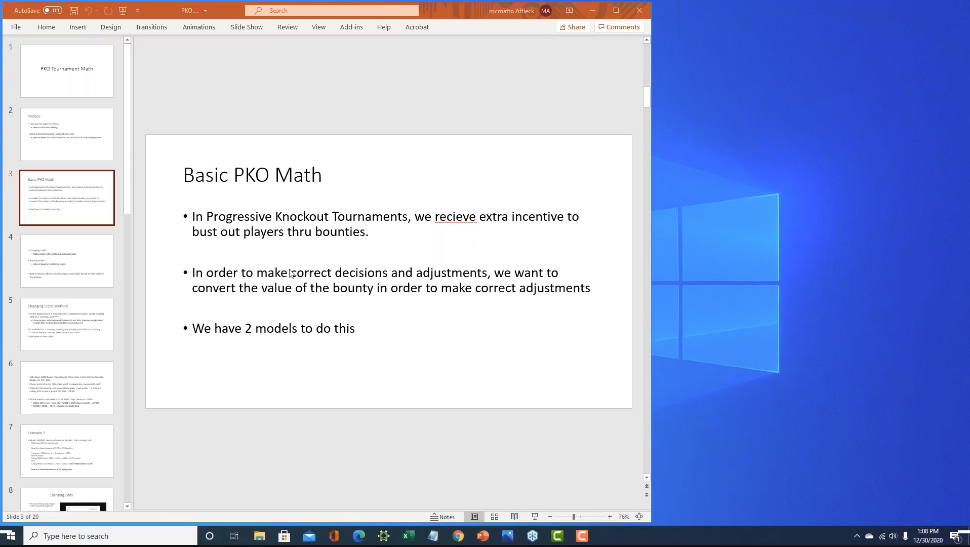
The video also highlights how dramatically strategy changes based on stack sizes and bounty distributions. Large stacks can apply enormous pressure in PKOs, while short stacks often become wider calls because of bounty incentives.
Affleck additionally discusses common mistakes players make in bounty tournaments, particularly overvaluing eliminations and chasing bounties too aggressively early in events.
For players who regularly play online tournament series or bounty-heavy schedules, this lesson provides an extremely useful foundation for PKO strategy.
WATCH: PKO Tournament Math
5. River Decisions from the WSOP
River play remains one of the toughest areas in tournament poker, and Affleck provides excellent insight in this WSOP-focused hand review.
Using real tournament hands, he breaks down difficult river spots involving thin value bets, bluff-catching, and high-pressure folds. Rather than simply analyzing results, Affleck walks through the logic behind each decision in detail.

One of the strongest parts of the lesson is his discussion of blockers, range construction, and bet sizing. He explains how earlier street decisions shape river outcomes and why understanding overall hand structure is so important.
The video also highlights the emotional side of late-street poker. River decisions often involve massive pots and uncomfortable uncertainty, especially deep in prestigious tournaments like the WSOP. Affleck discusses how strong players remain calm and analytical despite that pressure.
For players looking to improve late-street thinking and become more confident in difficult river situations, this video is one of Affleck’s best lessons.
WATCH: River Decisions from the WSOP
Conclusion
Matt Affleck’s PokerCoaching.com videos stand out because they successfully combine modern tournament theory with practical application. His coaching style is clear, thoughtful, and focused on helping players make better real-world decisions at the tables.
Whether he’s teaching preparation habits, GTO study methods, aggressive postflop play, PKO strategy, or advanced river concepts, Affleck consistently delivers lessons players can apply immediately.
For tournament players looking to improve both technically and mentally, Matt Affleck’s training library remains one of the strongest resources available on PokerCoaching.com.
Here’s a common scenario: your buddies talk you into playing a few hands of poker after a hard day’s work… only for you to lose everything in the first 20 minutes because, let’s face it, you don’t know what you’re supposed to do.
“We’ll teach you next time, bro, no worries…” they kept repeating with smiles on their faces as they took your hard-earned tenner.
Luckily, there’s an easier way to learn the basics of the game. We recommend you explore free poker online, which acts as the natural first stepping stone on your journey to teach your buddies a lesson.
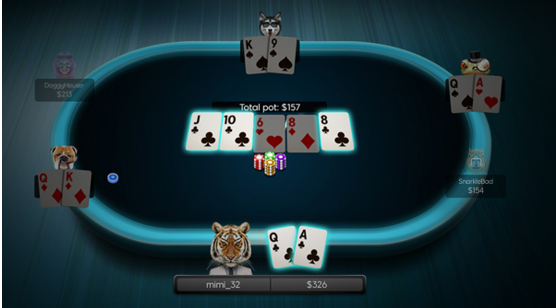
Free Poker Tables? Where?
In our experience, free poker tables have been around since the inception of the internet. Our personal favorites are as follows:
WSOP
If you’re looking for the best free Texas Hold’em poker tables, look no further than WSOP. It offers hundreds of free poker tables, a perfectly polished user interface, and an active Facebook community with over 3 million followers. If a risk-free poker environment is what you’re looking for, it doesn’t get much better than WSOP.
Zynga Poker
Zynga Poker has been around since 2007. Back in the glory days of Facebook, it was one of the most popular apps, with millions of active players across the globe. It still offers much of the same charm and poses as the best beginner-friendly way to enter the world of online poker.
Why Playing for Free Makes Perfect Sense
Playing poker without risking real money is what we recommend to all beginners. It makes perfect sense, and here’s why:
Learning the Rules in a Stress-Free Environment
Poker might not seem that complex at first. But, once you start playing, you’ll realize you need to learn all about hand rankings, betting rounds, pot odds, and positional play. If you’re playing at a real (read physical) table, you’ll need to learn proper table etiquette, too. Needless to say, figuring all this out is nearly impossible if you play for real money where the thought of losing your hard-earned cash will be constantly on your mind.
Building Up the Confidence to Play for Real
But, poker is not just a game of cards. It goes much deeper than that, featuring many psychological factors that come into play when you’re trying to outwit your opponents. Mind you, you won’t fare well in this department if you aren’t confident enough.
When it comes to poker, you won’t be able to build up your confidence if you keep losing hard-earned cash. Plus, the sole fact that you’re still learning will make you more nervous than usual. Being nervous can easily lead to second-guessing every decision you’ve made, which is a recipe for disaster.
Instead, focus on free tables, where you can hone your skills in a risk-free environment and focus on learning and improving your gameplay, instead of having to worry about coping with financial losses.
Knowing When to Move Up to the Big Boys Club
As you continue playing online poker for free, you will get a much better feel for the game. At some point, transitioning to real-money tables will feel natural.
Some of the signs will be obvious: frequently winning at free tables, mastering positional awareness, calculating pot odds, and feeling bored. Yes, feeling bored is an actual sign you’ve grown past the free phase and you’re ready to move to the big boys club.
Play Free Poker
There’s no point going head-first into a real-money poker game without any previous experience, just like there’s no point in trying to run a marathon without proper training first.
That’s why we recommend WSOP and Zynga, two of the world’s biggest and most popular free poker platforms. WSOP takes the top spot, if not for the massive FB community, then surely for its impressively polished user interface.
Card games have always been at the epicenter of casino culture, with players sitting at felt-topped tables and enjoying the vibe. Once card games shifted into the digital setting, everything felt like a compromise. The games were functional enough, but were solitary and had boring graphics, with Random Number Generator (RNG) technology deciding the deals.

Now, the average online casino has evolved enough that it’s far from boring. Platforms are faster, more immersive, and highly personalised compared to what they were like a decade ago. Developers have borrowed elements from game shows, video games and more, offering a more engaging experience for card players.
Standardisation of Live Dealer Games
The greatest loss that card game players likely felt when card games moved online was that they could no longer interact with the dealer. While there was some assurance in the RNG technology, you could no longer see the dealer shuffling and handing your cards out. Card game players were put against an algorithm, and it was no different than playing Solitaire on your computer.
This changed with the rise of live dealer gaming. Instead of playing against a computer, users can now interact with real dealers through high-definition streams. Modern online casinos recreated the vibe of a physical casino using multi-camera angles, interactive side bets, and real-time dealer interaction.
Market reports show that live dealer games and skill-based games, such as cards, attract 45% of online engagement. This happens because players seek more social and authentic experiences, with live dealer studios offering a hybrid setting.

The Hyper-Personalisation through AI Systems
Artificial intelligence is also rapidly changing how online casinos interact with card players. Since this category was limited in comparison to other casino games, table game players used to see the same lobby, table recommendations, and promotions.
READ MORE: Can AI Beat Humans at Poker?
However, modern online casinos use machine learning and artificial intelligence to track patterns. This allows platforms to create a responsive and customised casino experience for card players that is more likely to keep them engaged.
Personalised Table Recommendation
Nowadays, most online casinos create customised experiences that match an individual’s preferences. Rather than just making its users browse through hundreds of poker or blackjack rooms, players are recommended suitable choices based on their preferred betting limit, usual games played, or favourite playing schedules.
For example, players who usually join medium-stakes blackjack tables will see these options highlighted in the lobby.
Real-Time Gameplay Assistance
These days, AI technology is used more to streamline card game playing, without changing the rules or the outcomes themselves. For instance, personalisation tools may suggest beginner-friendly tables for players to join or provide contextual tutorials.
It can help explain blackjack rules to beginners and even deliver surface help prompts during gameplay. This improves onboarding for live dealer games, making them feel less intimidating.
Adaptive Responsible Gambling Features
Card games are significantly less addictive compared to online slots, but that doesn’t mean that players don’t want to prepare. AI personalisation is frequently used in modern casinos to improve responsible gaming, monitoring users’ behaviour in real time.
These features look for potentially risky patterns and trigger session reminders, recommending cooling-off periods. If they detect unusual betting spikes or frequent excessive session lengths, they suggest useful tools.
Smarter Rewards and Promotions
Modern online casinos also use AI to personalise bonuses and loyalty rewards for card players based on their behaviour. Rather than sending the same offer to every user, predictive analytics can identify preferred card games, engagement patterns, and which promotions players use the most.
For example, online casinos may offer their players cashback that is specifically tied to table games or invites for exclusive card game tournaments.
How Mobile Play Is Increasing Playtime
Many online casinos used to work on a desktop-first setting. However, in the second quarter of 2025, mobile devices accounted for 62.73% of the traffic. This made most platforms, casinos included, shift their attention to mobile-first approaches. Card games worked best on desktop, so game developers and operators had to make a couple of changes to adapt to the new trends.
Now, most modern card games on online casinos include features like vertical screen layouts, one-touch betting, and short session formats. For instance, blackjack tables now have a quick seating feature where they can jump into hands right away. They don’t have to wait through cumbersome lobby navigation. This adds more fluidity for each game without sacrificing depth, all through a simpler interface.
The modern online casino environment is continuously evolving to the point where it’s not just about playing cards. Now, it is an interactive experience with personalised recommendations and quick access. This makes it more likely for card game players to engage.
The first time I visited and reported on poker in Marrakech it was November 2025. I had wanted to complete my mission of playing all over the world. Africa was the last inhabited continent in which I had not played. So, the mountain came to Mohammed, so to speak. I visited and played poker at Casino de Marrakech. I won a tournament. I enjoyed myself enormously, touring the city thoroughly. I vowed to return.
Return I did, this time with my wife Debi, as guests of the affable and helpful casino assistant director, Paul Mateescu. We stayed for five days.

Tournament Poker in Marrakech: Updates
The poker room still operates every day of the week, opening at 6:00 PM for cash games, with tournaments starting at 6:30 (or a few minutes later at times). The once-a-day tournaments range in entry fees from about $25 to $80. If those stakes aren’t big enough for you, you can make sure to schedule your visit during one of the many poker festivals held at the Casino de Marrakech. There was a WSOP Circuit event held there in March. While we were leaving, the Marrakech Miniseries – boasting a $350 main event – was just getting started.
This time my tournament adventure was not nearly as profitable as my last time. I didn’t win or even cash. I feel like I played well, but busted out in 19th of 67 entries — after 9 levels of play. Hey, you can’t win them all!
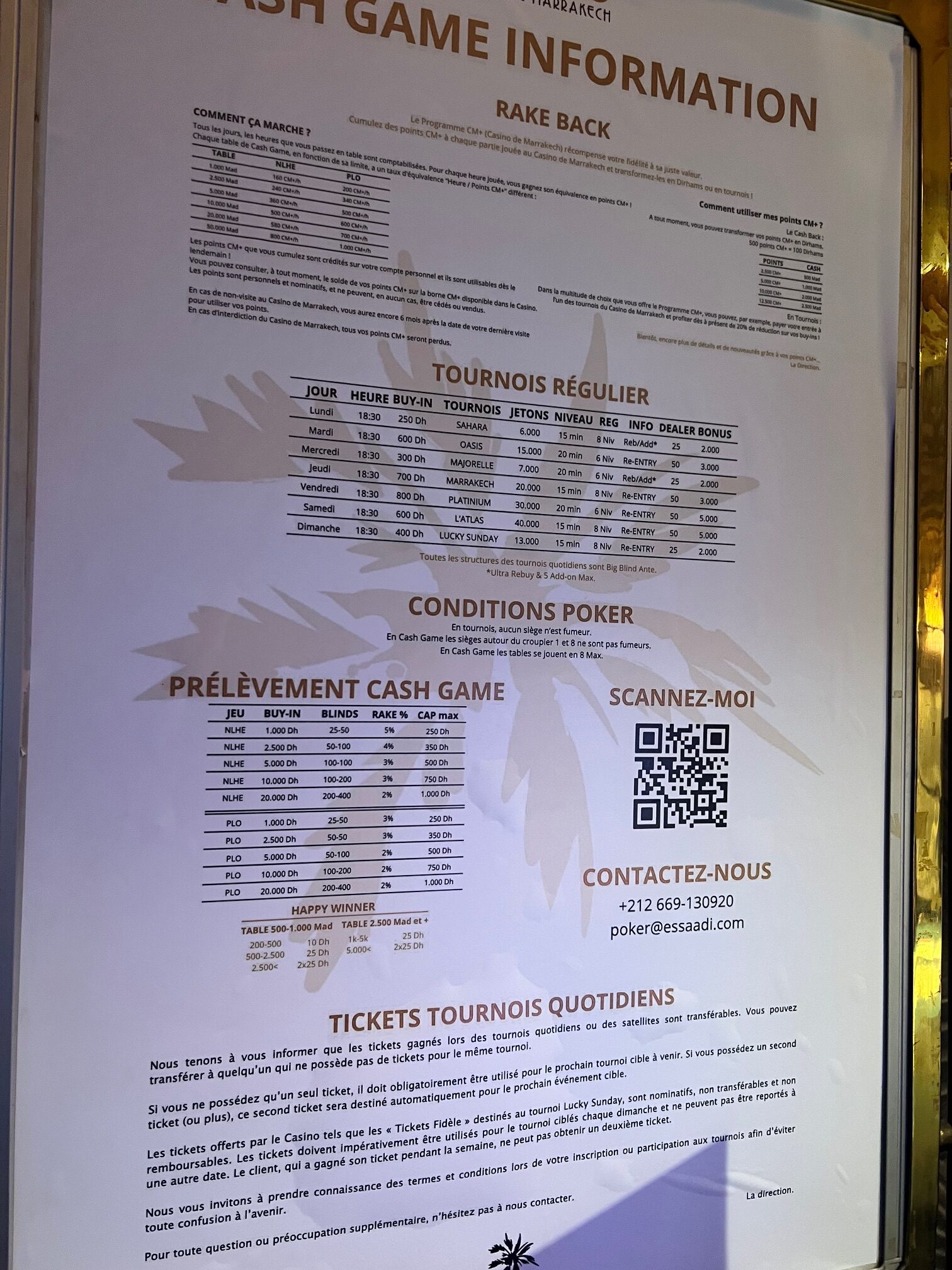
Though I only played in the one poker tournament during my stay, I did check in on the room many times. I can report that the cash games, including $2/5 and $5/10 NLHE and $5/10 PLO were busy and vibrant through the morning – with the last players getting kicked out at 8:00AM when the room closed. Similarly, the nightly tournaments were always full – with all six tournament tables of nine active – and often with significant waiting lists of alternates, as mine had.
Though I wasn’t financially successful, I enjoyed my playing experience this trip – having made friends with a few players from Casablanca – the largest Moroccan city, located about a two-hour drive to the north east. There are no public poker rooms there; but I got a good lead on a private game I can check out when and if my travels take me Morocco’s biggest city (pictured below).

Non-Poker Adventures in Marrakech
Typically, when I travel, I search out great bargains — for eating and touring. Not this time. This time, traveling with my wife Debi, I wanted her to appreciate the full opulence of the resort and the full beauty of the surrounding countryside. So, we engaged in uncharacteristic (for me) high-end experiences – sampling all of the five restaurants of the resort, and taking a private tour of the Atlas Mountains.
A Culinary Delight
I can report that the restaurants all lived up to their extremely high recommendations. We had a sumptuous Italian meal at Othello; an unparalleled Moroccan dining experience at La Cour Des Lions, three fantastic dinners at the Es Saadi Hotel restaurant – “where a traditional French restaurant meets a Mediterranean-inspired table.” We were drawn there by its convenience, in the lobby of our hotel, but returned for the music by Louis, the gifted pianistwho played great jazz standards during each of our meals.
We also enjoyed great meals at the piano bar, the pool-side snack bar, and the restaurant inside the casino. In addition, each morning, we were treated to an elaborate complimentary breakfast/brunch buffet. All tallied, six great places to eat. With the exception of our day touring the Atlas Mountains, we did not dine off the premises during our entire four nights and five days in Marrakech. And we were never disappointed!
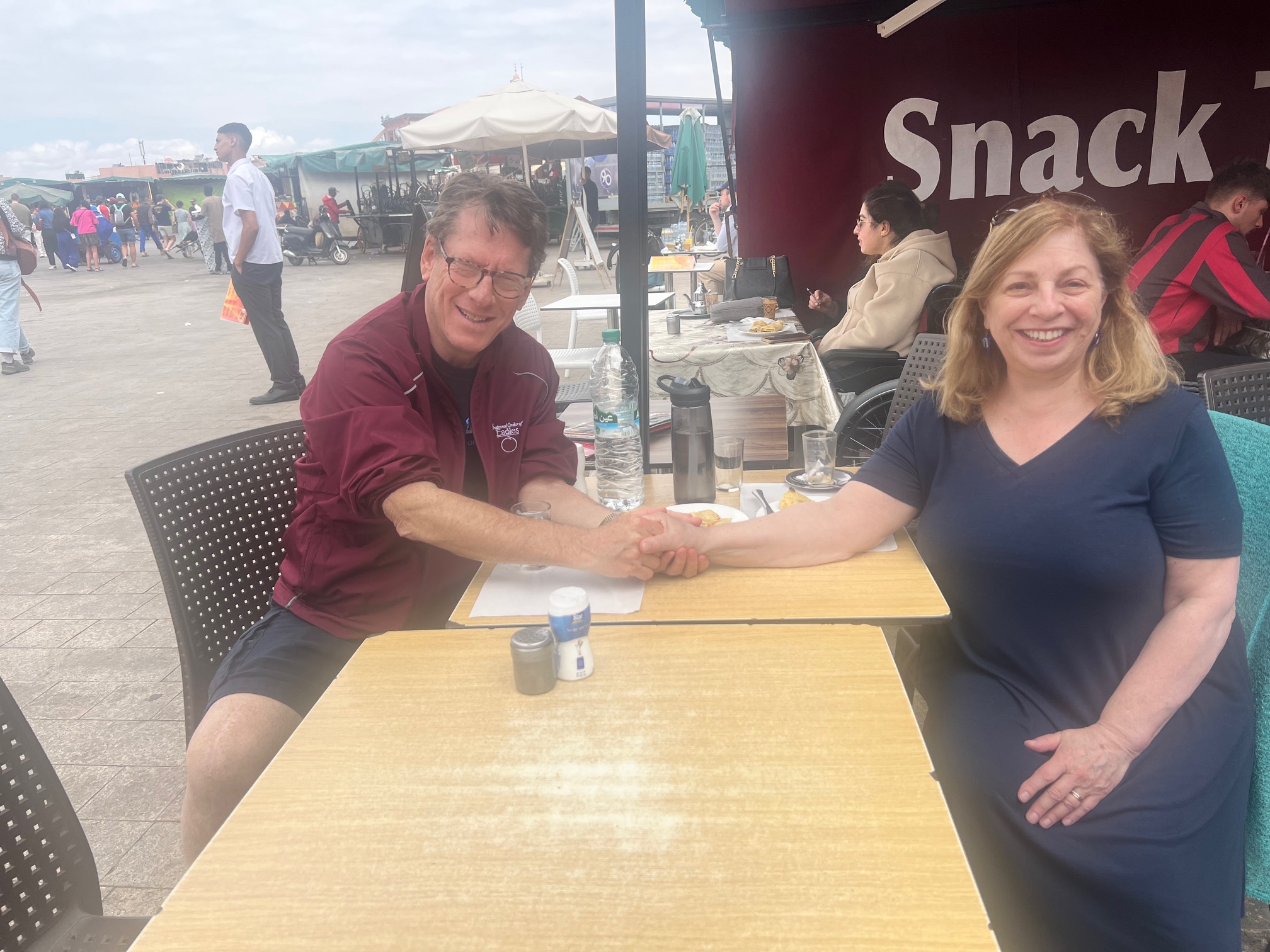
The Atlas Mountains & More
Aside from eating, we hired a driver/guide for a full day, taking us up into the Atlas Mountains. He stopped at a local shop, where the proprietor is also an artisan who oversees the local production of the many ceramic, silver, and beaded artwork sold on site. We stopped at a small cooperative manufacturing business, where they make products using the locally sourced spice, argan. They showed us how a cooperative of 30 or so women created a dozen or more product using this spice — which only grows in Morocco and in Turkey.
Our driver then released us into arms of a local guide who took us up to the waterfalls and then to his mother’s house for a delicious local meal: chicken tangine for me and vegetable tangine for my wife. We dined with our guide and his father. His mother came in to meet us as well, as children from the family and around the neighborhood paraded by, sneaking peeks at the exotic American guests as they did. We learned about the Berber culture, its language, alphabet, and history. It was a splendid time — something I would not have done had I been by myself. We returned after 7PM, exhausted but enthralled with our experience.
We’ve also done the typical touring through Marrakech — walking to and through the Medina with its snake charmers, monkeys, elaborate fruit juice displays; to a couple of museums, through some elaborate rug and spice stores, past tall mosques, through the beautiful gardens, the souks, the Jewish Cemetery, and the old enclosed Jewish neighborhood. It was an exceptional trip, leaving me eager to return once again. When I return, it will be for one of the major poker tournaments. I’m eager to do so before too long!
For roughly four years, Canadian online gambling sat in an awkward halfway state. Ontario flipped its private-operator market on in April 2022, the rest of the country waited for someone else to move next, and grey-market offshore sites continued to pick up the slack from Halifax to Victoria. That period is ending. Alberta is preparing to launch a fully regulated provincial online casino and sportsbook market in 2026, the first province to follow Ontario’s lead on opening to private operators rather than running a single Crown-monopoly platform. For poker players in Calgary, Edmonton, Red Deer, and the small towns that fill the spreadsheet between them, this is the most consequential change to how a Canadian plays online cards since the original Ontario opening, and it carries through to bankroll routing, currency handling, loyalty-tier portability, and which operator brands are about to fight for an Albertan deposit.

The Alberta launch matters for a second reason that gets less coverage in mainstream tech press. The operators lining up for Alberta licences are the same ones who dominated New Jersey from 2018 onward, then expanded across Pennsylvania, Michigan, and Ontario through 2022 and 2023. DraftKings is positioning an Alberta-specific platform off the back of its Ontario rollout. BetMGM Canada is preparing an Alberta extension of the joint venture that has carried the brand from Las Vegas to Toronto. PointsBet, which leaned hard into Canadian sports-betting after its US retreat, is reportedly applying for an Alberta licence. BetRivers, the Rush Street brand that ran a strong Ontario opening, is doing the same. The strategic question is which of these operators will treat poker as a first-class product rather than a marketing line item, and that question is suddenly worth answering with Canadian dollars rather than US ones.
Side-by-side operator comparisons help make sense of what the Alberta launch will look like once licences are issued. A current breakdown of Alberta online casinos by operator, payment method, table coverage, and live-dealer footprint is the cleanest reference for the planned launch lineup, and it is updated as new applicants are confirmed. Treat it as a working map of the market that will exist on launch day, not a recommendation of any specific brand, and use it alongside the operator-history context below before any account is funded.
The Ontario Template and Why Alberta Looked At It
Alberta has spent the last two years studying the Ontario rollout in detail because Ontario is the only Canadian province that has run a private-operator online market long enough to produce real data. The Ontario opening on April 4, 2022 was the most-watched provincial gambling story of the decade, and the post-launch numbers explain why other provinces stopped ignoring the model. Ontario’s first full fiscal year hit roughly 35.6 billion Canadian dollars in total wagers and 1.4 billion in gross gaming revenue, with online casino games producing about three-quarters of that figure and sports betting covering the remaining quarter.
The figure that mattered for Alberta’s planners was the rate at which grey-market traffic migrated to the licensed brands. Trade press tracking from iGaming Business and Yogonet put the channelisation rate at over eighty per cent within 12 months, the highest figure observed in any North American online gambling opening to date and the strongest argument any provincial government has for repeating the model.
Operator Pipeline: Who Has Confirmed Alberta Intent
The operator pipeline for Alberta has been visible in earnings calls, supplier filings, and Canadian trade-press coverage since late 2024. DraftKings has talked openly about Alberta in two consecutive investor updates, framing it as a natural extension of the Ontario platform launched in mid-2022 and noting that a substantial portion of the engineering work transfers directly. BetMGM Canada has confirmed Alberta plans through its joint venture, with Entain providing the platform stack that already powers BetMGM in New Jersey, Pennsylvania, Michigan, and Ontario. PointsBet has briefed Australian shareholders on a Canadian expansion that explicitly names Alberta as the second province after its existing Ontario presence. BetRivers, owned by Rush Street Interactive, has signalled similar intent.
Beyond the visible four, there are Canadian operator groups, European-licensed brands looking for North American footholds, and at least one Las Vegas-based operator that has yet to enter Ontario but is reportedly building toward Alberta directly. The lineup that lands at launch will probably look like a mix of the Ontario regulars, two or three new entrants, and a small number of provincial Crown-era products migrating to the new regulated framework.
What Changes for a Poker Player Specifically
Most coverage of provincial online launches focuses on casino and sportsbook because those are the volume products. Poker deserves a more careful look from anyone reading from a Canadian poker perspective, because poker behaviour under a regulated provincial regime is fundamentally different from casino behaviour. Cash-game volume depends on liquidity, tournament volume depends on guaranteed prize pools, and both depend on whether the regulator allows liquidity sharing with other provinces or jurisdictions. Ontario has been the live experiment for this question since 2022 and the answer there has been that domestic-only player pools are workable for cash games but harder for tournaments.
Alberta’s framework reportedly leaves the door open for inter-provincial liquidity sharing with Ontario down the road, which would change tournament prize structures meaningfully. In the interim, a poker player in Edmonton should expect cash-game offerings comparable to Ontario at launch, smaller MTT fields than the offshore sites previously offered, and faster cashier flow than the grey-market alternatives most Canadian players have used for years.
Currency, Payments, and the End of Grey-Market Routing
The most underrated quality-of-life change a regulated Alberta launch brings is the end of grey-market payment routing. Canadian players who funded offshore poker rooms through the 2010s and 2020s lived with crypto on-ramps, prepaid Visa workarounds, and slow international withdrawals that occasionally got flagged by the bank. A licensed Alberta operator deposits and withdraws in Canadian dollars through Interac, debit, and major credit cards, with same-day or next-day withdrawal SLAs that match what Ontario players already enjoy. Trade-press coverage of poker players expanding into regulated casinos through 2024 and 2025 mapped how operators built domestic payment integrations once provincial frameworks went live, and the same playbook applies to Alberta.
The practical effect is that bankroll management gets boring, which is exactly the outcome a serious player wants. Money in, money out, on the same day, in the same currency, with a tax slip that matches the operator records, the unglamorous stack that grey-market sites could not deliver and that any Alberta licensee will have to deliver on day one or lose share quickly.
Loyalty-Tier Portability Across Operator Footprints
An overlooked feature of the operators preparing for Alberta is how their loyalty programmes travel. DraftKings has a single Dynasty Rewards programme that recognises play across its US and Canadian footprints, with conversion paths between sportsbook, daily fantasy, and casino activity. BetMGM’s M life Rewards tier travels with the wallet across the Entain platform footprint, so a player who built status at the MGM Grand can in principle carry recognition into the Canadian online product. PointsBet operates a unified rewards programme across its remaining markets. BetRivers’ iRush Rewards is internally portable across Rush Street’s Canadian and US states.
For an Alberta player who already has loyalty status with one of these brands through a prior US trip or an Ontario account, the launch is a chance to consolidate the recognition rather than start from zero. The catch is that provincial regulations require Alberta-specific player accounts at the wallet level, so the loyalty travel works at the brand level rather than the cashier level.
The Wider Provincial Economy Context
Alberta’s online casino opening sits inside a broader provincial economic story that is worth understanding even for a reader focused only on cards. The province is mid-cycle through a policy rebalancing that touches energy royalties, technology-sector incentives, and a federal-provincial revenue argument that has dominated Canadian business coverage for two years. The Globe and Mail’s Alberta’s case for Canada’s energy advantage is a useful primer on the macro position Alberta has staked out heading into 2026 and the political mood that produced the appetite for a competitive private-operator gambling framework in the first place.
Provincial policymakers who treat oil-and-gas royalties, AI compute investment, and online entertainment licensing as parts of one revenue conversation produce different framework choices than ones who silo each industry. Alberta’s choice to model on Ontario rather than design a Crown-only platform fits the broader pattern of a province that prefers market entrants to monopoly stewards, which is the same pattern that has shaped its energy and tech policy through the same window.
Responsible Gambling Architecture in the Licensed Environment
Responsible gambling tooling is one of the load-bearing pieces of any licensed online product, and it is the single biggest functional difference between the grey-market sites Canadians used in the 2010s and the licensed brands that will be available in Alberta from 2026. Licensed operators have to surface deposit limits, time-played warnings, session reality checks, self-exclusion options, and reverse-withdrawal blocks within the product itself rather than buried in an account-settings page.
Ontario operators have spent three years refining how these surfaces fit into a poker client without disrupting play, and the patterns that have emerged are largely intelligent: pre-set deposit ceilings the player can lower but not raise without a cool-off, voluntary loss limits that travel across casino and poker products, and a single-click self-exclusion mechanism that revokes access across every Alberta-licensed brand at once through a shared registry. For a player evaluating which operator to choose at launch, the responsible-gambling UX is a better proxy for product seriousness than any welcome bonus.
What to Watch Between Now and Launch Day
Anyone tracking the Alberta opening from a player perspective should watch four things between now and launch day. First, the final list of licence applicants, expected to include the four operators named above plus a handful of additions and at least one withdrawal as commercial reality sets in. Second, the inter-provincial liquidity question, which will probably move slowly but matters enormously for tournament poker. Third, the responsible-gambling registry implementation, which Ontario reformed mid-cycle and which Alberta has the advantage of designing against a known set of edge cases. Fourth, the offshore-site response, which has historically involved a marketing pivot toward Quebec and British Columbia each time another province opens, plus a last-call push for Albertan deposits before licence enforcement starts. A serious player who reads these four signals carefully will know which operators are ready and which to skip entirely without waiting for the first month of post-launch reviews.
Reading the 2026 Launch Without Hype
Provincial online gambling openings produce a particular coverage cycle. There is a six-month build-up of operator-confirmation pieces, a launch-week scramble of welcome-bonus comparisons, a three-month settling period in which the brands that overspent on acquisition realise they cannot keep up, and a slow consolidation toward whichever two or three operators had the best product on day one. Alberta will follow the same arc that Ontario did.
The Canadian poker player who reads carefully through that cycle will end up with one or two trusted Alberta accounts, a clear sense of which operator handles poker as a real product, a clean Canadian-dollar payment routine, a portable loyalty tier, and a responsible-gambling setup that fits how they play. The 2026 launch is worth taking seriously precisely because the operators who get it right in Alberta will be the same names that compete for licences in British Columbia, Saskatchewan, and the Atlantic provinces over the next three years. A working model of the Alberta launch is also a working model of the Canadian online gambling market that will exist for the rest of the decade.
High-stakes gamblers used to come with a certain image. They could often be found in a poker room in Vegas, with tonnes of composure and a slick way of playing.
Nowadays, that image hasn’t completely disappeared, but it doesn’t quite tell the full story. With online gambling surging to the fore, high-stakes play has taken on several different guises, and the definition changes depending on who you ask.
In Canada, there’s still a big appetite for high-stakes play, with online platforms being more accessible than ever, but the people doing it have changed. This article takes a closer look at who they might be and how they separate themselves from normal players.
The meaning of high stakes
High-stakes play is all relative to what you have in your bankroll and the type of game you’re playing.
For Canadian poker players, cash games with blinds of $50/$100 are generally seen as serious money games, and you can find tables with these levels across many major platforms. These do, however, demand efficient bankroll management as it’s easy to plow through funds once you’re in the swing of things.
Ontario is one region that has taken steps to prevent this, with a regulated market that has closed player pools and fewer tables running in the physical world. It also has regulation that limits excessive online play.
In short, “high stakes” in Canada is a moving threshold, rather than a single number, that depends heavily on where you’re playing and who else is sitting down.
Live vs online
The high-stakes poker scene in Canada is focused on a few hubs: Vancouver, Toronto, and Montreal. These have private games and casino series all year round, with the likes of the Playground Poker Club near Montreal being one of the more respected live venues in North America for serious players.
Yet more players now operate online, for obvious reasons. You can play more hands, access more games, and manage your time without being physically present at a table. The flip side is that internet players tend to be more studious and have spent more time honing their skills. There’s often a pool of regulars that shouldn’t be messed with, rather than one or two poker wizards seated at a physical table.
That’s not a reason to avoid online play, but to simply approach it with clear eyes.
How to choose the right high-stakes platform
If you’re looking to play casually, most platforms are similar, but that changes when you up the ante.
At high stakes, the differences get more profound: you get lower game availability and longer withdrawal times, generally speaking. It’s a lot easier to pick the wrong one.
For Canadian players doing this research properly, a well-curated list of online casinos is a useful starting point, particularly one that breaks down operator strengths at higher limits rather than just covering the welcome bonus details. Traffic data, software quality, cashout reliability, and the presence of dedicated high-roller tables are all important features that general reviews tend to gloss over.
The best platforms for high-stakes Canadian players are those whose infrastructure holds up when the numbers on the table get serious, rather than just a list of big industry names.
The bankroll requirements nobody talks about honestly
You may have heard the advice of 20 buy-ins for cash games being the minimum for serious players, but this should be much higher in 2026. This is because win rates have compressed as the average field has improved.
The variance now works against you with a smaller edge because of longer stretches of play. Instead, you’ll need a bigger bankroll requirement to survive them without dropping stakes.
A more sensible move is to target at least 50 buy-ins. This way, you’ll spread the risk and increase your financial security. Most players operating at serious stakes either have that cushion or are taking on more risk than they acknowledge.
The takeaway: High stakes is a discipline
We tend to talk about money a lot in gambling. While it’s obviously important, it should come second to the discipline you put into your play. This means focusing on bankroll management and controlling your emotions, especially in the pressurized world of high stakes.
Get this right, and you’ll stand a better chance of lasting in this intense world. If not, then you may wish you’d never started.